
Unique last names can make a character memorable, add personality to a fictional family, or help you discover more about your heritage. Some surnames stand out because of their beautiful sound, while others have historical roots connected to nature, occupations, places, strength, or family ancestry.
The best unique last names are not necessarily the rarest ones. A familiar surname with an interesting origin can be just as distinctive as an uncommon family name. The key is understanding what a name means, where it comes from, and whether it fits your purpose.
This guide explores unique last names with meanings, beautiful and elegant surnames, powerful family names, and examples from different cultural backgrounds. It also explains how to research surname origins without relying on misleading or unsupported claims.
Unique Last Names With Meaning
Many surnames developed from occupations, geographical features, personal characteristics, or the names of ancestors. Their original meanings can provide clues about the lives of earlier generations, although a surname alone cannot establish someone’s complete family history.
Here are distinctive surnames with established or commonly documented linguistic associations.
| Last Name | Origin | Meaning or Historical Association |
| Ashford | English | A place associated with ash trees and a river crossing |
| Beaumont | French | Beautiful mountain |
| Blackwood | English or Scottish | A place name associated with dark woods |
| Brooks | English | A person who lived near a brook |
| Calder | Scottish or Northern English | A name associated with places and rivers called Calder |
| Chandler | English or French | An occupational surname associated with a candle maker or dealer |
| Fletcher | English | Arrow maker |
| Hawthorne | English | A name associated with hawthorn bushes or places named for them |
| Holloway | English | A sunken or hollow road |
| Mercer | English or French | A merchant, particularly one dealing in textiles |
| Rivers | English | A geographical surname associated with rivers |
| Shepherd | English | A person who tended sheep |
These names are useful starting points for readers who want a surname with a recognizable meaning or historical connection. Some have multiple possible origins, so the precise explanation may depend on the family and its earliest records.
Nature-Inspired Last Names
Nature-inspired surnames work especially well for writers who want a subtle connection to the outdoors without creating an obviously invented name.
- Ashcroft — English: A surname associated with an ash-tree enclosure or field.
- Birch — English: Derived from the birch tree or a place associated with it.
- Hart — English and other European traditions: May be associated with a stag in English surname history, though other origins exist.
- Linden — German and other European traditions: Associated with the linden tree or places named for it.
- Rowan — Scottish, Irish, and other traditions: A surname and personal name associated with the rowan tree, with multiple possible family-name origins.
- Wolfe — Germanic and English-language traditions: May have developed from a personal name, nickname, or other historical source.
Place-Based and Occupational Surnames
Place-based surnames can suggest a family’s geographical background, while occupational surnames preserve clues about ancestral work.
- Fielding — English: A surname associated with fields or place names.
- Gardner — English: An occupational surname for someone who tended gardens.
- Hayes — English or Irish: Has several possible origins, including geographical and Irish family-name roots.
- Porter — English and French: Often an occupational name for a gatekeeper or someone who carried goods.
- Underwood — English: A geographical surname associated with living below or near a wood.
- Wheeler — English: An occupational surname connected with wheel making.
Beautiful Last Names
Beautiful last names often appeal to readers because of their rhythm, spelling, sound, or associations. Beauty is subjective, however, and a surname does not need to mean “beautiful” to sound elegant or memorable.
Consider these options for stories, fictional families, or creative naming projects.
| Last Name | Origin | Why It Stands Out |
| Bellamy | French and English usage | Has a soft, flowing sound; historically associated with “beautiful friend” |
| Delaney | Irish | A recognizable Irish family name with a melodic sound |
| Laurent | French | A refined surname derived from the Latin name Laurentius |
| Marlowe | English | Literary associations and a distinctive ending |
| Sinclair | Norman French and Scottish | Strong historical associations and a polished sound |
| Solberg | Scandinavian | A place-based surname commonly interpreted through elements meaning sun and mountain |
| Valentine | English and French usage | Connected historically to the personal name Valentinus |
| Winslow | English | An established surname derived from a place name |
Elegant Last Names for Characters
Elegant surnames can help establish a character’s personality or social environment without making the name feel unrealistic.
- Beaumont: Suitable for a sophisticated character or an established fictional family.
- Cavendish: A historical English surname associated with an English place name.
- Ellington: An English surname with place-name roots and a polished sound.
- Fairfax: An English surname historically associated with the expression “fair hair.”
- Montgomery: A surname with Norman French and British historical associations.
- Pembroke: A Welsh place name that also appears as a surname.
- Whitmore: An English surname associated with place-name elements referring to white or open land, depending on the historical source.
These are style recommendations, not claims that the people who bear the names share any particular social status.
Powerful Last Names With Meaning
Powerful last names may suggest courage, authority, resilience, leadership, or a commanding sound. Some have direct historical connections to strength, while others simply carry strong literary or cultural associations.
Powerful Surnames With Strong Associations
| Last Name | Origin | Meaning or Association |
| Armstrong | Scottish and English | A nickname surname traditionally associated with physical strength |
| Barrett | English, Irish, and other origins | Has several possible etymologies; often associated with Norman or Germanic personal-name traditions |
| Conrad | Germanic | Derived from elements commonly interpreted as “bold” and “counsel”; also used as a surname |
| Everett | English | Derived from a Germanic personal name associated with boar and strength |
| Griffin | Welsh and other origins | May derive from the Welsh personal name Gruffudd; other surname origins exist |
| Hardy | English and French | Associated with being bold, hardy, or resilient |
| Marshall | English and French | Historically an occupational surname connected with a marshal |
| Sterling | English and Scottish | Associated with several possible origins, including a place name and historical word forms |
| Strong | English | A nickname surname associated with physical strength |
| Ward | English and Irish | Has multiple origins, including occupational or protective associations |
Important distinction: A name’s modern impression is not the same as its historical meaning. For example, a surname may sound authoritative without having originated as a title of leadership.
Powerful Last Names for Male and Female Characters
Surnames are generally inherited family names rather than male or female names. The following options can work for characters of any gender, depending on the setting and the writer’s preferences.
For male characters: Armstrong, Blackwood, Conrad, Fletcher, Sterling, Wolfe.
For female characters: Bellamy, Beaumont, Delaney, Laurent, Marlowe, Sinclair.
For gender-neutral characters: Brooks, Ellis, Hart, Morgan, Parker, Rivers.
A character’s first name, background, age, and setting usually matter more than gender when choosing a surname. A historical novel may benefit from a regionally appropriate family name, while a fantasy story may allow more creative combinations.
Unique Last Names for Boys and Girls
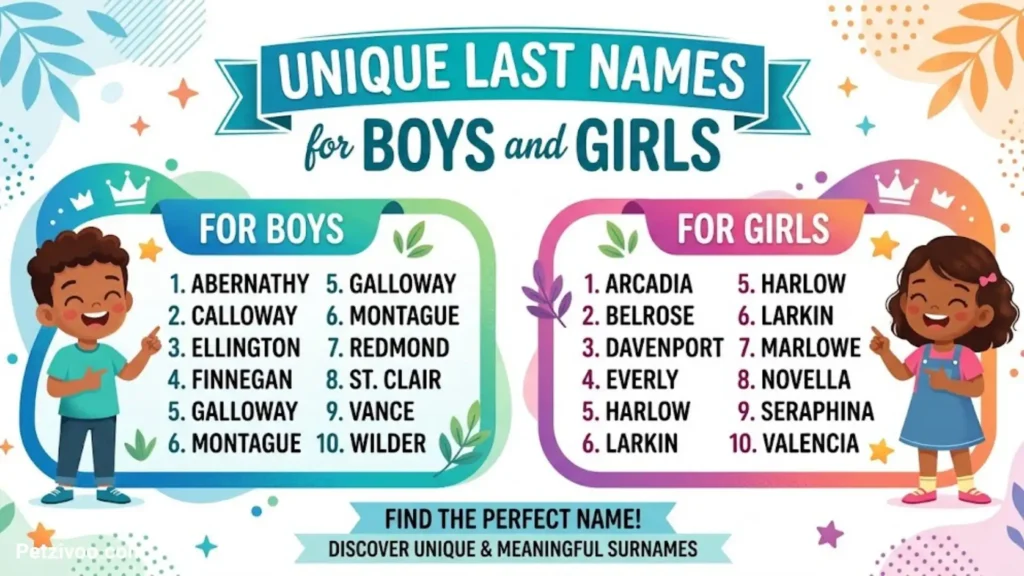
If you’re looking for a surname to use as a character name, a pen name, or inspiration for a fictional family, start with the impression you want the full name to create.
Unique Last Names for Boys
- Ashford: Traditional and place-based.
- Calder: Short, strong, and geographically rooted.
- Hawthorne: Literary and nature-associated.
- Maddox: A Welsh-derived surname linked to the personal name Madoc.
- Prescott: An English place-name surname.
- Thorne: A concise surname associated with thorny plants or places.
Unique Last Names for Girls
- Bellamy: Soft-sounding and memorable.
- Delaney: Irish in origin, with a flowing pronunciation.
- Ellery: An English surname and given name with historical name roots.
- Marlowe: Literary in tone and easy to recognize.
- Rowan: Nature-associated and suitable for different genders.
- Winter: A seasonal surname with a distinctive sound.
These lists describe stylistic suitability rather than exclusive gender rules. Every name should be evaluated in the context of the full name and the character’s background.
Unique Last Names From Around the World
Surnames develop differently across languages and regions. Some preserve an ancestor’s given name, while others come from a place, occupation, title, or historical relationship. The examples below are established family names, but their frequency and meaning can vary by region and family.
Japanese Last Names Unique
Japanese surnames are often written in kanji. The meaning depends on the particular characters used, so the same pronunciation can have more than one possible written form.
- Aoki (青木): Blue or green tree, depending on the interpretation of 青.
- Fujimoto (藤本): Commonly interpreted as “wisteria origin” or “base of the wisteria.”
- Hoshino (星野): Star field.
- Matsumoto (松本): Origin or base of the pine tree.
- Mizuno (水野): Water field.
- Tachibana (橘): Associated with the tachibana citrus tree.
These are examples of Japanese surnames, not a ranking of their rarity. Always verify the kanji before assigning a precise meaning to a particular family.
Korean Last Names Unique
Korean family names are commonly written in Hangul and may also be represented in Hanja. Romanized spellings vary, and the meaning of a surname often depends on its associated Chinese character and family lineage.
- Han (한): A Korean surname with different possible Hanja associations.
- Hwang (황): Often associated with 黃, meaning yellow.
- Kang (강): Can correspond to different Hanja characters, including 姜 and 康.
- Kim (김): Commonly associated with 金, meaning gold.
- Park (박): Commonly associated with 朴, a character whose historical meaning and name interpretation require context.
- Yoon (윤): Can represent different Hanja characters, including 尹.
For Korean surnames, romanization alone is not enough to determine the exact meaning. Official Korean cultural guidance explains that the same Korean sound may correspond to multiple Chinese characters and that families can use different Roman-letter spellings. <Cite refs={[“turn337322search17″,”turn337322search16”]}/>
Chinese Last Names Unique
Chinese surnames may have different pronunciations and spellings depending on the language, dialect, and romanization system. These examples use Mandarin pinyin.
- Bai (白): White.
- Fang (方): Square or direction, depending on context.
- Gu (顾): A surname with a long Chinese history; its historical derivation requires family-specific research.
- Lin (林): Forest.
- Shen (沈): An established Chinese surname; its historical origins are not fully captured by a simple translation.
- Xie (谢): A well-established Chinese family name.
A surname shared by Chinese and Korean families does not automatically indicate shared ancestry. Historical use of Chinese characters across East Asia creates similarities that must be interpreted carefully.
Mexican and Hispanic Last Names Unique
Mexican and Hispanic surnames overlap, but the terms are not interchangeable. Mexican surnames reflect Mexico’s varied Indigenous, Spanish, and other historical influences. Hispanic generally refers to a connection with Spanish-speaking cultures.
- Delgado: Spanish surname historically associated with the word for slender.
- Esquivel: A Spanish surname associated with place-name history.
- Ibarra: A Basque-origin surname associated with a geographical term for a valley or low-lying area.
- Mendoza: A Basque-origin surname with historical place-name roots.
- Montoya: A Spanish surname with geographical associations.
- Navarro: Traditionally associated with Navarra, a region in northern Spain.
- Salazar: A Basque-origin surname with place-name associations.
Many Spanish-speaking families use two surnames, commonly one paternal and one maternal. Practices differ across countries and families, so a surname’s position in a full name should not be interpreted without cultural context.
Spanish Last Names Unique
- Cabrera: A Spanish surname associated with places and the word for a goat enclosure.
- Fuentes: Means “springs” or “fountains” in Spanish and is also a place-based surname.
- Luna: Means “moon” in Spanish and has a long history as a surname.
- Paredes: Means “walls” in Spanish and is often associated with place names.
- Vega: A Spanish surname associated with a fertile plain or meadow.
Irish Last Names Unique
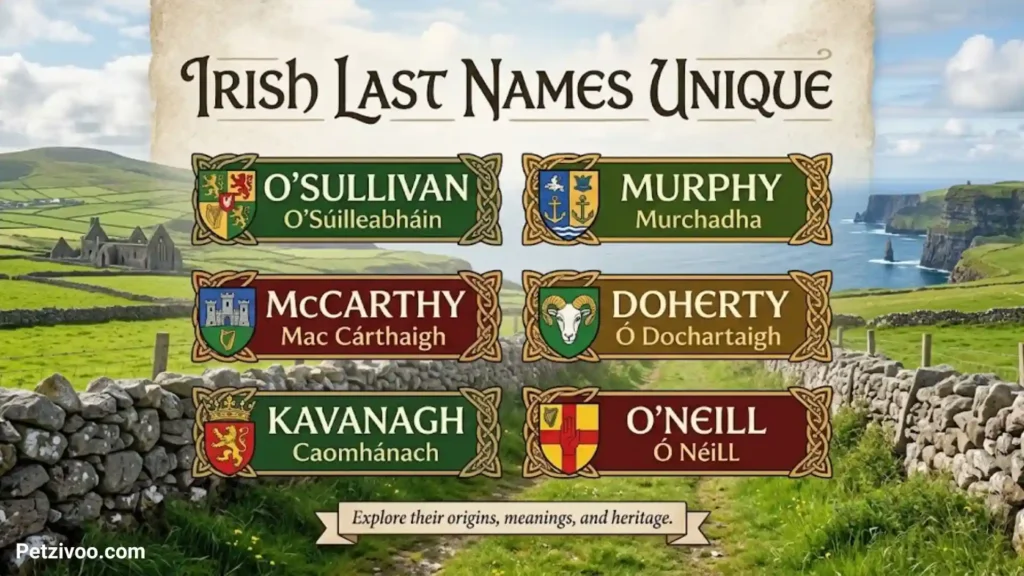
Irish surnames often preserve Gaelic naming traditions, although many have undergone spelling changes over time.
- Callahan: An anglicized form of an Irish family name associated with the Gaelic Ó Ceallacháin.
- Donovan: Derived from the Irish Ó Donnabháin.
- Finnegan: An anglicized Irish surname associated with Ó Fionnagáin.
- Kavanagh: An anglicized form of Caomhánach.
- Quinn: An anglicized Irish surname associated with Ó Cuinn.
- Tierney: An anglicized form of an Irish surname associated with Ó Tighearnaigh.
Irish surname etymologies can be complex, and different families with similar spellings may have distinct origins. Specialist dictionaries document these variations rather than assuming every spelling has one meaning. <Cite refs={[“turn337322search10″,”turn337322search13”]}/>
Italian Last Names Unique
- Bellini: An Italian surname derived from a personal-name family.
- Conti: Historically associated with the Italian word for counts or nobles.
- Ferraro: An occupational surname associated with ironworking.
- Moretti: An Italian surname formed from a personal-name or nickname tradition.
- Ricci: Commonly associated with a nickname referring to curly hair, though family origins vary.
- Vitale: Derived from a personal name connected to the Latin word for life.
French Last Names Unique
- Beaulieu: A French place-name surname commonly interpreted as “beautiful place.”
- Charbonneau: Historically associated with charcoal or charcoal-related occupations and nicknames.
- Chevalier: Means “knight” in French and developed as a surname from the word or title.
- Lefèvre: An occupational surname associated with a smith or craftsman.
- Moreau: A French surname with historical nickname and personal-name origins.
- Rousseau: Traditionally associated with a reddish complexion or hair, although individual family histories vary.
British and English Last Names Unique
British surnames include English, Scottish, Welsh, and Northern Irish traditions. English surnames are therefore only one part of the wider British surname landscape.
- Ainsworth: English place-name surname.
- Blythe: Associated with an Old English word meaning cheerful or happy, as well as place names.
- Chadwick: English surname derived from place-name elements.
- Fairchild: English surname historically associated with the expression “fair child.”
- Huxley: English place-name surname.
- Pemberton: English place-name surname.
- Sinclair: A surname with Norman French roots and a long history in Scotland.
Russian Last Names Unique
Russian surnames often reflect Slavic linguistic patterns, personal names, occupations, or historical nicknames. The examples below are established surnames, not necessarily rare ones.
- Alekseev: A surname derived from the personal name Aleksei.
- Belov: Derived from a root associated with the word for white.
- Morozov: Connected with moroz, meaning frost.
- Orlov: Derived from orel, meaning eagle.
- Volkov: Derived from volk, meaning wolf.
- Zaitsev: Derived from zayats, meaning hare.
Russian surnames may have masculine and feminine forms. For example, Belov and Belova are related forms. These patterns should not be applied indiscriminately to all Slavic languages.
Filipino Last Names Unique
Filipino surnames reflect a mixture of Indigenous, Spanish, Chinese, and other historical influences. A Spanish-looking surname does not necessarily prove Spanish ancestry.
- Agbayani: A Filipino surname associated with Ilocano language and cultural traditions.
- Dimaculangan: A Filipino surname with Tagalog linguistic roots.
- Lacson: An established Filipino surname.
- Manalo: A Filipino surname associated with Tagalog-speaking communities.
- Mercado: A surname of Spanish origin, meaning “market.”
- Villanueva: A Spanish-origin surname meaning “new town” or “new settlement.”
Family-specific records are especially important when researching Filipino surnames because colonial naming policies and later migration influenced how family names were recorded and inherited.
American, Black, and White Last Names
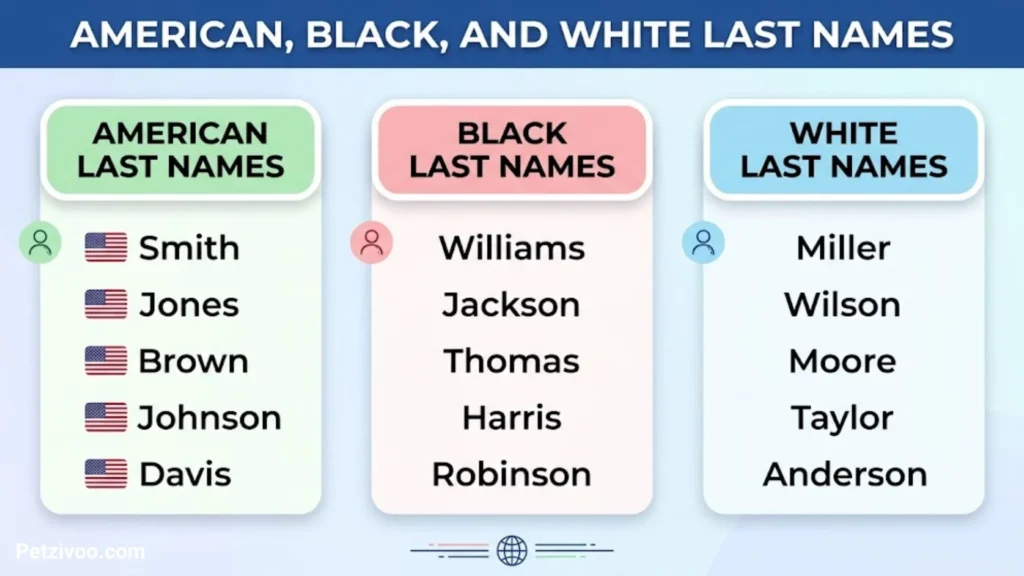
American surnames come from many linguistic and cultural backgrounds. Immigration, migration, marriage, adoption, and changes in spelling have all shaped the surnames used in the United States.
American Last Names Unique
The following are established surnames found in American naming contexts, although most also have origins elsewhere.
- Boone: An English-language surname with multiple historical origins.
- Culpepper: An English surname with historical family and place-name associations.
- Holliday: An English surname with historical nickname and personal-name origins.
- Jefferson: A patronymic surname meaning “son of Jeffrey.”
- Madison: A surname traditionally interpreted as “son of Maud” or related personal-name forms.
- Presley: An English surname derived from place-name traditions.
Black Last Names Unique
There is no single set of surnames that belongs exclusively to Black Americans. Black family histories may include surnames inherited from enslavers, chosen or adopted after emancipation, derived from African heritage, or connected to many other family experiences.
Examples found among Black Americans include Freeman, Jackson, Robinson, Washington, and Williams. All are also used by people from other racial and cultural backgrounds.
For family-history research, census records, emancipation-era records, marriage certificates, and local archives can be more informative than trying to infer ancestry from a surname alone.
White Last Names Unique
There is no reliable, universal list of surnames exclusive to white people. Surnames such as Anderson, Bennett, Campbell, Foster, and Mitchell have varied origins and are shared by people from different backgrounds.
If your goal is to explore European ancestry, it is more useful to research a surname’s specific linguistic or geographical history than to categorize it by race.
How to Choose a Unique Last Name
The right surname depends on whether you are naming a fictional character, researching a family tree, or simply exploring interesting names.
- Choose the purpose. A historical novel, fantasy series, and family-history project require different levels of historical accuracy.
- Consider the origin. Select a surname that fits the character’s language, geographical background, or family history when realism matters.
- Check the meaning. Confirm whether a meaning is a literal translation, an occupational association, or a disputed etymology.
- Say the full name aloud. Check its rhythm, pronunciation, and readability alongside the first name.
- Research alternate spellings. Migration and transliteration often produce several versions of the same family name.
- Avoid stereotypes. Do not assume that a surname automatically reveals a person’s race, nationality, personality, or social class.
How to Research a Family Name’s Origin
If you are researching your own surname, begin with the oldest reliable records available for your family. A modern name-meaning website can provide an initial lead, but historical documentation is needed to establish a more credible explanation.
Start with these steps:
- Record known spellings: Include variations found on birth certificates, marriage records, immigration papers, and older family documents.
- Identify geographical clues: Determine where your earliest documented relatives lived rather than assuming the surname originated there.
- Check specialist references: Consult established surname dictionaries, local archives, historical newspapers, and genealogy collections.
- Compare independent records: Look for evidence that supports a proposed origin across multiple generations.
- Separate tradition from evidence: Family stories can be valuable leads, but they should be distinguished from documented facts.
A surname can have multiple unrelated origins. Two people with the same last name may have no recent common ancestor, while spelling differences do not necessarily mean two families are unrelated.
Frequently Asked Questions
What makes a last name unique?
A last name may feel unique because it is uncommon, has an unusual spelling, carries a distinctive meaning, or sounds memorable. Statistical rarity is a separate question and requires population or surname-frequency data.
What are some beautiful unique last names?
Bellamy, Beaumont, Delaney, Laurent, Marlowe, Sinclair, and Winslow are appealing options for readers who prefer melodic or elegant surnames. Their appeal is subjective, and their histories differ.
Which last names have powerful meanings?
Armstrong and Strong have direct associations with physical strength, while Hardy suggests resilience. Conrad has Germanic roots associated with bold counsel. Meanings and origins should be checked against the relevant historical name form.
Are last names different for boys and girls?
Most inherited surnames are not inherently gender-specific. Some cultures have gendered surname forms, including certain Russian and other Slavic naming traditions, while many English-language surnames are used by all genders.
How can I find the origin of my last name?
Start with the earliest family records you can find, compare historical spellings, and consult reliable surname dictionaries and genealogy archives. A surname alone cannot prove a particular ethnicity or family connection.
Are Hispanic and Spanish last names the same?
No. Spanish surnames originate in Spain or the Spanish language, while Hispanic describes a broader connection to Spanish-speaking cultures. Hispanic surnames may come from many countries, including Mexico and other parts of Latin America.
Can two unrelated families have the same last name?
Yes. Surnames often developed independently in different places, and common names can have multiple origins. Establishing a family connection requires historical evidence, not just a matching surname.
Conclusion
Unique last names can be beautiful, powerful, historically meaningful, or simply memorable. The best choice depends on the purpose behind the search and the qualities you want the name to convey.
Whether you prefer elegant English surnames, culturally specific family names, nature-inspired options, or strong character surnames, look beyond sound alone. Understanding the spelling, meaning, cultural context, and historical origins of a surname will help you make a more informed choice.
For anyone researching family history, treat name meanings as clues rather than proof. Reliable records and carefully documented surname research offer a clearer picture of where a family name came from and how it changed over time.

 Noah Williams
 Amelia Parker