
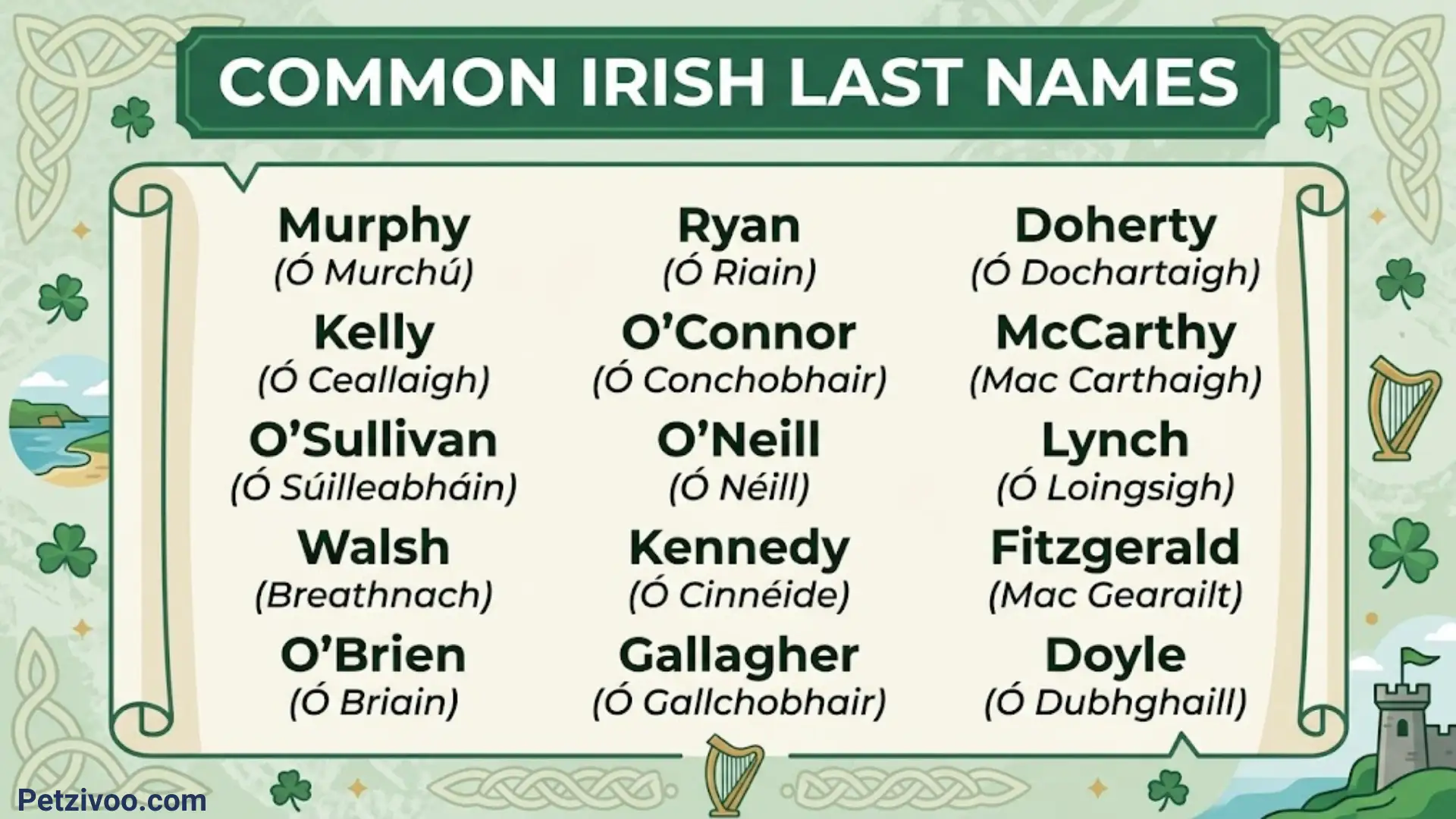
Common Irish last names offer clues about family history, Gaelic language, ancestral names, and Ireland’s changing cultural landscape. Surnames such as Murphy, Kelly, Byrne, Ryan, O’Brien, and O’Connor are widely associated with Ireland and Irish heritage in the United States. Many developed from the names of ancestors, while others came from occupations, personal characteristics, or older place names.
This guide explores common Irish last names and their meanings, traditional Mc and Mac surnames, Irish-American family names, historical naming patterns, and less common examples. If you’re researching your family tree or looking for an Irish surname for a character, you’ll find useful examples organized by category and letter.
What Makes a Last Name Irish?
An Irish last name may have Gaelic roots, Norman French origins, or connections to other communities that became part of Irish society over centuries. Not every surname associated with Ireland began in the Irish language, and not every person with an Irish surname has Irish ancestry.
Many traditional Irish surnames developed from a male ancestor’s name. The Gaelic prefixes Ó and Mac are especially important. Ó originally referred to a grandson or descendant, while Mac means “son of.” Over time, these prefixes became parts of hereditary surnames passed between generations.
Irish surnames also changed as Irish names were written in English-language records. Pronunciation, spelling conventions, and the loss or restoration of prefixes produced variations that can be important when researching family history.
For example, McCarthy and MacCarthy share a traditional naming element, while some surnames developed into English forms that look quite different from their original Gaelic versions.
25 Common Irish Last Names and Their Meanings
The following collection features recognizable Irish surnames and traditional explanations of their origins. Meanings can vary by historical form, and a surname’s interpretation does not establish that every family bearing it descends from the same ancestor.
| Irish Last Name | Traditional Origin or Meaning |
| Murphy | From Irish Ó Murchadha, associated with a sea warrior or sea-faring warrior |
| Kelly | From Ó Ceallaigh; traditionally associated with Ceallach, a personal name whose meaning is debated |
| Byrne | From Ó Broin, associated with the personal name Bran |
| Ryan | From Ó Riain; traditionally connected with the personal name Rían, whose original meaning is uncertain |
| O’Brien | From Ó Briain, meaning descendant of Brian |
| O’Connor | From Ó Conchobhair, meaning descendant of Conchobhar |
| O’Sullivan | From Ó Súilleabháin; traditionally interpreted in several ways, including associations with eyes |
| O’Neill | From Ó Néill, meaning descendant of Niall |
| Doyle | From Ó Dubhghaill, traditionally interpreted as descendant of Dubhghall |
| Walsh | Historically associated with the Anglo-Norman or English term for a Welsh person or foreigner |
| McCarthy | From Mac Cárthaigh, meaning son or descendant of Cárthach |
| Gallagher | From Ó Gallchobhair, a traditional Gaelic family name |
| Kennedy | From Ó Cinnéide, traditionally associated with a personal name interpreted as “helmet-headed” |
| Lynch | From Ó Loingsigh, traditionally associated with a mariner or seafarer |
| Murray | Can represent different origins, including Irish Ó Muireadhaigh |
| Quinn | From Ó Cuinn, meaning descendant of Conn |
| Nolan | From Ó Nualláin, traditionally associated with Nuallán |
| Brennan | From Ó Braonáin, meaning descendant of Braonán |
| Burke | An Irish surname of Norman origin, associated with the de Burgh family name |
| Fitzpatrick | An Irish surname formed with the Norman-derived Fitz prefix and the name Patrick |
| Flanagan | From Ó Flannagáin, traditionally connected with Flann, a name associated with redness or a ruddy complexion |
| Donovan | From Ó Donnabháin, meaning descendant of Donnabhán |
| Kavanagh | From Caomhánach, historically associated with a family connected to St. Caomhán |
| McGrath | From Mac Craith, a traditional Gaelic surname with a complex historical etymology |
| Duffy | From Ó Dubhthaigh, associated with the personal name Dubhthach |
The Gaelic forms and English equivalents are documented in Irish surname references, including the Irish-language surname database maintained by the Gaois research group and historical Irish genealogy resources. Some names have several possible interpretations, so the table gives traditional associations rather than claiming that every meaning is certain.
Which Irish Last Names Are Especially Recognizable?
Murphy, Kelly, Byrne, Ryan, O’Brien, O’Connor, O’Sullivan, Doyle, Walsh, and O’Neill are familiar examples in Irish surname collections. However, a definitive ranking depends on the population being measured: people living in Ireland, Irish-born immigrants, Irish Americans, or descendants of Irish families worldwide.
For current rankings, use a dated official dataset or a clearly identified surname database instead of assuming that a frequently mentioned surname is necessarily the most common.
Common Irish Last Names Beginning With Mc and Mac
Irish surname searches often include Mc and Mac names because both prefixes have deep roots in Gaelic naming traditions.
Mac means “son of,” while Mc is a shortened written form of Mac. Both spellings appear in Irish and Scottish surnames. The prefix alone cannot establish whether a particular family originated in Ireland or Scotland.
Here are common examples:
| Surname | Traditional background |
| McCarthy | Descendant of Cárthach |
| McMahon | From Mac Mathghamhna, a traditional Gaelic surname |
| McGrath | From Mac Craith |
| McDermott | From Mac Diarmada |
| McDonnell | From Mac Domhnaill |
| McKenna | From Mac Cionaoith |
| McHugh | From Mac Aodha |
| McCabe | From Mac Cába |
| McNamara | From Mac Conmara |
| McLoughlin | From Mac Lochlainn |
| McDonagh | From Mac Donnchadha |
| McNally | A surname associated with Irish Gaelic naming traditions |
Is Mc Different From Mac?
The difference is mainly spelling, not a reliable indicator of national origin. Older records may show the same family name in forms such as Mac, Mc, M’, or other historical spellings. Clerks often recorded names according to the writing conventions of their time.
When researching an ancestor, search for both the full and shortened prefixes. Also check records with and without apostrophes, spaces, or accents where the database permits it.
Common Irish Last Names for Boys and Male Names
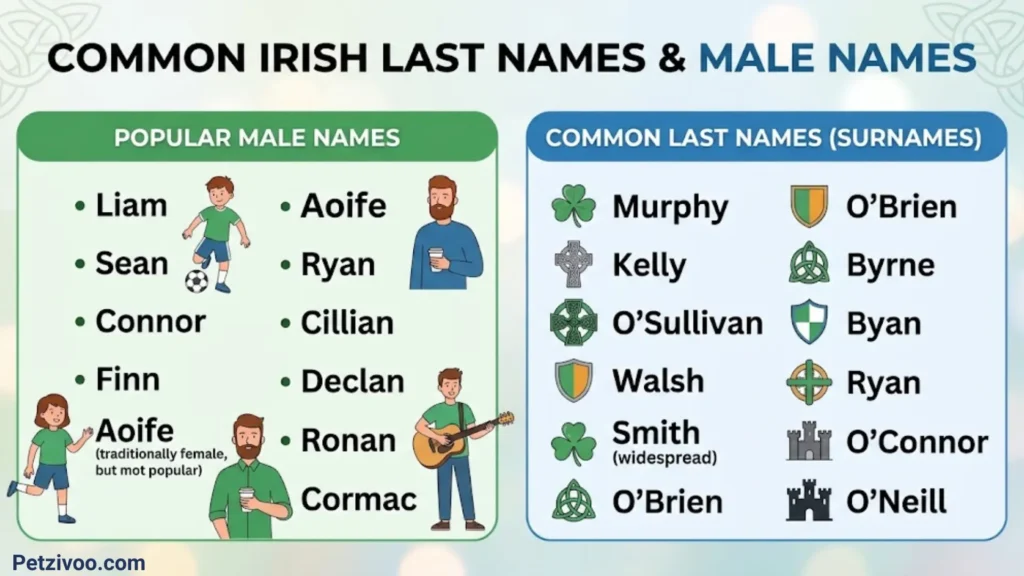
Irish surnames are inherited family names, so they generally do not change simply because the person carrying them is male. Searches for male Irish last names often reflect a desire for traditional, strong-sounding names for fictional characters, baby-name inspiration, or family-history research.
These examples have established surname usage:
- O’Neill — a traditional Gaelic surname associated with descent from Niall.
- Murphy — a familiar Irish surname derived from Ó Murchadha.
- McCarthy — a surname derived from Mac Cárthaigh.
- Kennedy — a surname associated with Ó Cinnéide.
- Donovan — an established surname derived from Ó Donnabháin.
- Gallagher — a traditional surname derived from Ó Gallchobhair.
- Fitzgerald — an Irish surname of Norman origin.
- Kavanagh — associated with the Gaelic family name Caomhánach.
- O’Brien — a surname derived from Ó Briain.
- Brennan — a surname derived from Ó Braonáin.
If you want a surname that sounds traditional rather than modern, names such as O’Neill, Murphy, McCarthy, and Fitzgerald are useful starting points. For historical fiction, the character’s location and time period matter: a surname’s spelling or prefix may have differed in records from the 1700s or 1800s.
Irish Surnames List A–Z
This alphabetical directory gives examples of Irish surnames and surnames historically associated with Irish families. It is a practical selection, not a claim that every name listed is exclusively Irish or equally common.
| Letter | Irish Last Names |
| A | Ahern, Allen, Allenby |
| B | Barry, Byrne, Brennan, Burke |
| C | Casey, Carroll, Connolly, Collins |
| D | Daly, Doyle, Donovan, Duffy |
| E | Egan, Enright, Eustace |
| F | Farrell, Fitzgerald, Flanagan, Flynn |
| G | Gallagher, Griffin, Gorman, Grady |
| H | Hayes, Healy, Hogan, Hughes |
| I | Ivers, Ireland |
| J | Joyce, Judge |
| K | Kelly, Kennedy, Kavanagh, Keane |
| L | Lynch, Lyons, Larkin, Lennon |
| M | Murphy, Murray, McCarthy, McMahon |
| N | Nolan, Neville, Naughton |
| O | O’Brien, O’Connor, O’Donnell, O’Neill |
| P | Power, Phelan, Prendergast |
| Q | Quinn, Quigley |
| R | Ryan, Reilly, Regan, Roche |
| S | Sullivan, Sheehan, Sweeney, Sheridan |
| T | Thompson, Tierney, Tobin, Tracey |
| U | Upton, Usher |
| V | Vaughan, Vance |
| W | Walsh, Ward, Whelan, Whelan |
| X | No widely recognized traditional Irish surname is commonly listed under X |
| Y | Yeats, Young |
| Z | Zeller, Zouch |
Important note: An alphabetical list is not a verified frequency ranking. Some names have multiple origins, and several surnames in the less common letters may have English, Norman, or other European roots rather than being exclusively Irish. A surname’s presence in Ireland does not automatically prove Gaelic origin.
The letter X is particularly uncommon in traditional Irish surname collections. It is better to acknowledge that gap than to invent names to complete the alphabet.
Common Irish Last Names in America
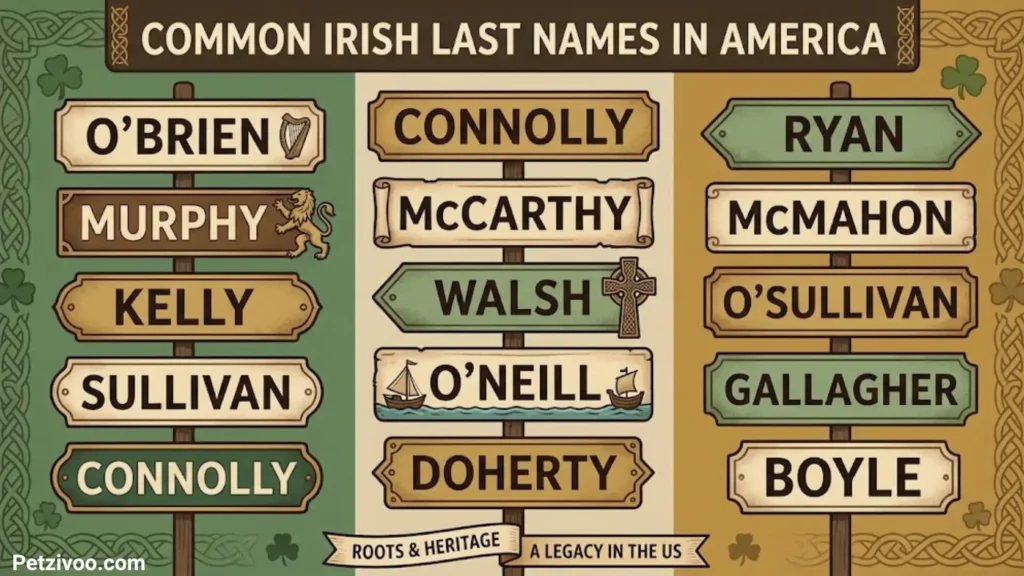
Irish surnames are familiar throughout the United States because generations of Irish immigrants settled in American communities. Immigration occurred across several periods, including the major migration associated with the Great Famine of the 1840s and the decades that followed.
Common surnames among Irish Americans include:
- Murphy: A widely recognized surname associated with Irish heritage.
- Kelly: A familiar surname found among Irish American families.
- O’Brien: A traditional Gaelic surname that retains its distinctive apostrophe in many families.
- Ryan: A surname that appears in Ireland and among Irish descendants abroad.
- Sullivan: Often associated with the Irish form Ó Súilleabháin.
- McCarthy: A traditional surname with Gaelic roots.
- Doyle: An Irish surname whose original Gaelic form is Ó Dubhghaill.
- Walsh: A surname associated with historical Welsh or foreign origins.
- Kennedy: A surname used by Irish families and many American descendants.
- Gallagher: A traditional Irish surname also found in the United States.
Why Do Irish Surnames Have Different Spellings in America?
Surname spellings can differ because of clerical practices, language changes, personal choices, and the way names were recorded during migration. Some families retained their original spelling, while others used a shorter or more familiar English form.
For example, historical records may contain different spellings of a name across birth, marriage, immigration, and census documents. The presence or absence of an O’ or Mc prefix can also vary between records.
These differences do not automatically mean that two people with similar surnames are related. To establish a family connection, compare names with dates, locations, relatives, and original documents.
Common Irish Last Names in the 1800s
Irish surnames were already well established by the 1800s, although their written forms were not always consistent. English-language administration and recordkeeping contributed to variations in how Gaelic names were written. Some families dropped traditional prefixes, while others later restored them.
Surnames useful to investigate in nineteenth-century Irish records include:
| Surname | Research note |
| Murphy | Search for Ó Murchadha when exploring Gaelic surname origins. |
| O’Brien | Compare records with and without the O’ prefix. |
| O’Neill | Check variations in prefix spelling and punctuation. |
| Kelly | Look for historical Gaelic forms such as Ó Ceallaigh. |
| Byrne | The Gaelic form Ó Broin may help with linguistic research. |
| McCarthy | Try MacCarthy and other recorded variations. |
| Ryan | Search the surname alongside the ancestor’s town or parish. |
| Doyle | Consider the older form Ó Dubhghaill. |
| Walsh | Check regional records because the surname has a different linguistic history from many Gaelic patronymics. |
| Fitzgerald | Consider Anglo-Norman family history as well as Irish records. |
How to Research an Irish Ancestor From the 1800s
Start with the oldest reliable record you have, such as a birth, marriage, death, or immigration document. Record the person’s full name, approximate birth year, religion if documented, spouse, parents, and last known location.
Then work backward through available civil and parish records. Ireland’s official genealogy resources provide historical records and guidance for tracing family history.
Search for alternate spellings, but don’t assume every similar spelling belongs to your family. A surname can have multiple independent origins, and a shared surname alone does not establish a common ancestor.
Uncommon Irish Last Names
Some Irish surnames are less familiar to American readers than Murphy or Kelly. Others remain associated with particular regions or historical families. Whether a name is uncommon depends on the country, period, spelling, and population being studied.
Here are some distinctive examples worth exploring:
| Surname | Background |
| O’Keeffe | From Ó Caoimh, a Gaelic surname associated with the personal name Caoimh |
| O’Dea | From Ó Deághaidh, a traditional Irish surname |
| O’Flaherty | From Ó Flaithbheartaigh, an established Gaelic family name |
| MacSweeney | From Mac Suibhne, a traditional surname also associated with Gaelic Scotland |
| O’Donoghue | From Ó Donnchadha, a Gaelic surname |
| Mulrooney | An anglicized surname with Gaelic roots; historical forms vary |
| Gilmartin | Associated with Gaelic name elements referring to a follower or devotee of St. Martin |
| MacAuley | A surname with Gaelic and Scottish-Irish associations |
| O’Callaghan | From Ó Ceallacháin, a traditional Gaelic surname |
| O’Gorman | A surname with historical Irish forms and a complicated prefix history |
These names can be useful for readers seeking distinctive family names or investigating less familiar branches of an Irish family tree. However, it would be misleading to label every example rare without comparing it against a specific, dated surname dataset.
What Makes an Irish Surname Unusual?
A surname may appear unusual because its spelling is unfamiliar, it preserves older Gaelic elements, or it is uncommon in a particular country. Some names that seem rare in the United States may be well known in a specific Irish county or family-history context.
For genealogical purposes, regional records can be more informative than a general list of unusual names. The place where an ancestor lived may narrow the search more effectively than the surname alone.
Most Common Irish Last Names by Letter
Readers searching for common Irish last names by letter often want a quick way to discover names for research, writing, or personal interest. The examples below highlight familiar surnames and some less common options.
| Letter | Examples |
| B | Byrne, Brennan, Barry, Burke |
| C | Collins, Connolly, Casey, Carroll |
| D | Doyle, Daly, Donovan, Duffy |
| F | Fitzgerald, Farrell, Flynn, Flanagan |
| G | Gallagher, Griffin, Gorman, Grady |
| K | Kelly, Kennedy, Kavanagh, Keane |
| M | Murphy, McCarthy, McMahon, McGrath |
| O | O’Brien, O’Connor, O’Donnell, O’Neill |
| R | Ryan, Reilly, Regan, Roche |
| S | Sullivan, Sweeney, Sheehan, Sheridan |
This is a selection of recognizable surnames, not a letter-by-letter popularity ranking. For example, the four surnames under B are not necessarily the four most common Irish surnames beginning with that letter. A genuine ranking requires a defined population and reliable frequency data.
Are Irish Last Names Always Gaelic?
No. Irish surname history includes Gaelic, Anglo-Norman, English, and other influences. Fitzgerald and Burke, for instance, are associated with Norman origins and became established in Ireland. Walsh has a different historical background from surnames formed directly with Ó or Mac.
This mixture is one reason surname research benefits from looking beyond modern spelling. A name’s history may reflect language, migration, political change, and family decisions across several centuries.
How to Research Your Irish Family Name
If you are investigating your own surname, use the name as a starting point rather than as proof of ancestry.
- Collect family details. Write down names, dates, places, and relationships from family documents or reliable family accounts.
- Check spelling variations. Search for versions with and without O’, Mac, or Mc, and consider older forms where supported by historical sources.
- Identify a location. A county, townland, parish, or city can help distinguish between unrelated families with the same surname.
- Consult historical records. Use civil registrations, parish records, census material, and immigration documents where available.
- Compare multiple records. Look for matching relatives and dates rather than relying on one record or a surname-meaning website.
- Treat surname meanings carefully. A traditional etymology can explain a name’s linguistic roots, but it cannot establish a specific family’s lineage.
The Irish government’s genealogy resources and the Gaois Irish-language surname database are useful starting points for surname forms and historical context.
Irish Genealogy+1
Frequently Asked Questions
What are the most common Irish last names?
Murphy, Kelly, Byrne, Ryan, O’Brien, O’Connor, O’Sullivan, Doyle, Walsh, and O’Neill are widely recognized Irish surnames. Their exact order depends on the population and dataset being used.
What does Mc mean in an Irish last name?
Mc is a shortened spelling of Mac, a Gaelic prefix meaning “son of.” Both Mc and Mac occur in Irish and Scottish surnames, so neither spelling alone proves a family’s national origin.
What are some traditional Irish last names for boys?
Murphy, O’Neill, McCarthy, Kennedy, Gallagher, Donovan, Fitzgerald, and O’Brien are established surnames that can suit male characters or surname-inspired naming projects. They are family names, not exclusively male names.
Why do some Irish surnames begin with O’?
O’ represents the anglicized form of the Gaelic Ó, a traditional ancestral prefix. It originally indicated a grandson or descendant and became part of hereditary surnames.
Are Irish last names in America different from those in Ireland?
Many are the same, but spellings and family usage can differ because of migration, recordkeeping, and personal choices. An American family may preserve a traditional spelling or use a variation that developed over generations.
What are some uncommon Irish last names?
O’Keeffe, O’Dea, O’Flaherty, MacSweeney, O’Donoghue, and O’Callaghan are distinctive examples. Whether any one of these is truly uncommon depends on the country and the population being examined.
How can I find my Irish surname’s original meaning?
Start with a reliable surname dictionary or an Irish-language surname resource. Compare the historical Gaelic form with your family’s earliest records, since similar English spellings can have different origins.
Does having an Irish last name prove Irish ancestry?
No. Surnames can be adopted, changed, inherited through different family lines, or shared by unrelated families. A surname can provide a useful research clue, but family records are needed to investigate ancestry.
Conclusion
Common Irish last names preserve clues about Gaelic naming traditions, historical family names, migration, and Ireland’s linguistic heritage. Murphy, Kelly, Byrne, Ryan, O’Brien, and O’Neill are familiar examples, while names such as O’Keeffe, MacSweeney, and O’Flaherty offer additional avenues for exploration.
Understanding the meaning of a surname can make family-history research more interesting, but spelling and traditional etymology are only the beginning. For a stronger picture of your ancestry, combine surname research with historical documents, family relationships, and geographic evidence.

I am Noah Williams, an animal enthusiast and pet content creator who loves discovering creative ways to celebrate the bond between pets and their owners. I specialize in researching memorable pet names, naming trends, and meaningful ideas for dogs, cats, and other beloved animals.
I enjoy helping families choose names that are not only beautiful but also reflect their pet’s personality and unique qualities. My goal is to provide simple, inspiring, and practical naming advice for every type of pet owner.
My books include:
- The Ultimate Pet Names Encyclopedia
- Finding the Right Name for Your New Best Friend
 Amelia Parker
 Isabella Carter