
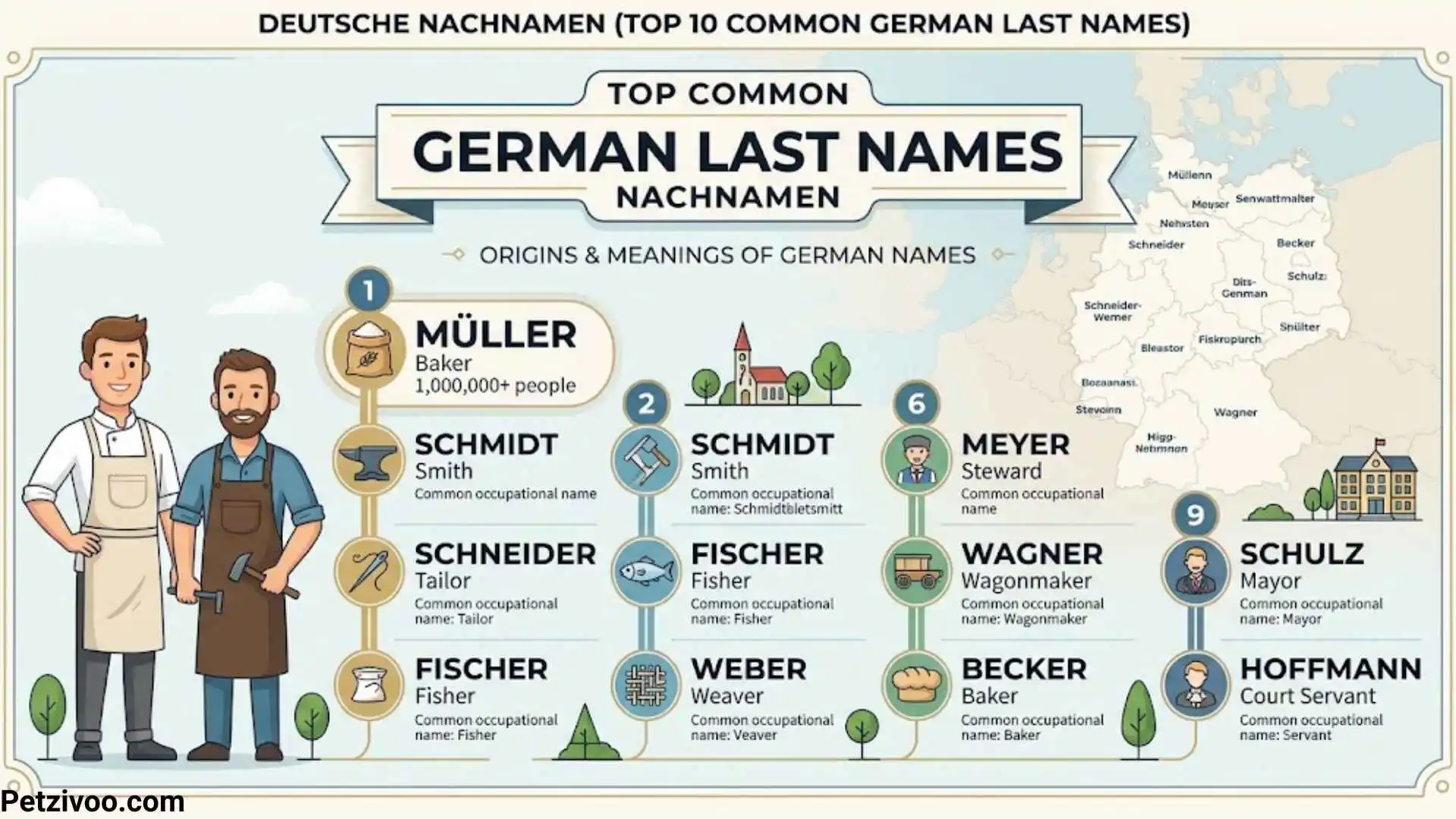
Common German last names offer a glimpse into the country’s language, occupations, regional traditions, and family history. Names such as Müller, Schmidt, Schneider, Fischer, and Weber remain familiar examples of German surnames. Many developed from everyday jobs, while others came from personal names, physical characteristics, or places where families lived.
If you’re researching your ancestry, looking for a German surname for a character, or simply curious about name meanings, this guide explores popular German last names, uncommon choices, alphabetical examples, and the history of German surnames in America.
What Are Common German Last Names?
Some of the most common German last names are Müller, Schmidt, Schneider, Fischer, Weber, Meyer, Wagner, Becker, Schulz, and Hoffmann. These names appear near the top of commonly cited surname lists for Germany, although exact rankings vary according to the dataset and how spelling variations are counted.
A surname is a family name passed down through generations. German surnames often developed from occupations, places of residence, personal names, and descriptive nicknames. Over time, these names became hereditary and helped distinguish people who shared the same given name.
For example, Müller refers to a miller, while Schneider refers to a tailor. These occupations were important in earlier German-speaking communities, helping explain why occupational surnames became so widespread.
Common German Last Names and Meanings
The following examples illustrate familiar German surnames and their traditional meanings. Some names have several possible origins, so the explanations describe common interpretations rather than the history of every family bearing that name.
| German Last Name | Meaning or Origin |
| Müller | Miller; someone associated with operating a mill |
| Schmidt | Smith; traditionally associated with metalworking |
| Schneider | Tailor; someone who made or altered clothing |
| Fischer | Fisherman; someone who caught or sold fish |
| Weber | Weaver; a person who made cloth |
| Meyer | Historically associated with a steward or farm administrator |
| Wagner | Wagon maker or cartwright |
| Becker | Baker; associated with baking bread |
| Schulz | Derived from an administrative title associated with village authority |
| Hoffmann | Often associated with a farm, estate, steward, or court-related role |
| Koch | Cook |
| Bauer | Farmer or rural inhabitant |
| Schäfer | Shepherd |
| Richter | Judge or judicial official |
| Zimmermann | Carpenter |
| Klein | Small or little |
| Braun | Brown; sometimes a descriptive nickname |
| Schwarz | Black or dark; sometimes associated with dark hair |
| Neumann | New man or newcomer |
| Wolf | Wolf; also potentially derived from a personal name |
| Hartmann | A surname developed from a personal name |
| Krüger | Historically associated with an innkeeper or tavern keeper in some regions |
| Lange | Long or tall |
| Krause | Often associated with curly hair |
| König | King; sometimes a nickname rather than a royal connection |
| Keller | Cellar-related occupational or residential name |
These examples demonstrate how surnames preserved clues about everyday life. However, the meaning of a name does not necessarily reveal what an ancestor actually did. A person named Fischer today does not need to have a fisherman in their recent family tree.
How German Surnames Developed
German surnames arose from several naming traditions. Their meanings can be easier to understand when grouped by their original purpose.
Occupational German Surnames
Occupational surnames identify a trade, profession, or social role. Müller, Schmidt, Schneider, Fischer, Weber, Wagner, Becker, Koch, and Zimmermann are familiar examples.
These occupations were useful identifiers in communities where many people shared a first name. A village might distinguish one person as the miller, another as the blacksmith, and another as the baker. Eventually, these descriptions became hereditary surnames.
The spelling of occupational names could also vary across regions. Schmidt, Schmitt, Schmid, and Schmied are related forms associated with the German word for a smith, but a particular family’s spelling must be established through records rather than assumed.
Surnames Based on Appearance, Places, and Personal Names
Other surnames developed from descriptive characteristics. Klein means small, Lange can mean tall or long, and Braun and Schwarz may refer to color or appearance.
Place-based surnames could identify someone by a landscape feature, settlement, or location near their home. Berg is associated with a mountain or hill, while Bach means stream. Such names may have arisen independently in different places.
Personal names also contributed to German surnames. Hartmann and Werner, for example, developed from older personal-name traditions. The ending -mann means “man” in German, but its presence alone does not establish a single origin for every surname.
Common German Last Names for Men and Women
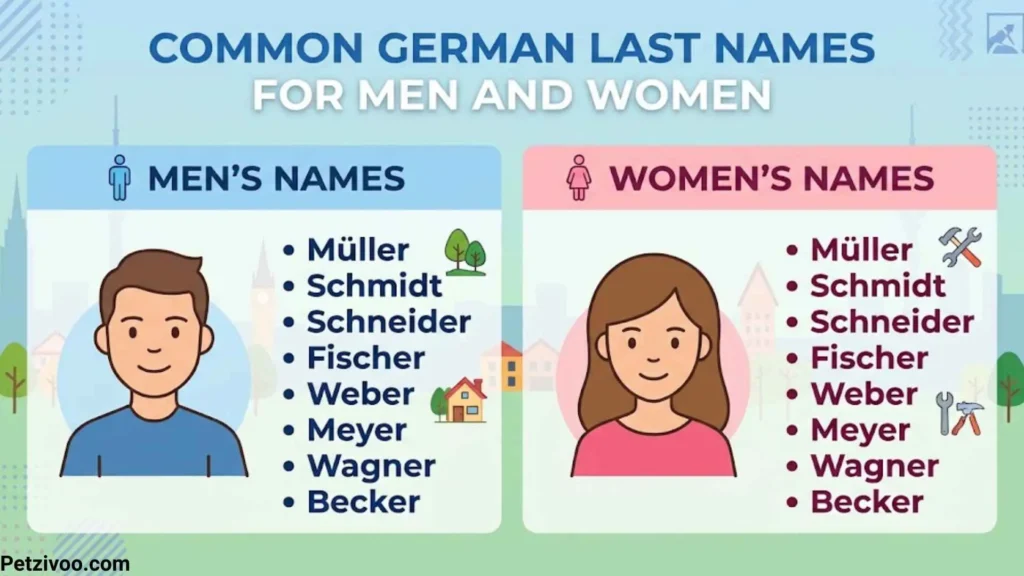
German family names generally do not change according to whether the person is male or female. Müller, Schmidt, Fischer, and Schneider can be surnames for men and women alike.
Searches for common German last names for men or German last names for girls often reflect a desire for names that sound traditionally masculine or feminine. However, that distinction usually applies to given names, not German surnames.
For example, Anna Müller and Lukas Müller can share the same surname without changing its spelling. Likewise, a woman named Sophie Schneider and a man named Daniel Schneider can belong to the same family.
Some historical European naming traditions used gender-specific surname forms, but standard German family names generally remain unchanged. Regional, historical, and foreign naming conventions can differ, so individual cases should be examined separately.
Uncommon German Last Names
Uncommon German surnames can be especially interesting for family-history research or fictional characters. A name may be uncommon nationally but familiar within a particular region or community.
Examples include:
- Siebenhaar: Literally associated with “seven hair” or seven hairs; its historical development may depend on the family and regional record.
- Zänker: Related to the German word for quarreling or arguing; the exact surname history requires context.
- Thalmann: Often connected with a valley or a person associated with one, depending on regional spelling and origin.
- Gruber: Commonly associated with a hollow, pit, or depression in the landscape; it is particularly familiar in southern German-speaking areas.
- Auer: May be a locational surname connected with places or landscape terms.
- Lüdtke: A regional surname associated with northern and northeastern German naming traditions.
- Böhm: Traditionally associated with Bohemia or a person from that region.
- Stolz: Means proud, and may have developed as a descriptive nickname.
These names should not automatically be labeled rare without a population dataset. Their frequency can differ considerably between Germany, Austria, Switzerland, and the United States.
A distinctive surname can also have multiple spellings or historical forms. When researching an unfamiliar family name, check old documents and regional records before deciding what it means.
Wealthy German Surnames and Noble Family Names
Some German surnames are associated with historically prominent, aristocratic, or wealthy families. However, a surname by itself does not prove that someone is wealthy today or descended from nobility.
Examples of historically prominent German family names include Hohenzollern, Habsburg, Wittelsbach, and Thurn und Taxis. These names are associated with well-known European dynasties and aristocratic histories, rather than being a representative list of the most common German surnames.
Other familiar names, such as König (king) and Kaiser (emperor), have meanings connected to royal titles. Their presence as surnames does not establish royal ancestry. A family could acquire a title-related nickname without having any royal connection.
If you’re investigating a possible aristocratic family connection, look for documented genealogies, historical registers, marriage records, and official records of titles. Shared surnames are not enough to establish a relationship.
German Surnames A–Z
This alphabetical directory provides examples of German surnames across the alphabet. Some are very common, while others are more regional or less familiar. The list is illustrative rather than a ranking.
| Letter | German Surname Examples |
| A | Albrecht, Arnold, Auer |
| B | Bauer, Becker, Bergmann, Braun |
| C | Conrad, Christmann, Clausen |
| D | Dietrich, Dietz, Dreyer |
| E | Engel, Eberhardt, Eckert |
| F | Fischer, Frank, Friedrich |
| G | Graf, Groß, Gruber |
| H | Hoffmann, Hartmann, Hahn, Herrmann |
| I | Imhoff, Ihle, Isenberg |
| J | Jäger, Jung, Jansen |
| K | Koch, Klein, Krause, Keller |
| L | Lange, Lehmann, Lorenz |
| M | Müller, Meyer, Maier, Meier |
| N | Neumann, Neubert, Nagel |
| O | Otto, Oppermann, Ochs |
| P | Peters, Petersen, Pfeiffer |
| Q | Quandt, Quast |
| R | Richter, Roth, Reinhardt |
| S | Schmidt, Schneider, Schulz, Schäfer |
| T | Thomas, Thiel, Theis |
| U | Ulrich, Ullmann, Urban |
| V | Vogel, Vogt, Voigt |
| W | Weber, Wagner, Werner, Wolf |
| X | Xander, a rare surname or family-name form in German-speaking contexts |
| Y | Yilmaz, found in Germany through migration and Turkish naming traditions |
| Z | Zimmermann, Ziegler, Zimmer, Zöller |
The list includes names used in German-speaking contexts, not exclusively names of German linguistic origin. Germany has a long history of migration and regional cultural exchange, so not every surname found there originated in the German language.
Common German Last Names Starting With H
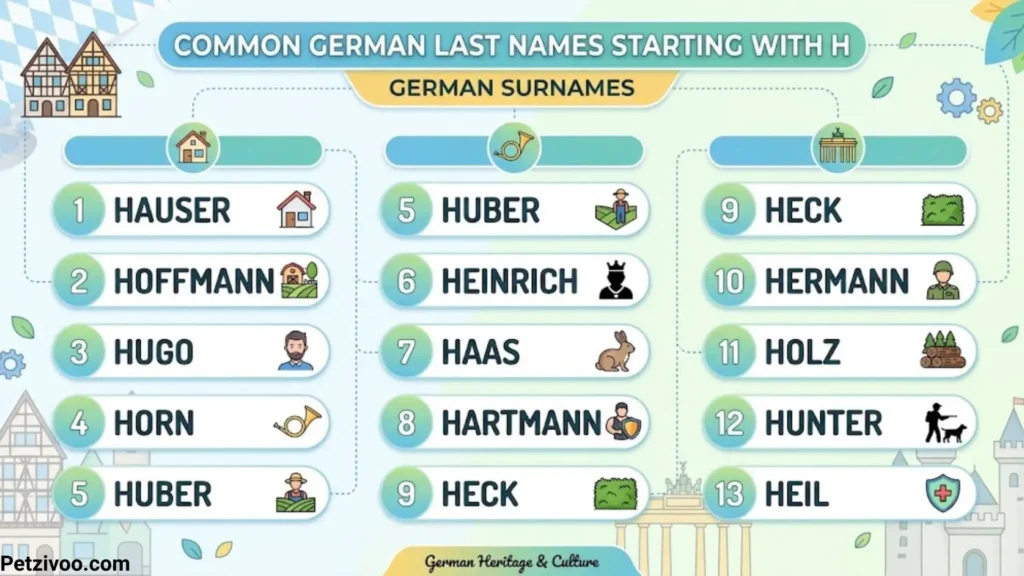
If you’re looking for German surnames beginning with H, these are useful examples:
- Hoffmann: Often connected with a farm, estate, steward, or court-related role.
- Hartmann: Developed from a traditional personal name.
- Hahn: Means rooster and may have originated as a nickname.
- Herrmann: A surname derived from an older personal name.
- Heinrich: A surname developed from the personal name Heinrich.
- Hermann: Another surname based on a traditional Germanic personal name.
- Huber: Associated with a farmholding or agricultural unit in southern German-speaking regions.
Hoffmann and Hartmann are particularly recognizable examples. Huber is also familiar in southern Germany and neighboring German-speaking areas.
Common German Last Names Starting With S
German surnames beginning with S include several of the country’s most familiar family names.
- Schmidt: Smith or metalworker.
- Schneider: Tailor.
- Schulz: Historically associated with a local administrative office.
- Schäfer: Shepherd.
- Schwarz: Black or dark; sometimes descriptive of appearance.
- Schröder: A regional occupational surname traditionally associated with a tailor or certain forms of transport and trade.
- Schmitt: A spelling variant related to Schmidt and the German smith-name tradition.
- Scholz: A regional surname related to older administrative titles.
Schmidt, Schmitt, and Scholz illustrate why regional history matters. Similar-looking names can be related, while names with different spellings may share a historical root.
Common German Last Names in America
German surnames are widespread in the United States because many German-speaking immigrants settled in America over several centuries. Their descendants often retained family names even as they adopted English as their main language.
Examples frequently encountered in American genealogy include Miller, Schmidt, Smith, Schneider, Snyder, Fischer, Fisher, Weber, Wagner, Meyer, and Becker.
Some names retained their German spellings, while others were adapted or replaced by more familiar English forms. Müller, for instance, may appear as Mueller in records that do not support the German umlaut. Some families also used Miller, although that English surname can have an independent origin.
The surname Snyder is associated with German Schneider in some family histories, but the relationship must be established for each family rather than assumed. Similarly, Fisher can be an anglicized form of Fischer or an independently developed English surname.
How to Research German-American Surnames
If you’re tracing a German surname in America, try the following:
- Search spelling variations. Check forms such as Müller and Mueller, Schmidt and Schmitt, or Meyer and Meier.
- Start with recent records. Census entries, obituaries, marriage certificates, and death records may identify parents or places of birth.
- Work backward. Use each record to identify the next generation instead of jumping to an assumed immigrant ancestor.
- Look for a German birthplace. A town, province, or historical state is often more useful than the surname alone.
- Check original documents. Handwriting, transcription errors, and changing borders can complicate family research.
The most common German surnames in the USA are not necessarily the same as the most common surnames in Germany today. American records reflect migration, intermarriage, spelling changes, and generations of population change.
German Last Names in the 1800s, 1940s, and During WWI
German surnames in historical documents can help genealogists locate family members and understand migration. However, a name found in a particular period should not automatically be described as one of the most common surnames of that era without a suitable historical dataset.
German Surnames in the 1800s
During the 1800s, German-speaking lands experienced substantial migration, including emigration to the United States. Family names such as Müller, Schmidt, Weber, Meyer, Fischer, and Schneider were already part of established German surname traditions.
Historical records from this period may contain regional spelling variants, handwritten forms, and place names that changed as political boundaries shifted. German-speaking ancestors may also have lived in Prussia, Bavaria, Württemberg, or other territories before modern Germany was unified in 1871.
When researching an ancestor from the 1800s, identify the historical locality before assuming that modern national boundaries or spelling conventions applied.
German Surnames During WWI
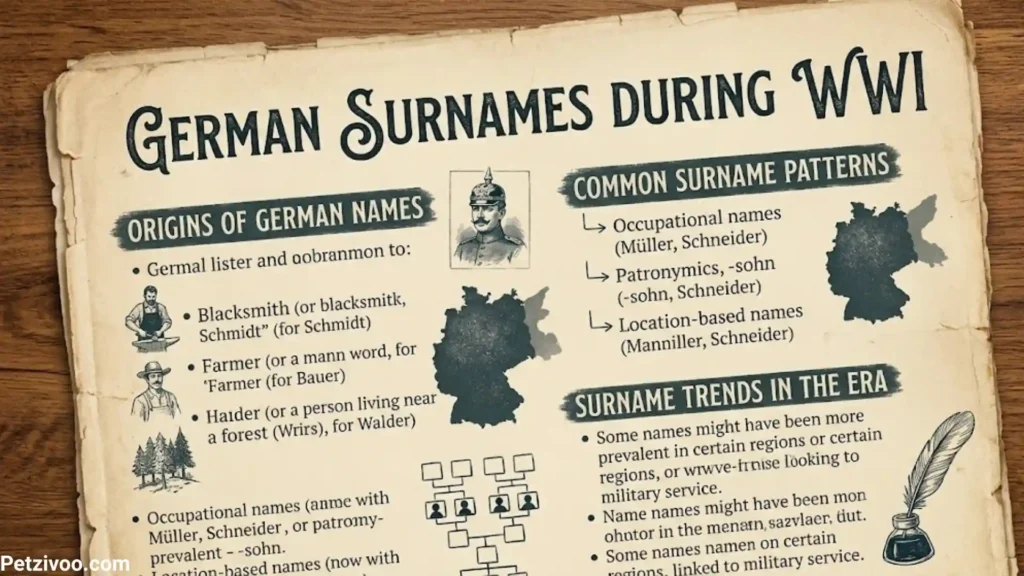
World War I lasted from 1914 to 1918. German military records, civil registrations, passenger documents, and family correspondence may contain surnames useful for genealogical research.
Names such as Hoffmann, Bauer, Richter, Wagner, and Neumann are examples of established German surnames that researchers may encounter in historical sources. Their appearance does not prove that they ranked highest during the war.
Researchers should also distinguish German military records from records created by other countries. A German-born immigrant might appear in US records with a translated, shortened, or differently spelled surname.
German Surnames in the 1940s
The 1940s were shaped by World War II, population displacement, border changes, and migration. Records from this decade may show families living outside the places where their ancestors were born.
For research, compare civil registers, church records, immigration files, and postwar documentation. If a family surname appears in multiple spellings, look for supporting details such as birth dates, parents’ names, and hometowns.
Without a clearly defined historical dataset, it is more accurate to discuss surnames documented during the 1940s than to claim a definitive ranking of the most common German last names in that decade.
Frequently Asked Questions
What are the most common German last names?
Müller, Schmidt, Schneider, Fischer, Weber, Meyer, Wagner, Becker, Schulz, and Hoffmann are among the best-known names near the top of commonly cited German surname lists. Exact rankings depend on the source and how spelling variants are counted.
What do common German last names mean?
Many German surnames developed from occupations. Müller means miller, Schneider means tailor, Fischer means fisherman, Weber means weaver, and Koch means cook. Other names refer to places, personal names, or physical characteristics.
Do German last names change for men and women?
Generally, no. German surnames such as Schmidt, Müller, and Schneider are normally spelled the same for men and women. Historical and regional exceptions may exist, but gender-specific surname forms are not the standard modern German pattern.
What are some uncommon German last names?
Examples of less familiar or regionally distinctive names include Lüdtke, Siebenhaar, Thalmann, and Zänker. Whether a surname is truly uncommon depends on the region and population dataset used.
What are common German last names in America?
Miller, Schmidt, Smith, Schneider, Snyder, Fisher, Weber, Wagner, and Meyer are examples found in American family-history research. Some reflect German immigration or spelling adaptation, while others have independent origins.
Can a German surname prove noble ancestry?
No. A surname such as König or Kaiser does not establish royal descent, and a familiar surname shared with an aristocratic family does not prove a genealogical connection. Historical records are necessary to establish ancestry.
Conclusion
Common German last names preserve clues about occupations, geography, personal names, and the history of German-speaking communities. Names such as Müller, Schmidt, Schneider, Fischer, and Weber demonstrate how everyday trades helped shape family naming traditions.
For genealogy, the spelling and meaning of a surname are useful starting points, not final proof of ancestry. Compare historical documents, regional variations, and family records to build a more reliable picture of where your surname came from and how it changed over time.

I am Amelia Parker, a dedicated pet lover and creative writer who enjoys helping pet owners find names that perfectly match their furry companions. I have a passion for exploring unique, adorable, and meaningful pet names inspired by personality, appearance, nature, and popular culture.
I believe every pet has a special story, and choosing the right name is one of the first ways owners create a strong connection with their animals. Through my research and writing, I share fresh ideas and helpful guides that make naming pets easier and more enjoyable.
My books include:
- The Perfect Pet Name Collection: Ideas for Every Furry Friend
- Amazing Animal Names: Creative Inspiration for Pet Lovers
 Noah Williams
 Isabella Carter