
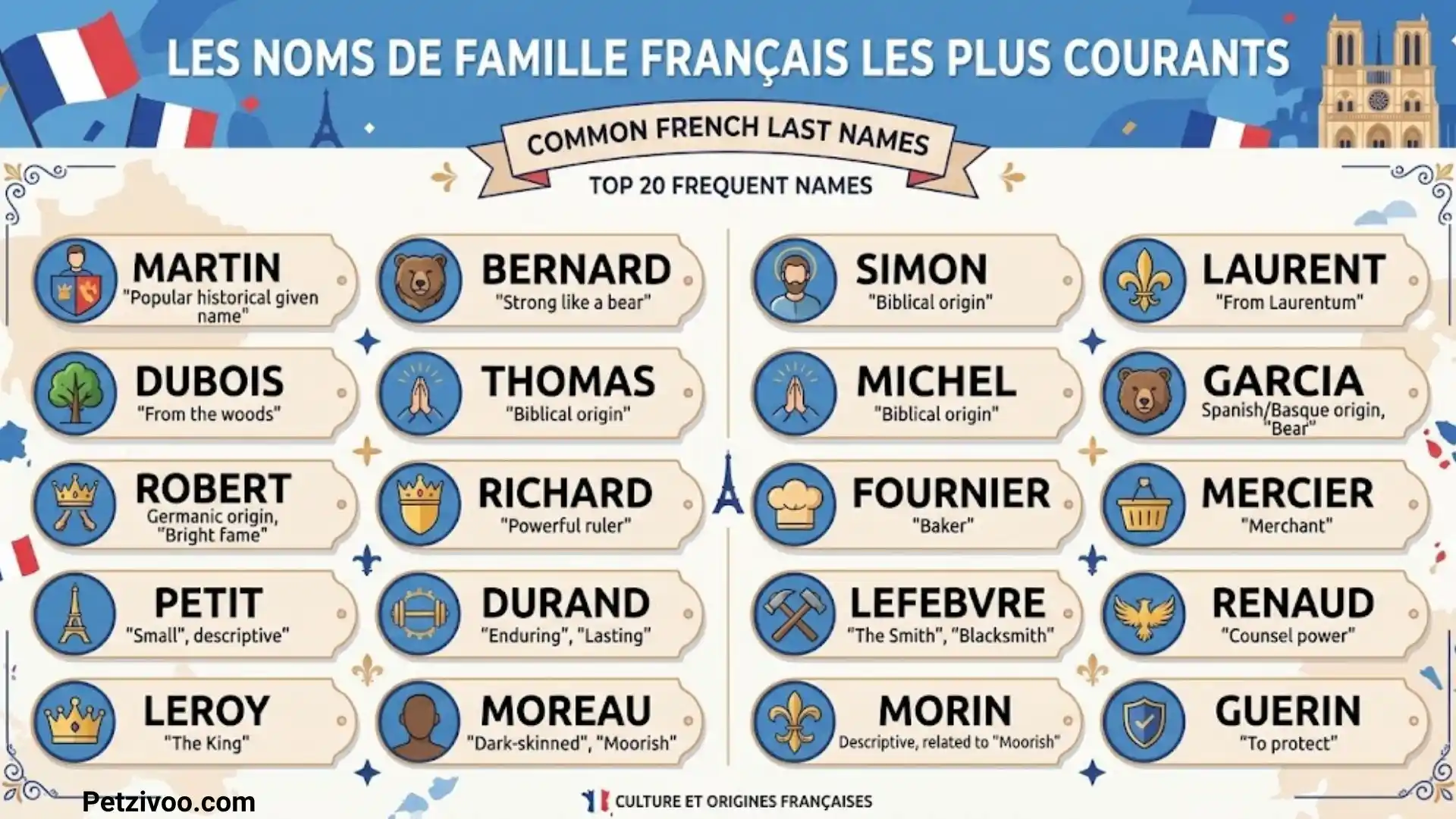
French last names reflect centuries of family history, regional languages, occupations, geography, and personal characteristics. Names such as Martin, Bernard, Dubois, Laurent, and Lefebvre are familiar examples of French surnames, while names such as Beauregard, Deschamps, and Charpentier offer clues about the places, occupations, or descriptions associated with earlier generations.
Many French surnames developed during the Middle Ages, when inherited family names gradually became more established. Some came from given names, some described a person’s work or appearance, and others identified a place or landscape. Research into French surname distributions also shows that family names can vary geographically and that spelling variants matter when tracing historical records.
This guide explores common French last names and their meanings, short and unique surnames, names associated with French nobility, and French family names found in the United States. Whether you’re researching your family tree or looking for a French surname for a character, you’ll find useful examples and historical context below.
What Are Some Common French Last Names?
Some recognizable French last names include Martin, Bernard, Dubois, Thomas, Robert, Richard, Petit, Durand, Moreau, and Laurent. They represent different naming traditions, including surnames derived from given names, descriptions, and places.
Here are 15 French surnames to know:
| French Last Name | Meaning or Origin |
| Martin | From the given name Martin, associated with the Roman name Martinus |
| Bernard | From a Germanic given name formed from elements meaning “bear” and “brave” or “hardy” |
| Dubois | From du bois, meaning “from the woods” |
| Thomas | From the biblical given name Thomas |
| Robert | From a Germanic given name meaning approximately “bright fame” |
| Richard | From Germanic elements associated with power and rule |
| Petit | “Small” or “little,” originally a descriptive name |
| Durand | From an old personal-name form associated with endurance |
| Moreau | Often associated with more, an old word linked to dark coloring; origins can vary |
| Laurent | From the given name Laurent, related to Latin Laurentius |
| Simon | From the given name Simon |
| Michel | From the given name Michel, the French form of Michael |
| Lefebvre | An occupational surname meaning “blacksmith” |
| Roux | “Red” or reddish-haired, from an old French descriptive term |
| Garnier | From a Germanic personal name |
These are examples of established French surnames, not a precise ranking of current popularity. A surname can have more than one origin, and a name’s historical meaning does not necessarily describe a modern bearer. For additional surname etymologies, see the French surname entries at Behind the Name.
Common French Last Names and Meanings
French surnames often become easier to understand when grouped by how they developed. The following examples illustrate several major categories.
Surnames Derived From Given Names
These surnames developed from personal names used by parents or earlier generations. Many have roots in Germanic, Latin, Greek, or biblical naming traditions.
- Bernard — Germanic personal name associated with the elements for “bear” and “brave.”
- Robert — From a Germanic name associated with “bright fame.”
- Richard — From Germanic elements associated with rule and strength.
- Thomas — Derived from the given name Thomas, traditionally traced to an Aramaic word meaning “twin.”
- Laurent — From Laurent, related to the Latin name Laurentius.
- Michel — From the French given name Michel, corresponding to Michael.
- Simon — From the given name Simon, with biblical and Hebrew-language roots.
A surname derived from a given name may have entered a family line through an ancestor, but it does not identify one specific founding person without supporting genealogical records.
Occupational French Surnames
Some family names originated in occupations, trades, or public roles.
| Surname | Meaning |
| Lefebvre | Blacksmith; a variant of Lefèvre |
| Fournier | Traditionally associated with a baker or someone responsible for an oven |
| Charpentier | Carpenter or woodworker |
| Barbier | Barber |
| Mercier | Merchant or textile trader |
| Meunier | Miller |
| Lemaire | Mayor or an earlier administrative title |
| Chevalier | Knight; may have originated as a nickname or status-related designation |
These meanings refer to the historical roots of the surnames, not necessarily the occupations of people who bear them today. Several French surnames have multiple regional spellings, including Lefebvre and Lefèvre.
Behind the Name+1
Geographic and Landscape-Based Surnames
Geographic surnames often described where an ancestor lived or the landscape near a settlement.
- Dubois — “From the woods” or “of the woods.”
- Dupont — “From the bridge” or associated with a bridge.
- Duval — “From the valley.”
- Dumont — “From the mountain.”
- Deschamps — “From the fields.”
- Desjardins — “From the gardens.”
- Lavigne — “The vineyard” or a connection to a vineyard or place name.
- Lacoste — Often linked to a slope or hillside, although individual origins can vary.
- Beaumont — Associated with French place names built from elements meaning “beautiful” and “mountain.”
- Beaulieu — Associated with place names meaning approximately “beautiful place.”
Geographic meanings are useful starting points for genealogy, but they rarely identify a single town on their own. Multiple communities may have had similar landscape features or place names.
Behind the Name+1
Descriptive French Surnames
Some names originated as nicknames describing an ancestor’s appearance, age, or a perceived characteristic.
- Petit — Small or little.
- Legrand — “The tall” or “the large.”
- Leblanc — “The white,” possibly referring to fair coloring or light hair.
- Lebrun — “The brown,” potentially associated with hair or complexion.
- Leroux — “The red,” often connected with reddish hair.
- Lebeau — “The handsome” or “the beautiful.”
- Lejeune — “The young.”
- Bonnet — A surname with several possible historical roots, including a connection to the given name Bonet.
These interpretations describe possible historical naming motivations. They should not be used to make assumptions about a living person’s appearance or personality.
Common French Last Names for Men and Women
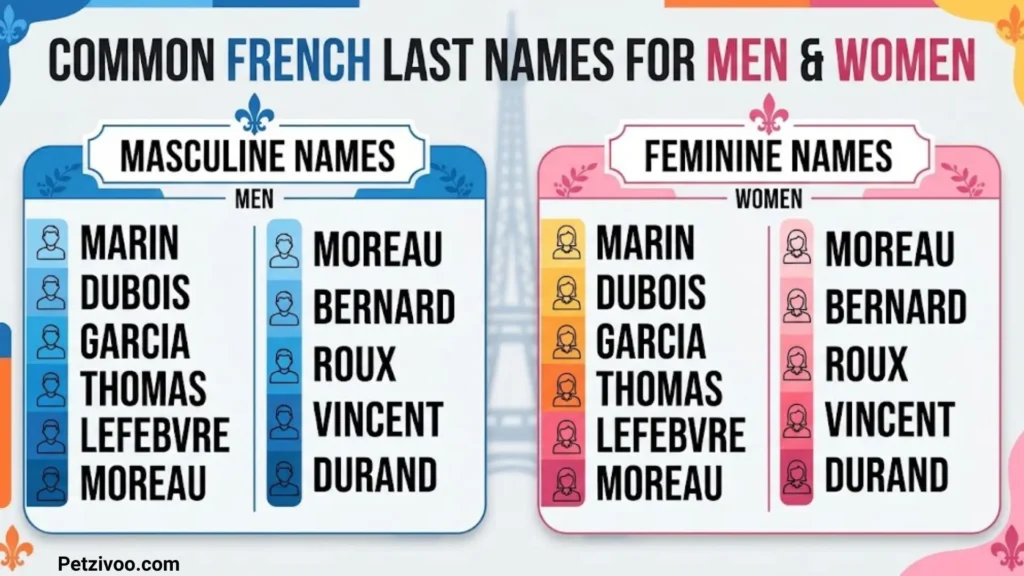
French surnames generally do not change according to whether the person is male or female. A woman named Marie Martin and a man named Jean Martin can share the same surname spelling without any grammatical change.
This differs from some naming traditions in which family names have gender-specific forms. In French, differences such as Martin versus Martine are not a general male-versus-female surname rule; the two forms can have different individual histories.
Common French Last Names for Men
The following surnames are traditionally used by people of all genders, including men:
- Martin
- Bernard
- Robert
- Richard
- Durand
- Petit
- Moreau
- Laurent
- Simon
- Michel
- Lefebvre
- Roux
These are suitable examples if you’re looking for masculine French character names or researching male ancestors in French records. The surnames themselves are not exclusively masculine.
Common French Last Names for Women and Girls
The same surname forms can be used for women and girls:
- Dubois
- Moreau
- Laurent
- Petit
- Bernard
- Lefèvre
- Fontaine
- Rousseau
- Garnier
- Chevalier
- Marchand
- Deschamps
In historical records, a woman’s surname may appear in a different form because of marriage conventions, local practices, indexing choices, or spelling changes. That does not mean that French surnames generally have separate feminine endings.
For genealogy, search for the surname alongside the person’s given name, spouse, parents, location, and approximate dates rather than assuming that a different spelling represents a gender-specific form.
Short French Last Names
Short French surnames can be appealing because they are easy to read, remember, and pronounce. Some also have straightforward meanings in modern French.
Roy
3 letters
Roy — A historical spelling related to roi, meaning “king.” It is also found in French-speaking Canada.
Roux
4 letters
Roux — A traditional descriptive surname associated with red or reddish coloring.
Noël
4 letters
Noël — Related to the French word for Christmas and historically used as a given name and surname.
Guy
3 letters
Guy — A French given name that also appears as a surname.
Paul
4 letters
Paul — A surname derived from the given name Paul, used in several European naming traditions.
Barre
5 letters
Barre — A surname with French and other European associations; its specific origin can vary.
Other short surnames include Blanc, Brun, Morel, Faure, and Adam. These names have varying regional and linguistic histories, so shortness alone does not establish that a surname is exclusively French.
Unique French Last Names
A unique French surname might be uncommon in one country, distinctive in spelling, associated with a particular region, or simply unfamiliar to the reader. There is no universal list of objectively unique surnames because frequency changes by location and time.
The following names are useful examples of distinctive French family names.
| Surname | Meaning or Origin | What Makes It Distinctive |
| Beauregard | Associated with “beautiful view” or a place name | Evocative geographic meaning |
| Desrosiers | “From the rose bushes” | Nature-related roots |
| Charbonneau | Related to charcoal or a descriptive nickname | Occupational or descriptive history |
| Lapointe | “The point”; sometimes associated with a lance or geographic feature | Strong, concise sound |
| Lachance | “Luck” or “good fortune” | Familiar French vocabulary |
| Desroches | “From the rocks” | Landscape connection |
| Dufour | Associated with an oven and traditionally a baker | Occupational roots |
| Beaulieu | “Beautiful place” in a place-name context | Pleasant geographic association |
| Dumont | “From the mountain” | Landscape-based meaning |
| Chastain | Connected with the chestnut tree or a place name | Historical spelling and regional associations |
Some names in this list are also well established in French-speaking communities outside France. A name can be distinctive to an American reader while being familiar in France, Quebec, or Louisiana. Meanings are summarized from established French surname etymologies and may have alternative explanations.
Royal French Last Names and Upper-Class Surnames
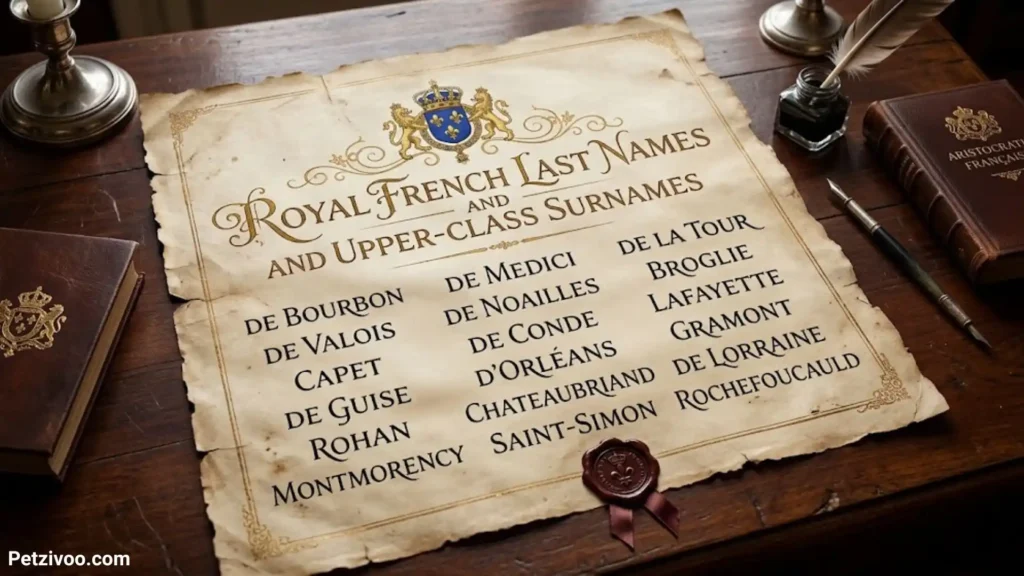
Royal and noble family names are an interesting part of French history, but it is important to distinguish an actual royal dynasty from a surname associated with nobility or a place.
French Royal Family Names
- Capet — The name associated with the Capetian dynasty, which became a major royal house in France.
- Valois — The name of a French royal branch that ruled from the 14th to the 16th century.
- Bourbon — A major European royal house that produced French kings, including members of the dynasty that ruled before the French Revolution and again after 1814, with a brief interruption.
- Orléans — A name associated with a branch of the French royal family and with the historic title of Duke of Orléans.
- Bonaparte — The family name of Napoleon Bonaparte and his imperial dynasty, rather than a traditional medieval French royal house.
These are historically important dynastic names. They are not all interchangeable, and their associations span different periods of French political history.
Upper-Class and Noble French Surnames
Names such as de Bourbon, de Rohan, de Montmorency, and de La Rochefoucauld are associated with historically prominent noble families.
In some French noble naming traditions, de connects a family name to a place or estate. Historical research into French nobility describes combinations of family names, land names, and titles, but also documents disputes over the use of noble-sounding names.
A few important cautions:
- The word “de” does not prove nobility. It can appear in names with different histories.
- A surname associated with a noble house does not mean every person bearing it descends from that house.
- A person may have an aristocratic ancestor without holding a title today.
- Noble titles, land names, and inherited surnames have different legal and historical meanings.
If you’re researching an aristocratic family, look for documented family relationships, historical records, and title-specific evidence rather than relying on a surname alone.
Common French Last Names Starting With P and T
Alphabetical lists can help readers find names for genealogy projects, character naming, or family history research. The following examples use established surname spellings.
French Last Names Starting With P
| Surname | Meaning or Origin |
| Petit | Small or little |
| Perrin | Derived from a diminutive form of Pierre |
| Philippe | Derived from the given name Philippe |
| Picard | Traditionally associated with a person from Picardy |
| Pascal | Derived from the given name Pascal, associated with Easter |
| Pruvost | A regional surname with historical occupational or title-related associations; specific origins vary |
| Perrot | A diminutive form of Pierre |
| Pelletier | Traditionally associated with the fur trade or preparation of skins |
| Poirier | “Pear tree,” often linked to a place or tree |
| Parent | A surname with several possible French and regional origins |
French Last Names Starting With T
| Surname | Meaning or Origin |
| Thomas | Derived from the given name Thomas |
| Thierry | Derived from the given name Thierry |
| Tessier | A French surname with regional and occupational interpretations |
| Thibault | Derived from an old Germanic personal name |
| Tournier | Historically associated with turning or a turner, though origins vary |
| Toussaint | “All Saints,” associated with the Christian feast day |
| Terrien | Related to terre, meaning “land” or “earth”; surname origins can vary |
| Tavernier | Traditionally associated with a tavern keeper |
| Tardif | “Late” or “slow,” potentially descriptive in origin |
| Thévenet | A regional surname associated with forms of the given name Étienne in some naming traditions |
The meanings of some surnames, especially regional names, are not always settled. Treat the descriptions above as general etymological guides rather than definitive explanations for every family.
Common French Last Names in America, Louisiana, and New Orleans
French surnames in the United States reflect several migration histories. These include French colonial settlement, French Canadian migration, Acadian displacement and resettlement, and later immigration from France and other French-speaking regions.
A French-looking surname does not necessarily mean that a family immigrated directly from France. A family’s route may have passed through Canada, the Caribbean, or another part of North America.
Common French Last Names in America
Examples of French-origin surnames found in the United States include:
- Martin
- Bernard
- Dubois
- Dupont
- Moreau
- Laurent
- Richard
- LeBlanc
- Roy
- Fontaine
- Girard
- Rousseau
Some of these names also have other linguistic origins or have become established in multiple countries. For instance, Martin and Richard are used across several European languages.
Spelling changes can occur when families move between French- and English-speaking communities. Accents may be dropped, spaces may disappear, and related forms such as Lefèvre and Lefebvre may appear in different records.
Common French Last Names in Louisiana
Louisiana has a distinctive French and French-derived surname history shaped by colonial settlement, Acadian migration, and other populations. Some familiar surnames in French Louisiana include:
- Landry
- LeBlanc
- Broussard
- Boudreaux
- Thibodeaux
- Hebert
- Guidry
- Fontenot
- Doucet
- Benoit
- Bergeron
- Daigle
The Acadian Memorial documents family names and settlement histories connected to Acadian communities, including families who later migrated to Louisiana. It also notes that some surnames found among Louisiana’s French-speaking communities have both Acadian and non-Acadian branches.
Common French Last Names in New Orleans
French-associated surnames in New Orleans may include Lafitte, Dufour, Dubois, Martin, Hebert, Boudreaux, and Landry, among others.
New Orleans has a diverse population history, so not every French surname there represents the same background. Family histories may connect to colonial Louisiana, Acadia, France, the Caribbean, or other communities.
For accurate research, combine surname clues with parish registers, civil records, census entries, marriage records, and known family locations. A surname by itself cannot establish whether a family was Creole, Cajun, Acadian, or descended from a particular immigrant.
French Last Names in the 1500s, 1800s, and 1900s
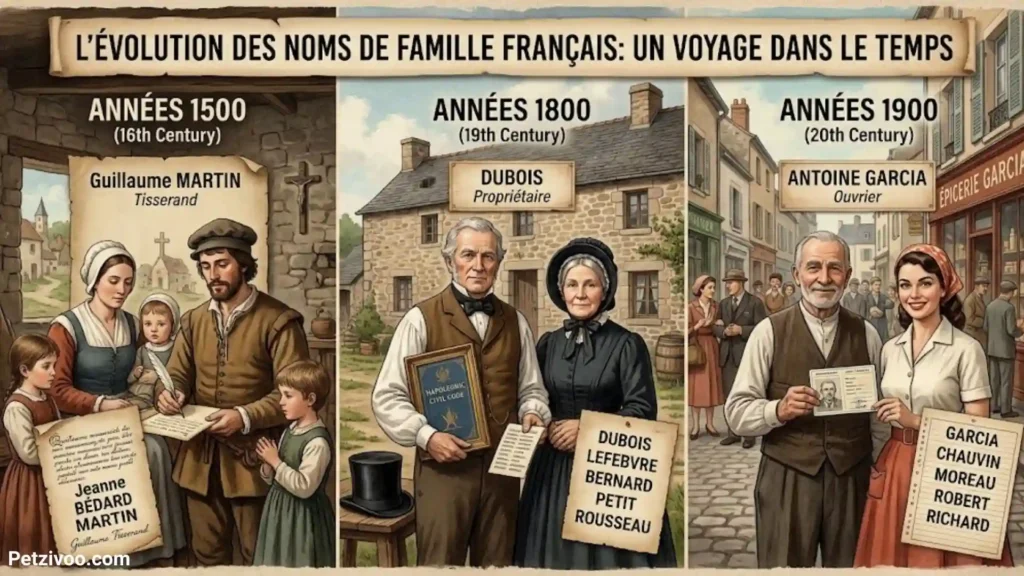
French surnames developed over many centuries. The best way to understand a surname’s historical use is to examine dated records rather than assume that a modern list represents the exact names or rankings of an earlier period.
Common French Last Names in the 1500s
By the 1500s, inherited surnames were well established in many French communities, although spelling and recordkeeping varied by location and record type.
Names such as Martin, Bernard, Laurent, Thomas, Petit, and Lefèvre belong to long-standing French naming traditions. Their presence in a modern surname list does not, by itself, prove how frequent each name was in the 16th century.
When researching this period, look for parish registers where available, notarial documents, land records, and local archives. Historical spelling variants can make the same family difficult to identify across documents.
Common French Last Names in the 1800s
The 19th century saw major political and social changes in France, including the French Revolution’s long-term effects on titles, property, and naming practices. Civil registration and other administrative records can be valuable sources for surname research.
Traditional surnames such as Durand, Moreau, Petit, Bernard, and Dubois are useful starting points for searches, but a reliable claim about their relative popularity in a specific decade requires period-specific data.
For French-American family histories, this period can also include migration to North America and changes in how surnames were written in English-language records.
Common French Last Names in the 1900s and 1940s
For the 20th century, birth registers, civil records, electoral documents, and census materials can help establish surname frequency in particular places and periods.
A published study of French surname distributions examined birth registers from 1891–1915 and 1916–1940, alongside telephone-directory data from 1975. This illustrates why historical comparisons should use dated records and account for geographical differences.
Names such as Martin, Bernard, Robert, Richard, Petit, and Durand are examples worth investigating in 20th-century records. However, without a verified dataset, it would be misleading to present them as an exact ranking for 1940 or another specific year.
What About Common French Last Names in 2017?
A year-specific ranking for 2017 requires a source that actually measures surname frequency for that year. A list of familiar French surnames cannot establish which names ranked highest in 2017.
If you are researching a modern family name, use current or historical official data where available, and distinguish births registered in a year from the total population carrying a surname. These are different measurements.
Frequently Asked Questions
What is the most common French last name?
Martin is widely recognized among the most common surnames in France. However, the exact top surname can depend on the dataset, the period measured, and whether researchers count births, living residents, or historical records.
Do French last names change for men and women?
Generally, no. French inherited surnames normally retain the same spelling regardless of gender. Differences in historical documents may reflect marriage practices, spelling variations, or recordkeeping conventions.
What French last names have royal connections?
Capet, Valois, Bourbon, and Orléans are associated with French royal dynasties or branches of the royal family. Bonaparte is associated with Napoleon’s imperial dynasty. A shared surname alone does not prove royal descent.
What are some short French surnames?
Examples include Roy, Roux, Guy, Paul, Noël, Brun, Blanc, and Adam. Some also occur in other languages or cultures, so their origins should be checked individually.
How can I find the origin of my French surname?
Start with the oldest known spelling in your family records. Compare birth, marriage, death, census, and parish documents, and check regional surname references. Record dates and places carefully because similar surnames may have independent origins.
Are French surnames in Louisiana always Acadian?
No. Louisiana’s French-associated surnames reflect several family histories, including Acadian and non-Acadian backgrounds. The Acadian Memorial’s genealogy resources document many Acadian family names and their migration destinations.
Acadien Acadian Memorial+1
Does having a French last name mean I have French ancestry?
Not necessarily. Surnames can be inherited through different family lines, adopted, changed through migration, or shared across cultures. A surname can provide a research clue, but genealogical records are needed to establish a specific family connection.
Conclusion
Common French last names preserve clues about personal names, occupations, landscapes, and the history of French-speaking communities. Martin, Bernard, Dubois, Laurent, and Lefebvre are useful examples, while surnames such as Beauregard, Desrosiers, and Charbonneau illustrate the range of descriptive and geographic traditions.
If you’re researching your family history, begin with the earliest documented spelling of your surname and work backward through records. If you’re choosing a name for a character, consider its sound, meaning, and regional associations. In either case, remember that surname meanings are useful starting points, not proof of a person’s ancestry, social status, or family story.

I am Noah Williams, an animal enthusiast and pet content creator who loves discovering creative ways to celebrate the bond between pets and their owners. I specialize in researching memorable pet names, naming trends, and meaningful ideas for dogs, cats, and other beloved animals.
I enjoy helping families choose names that are not only beautiful but also reflect their pet’s personality and unique qualities. My goal is to provide simple, inspiring, and practical naming advice for every type of pet owner.
My books include:
- The Ultimate Pet Names Encyclopedia
- Finding the Right Name for Your New Best Friend
 Amelia Parker
 Isabella Carter