
Korean last names offer a fascinating look at Korean culture, language, and family history. Some surnames, such as Kim, Lee, and Park, are extremely common, while others are shared by relatively small numbers of families. Each surname can have its own historical background, spelling variations, and connections to Korean ancestry.
If you are researching Korean family names, exploring your heritage, or looking for Korean surnames for a fictional character, understanding their origins can help you choose accurate and meaningful information. This guide covers common Korean last names, their meanings, popularity by percentage, royal connections, uncommon surnames, and names used by Korean Americans.
One important detail to remember is that a Korean surname’s English spelling does not always reveal its exact meaning. Many Korean family names have different Hanja characters, ancestral lineages, and romanized spellings.
What Are the Most Common Korean Last Names?
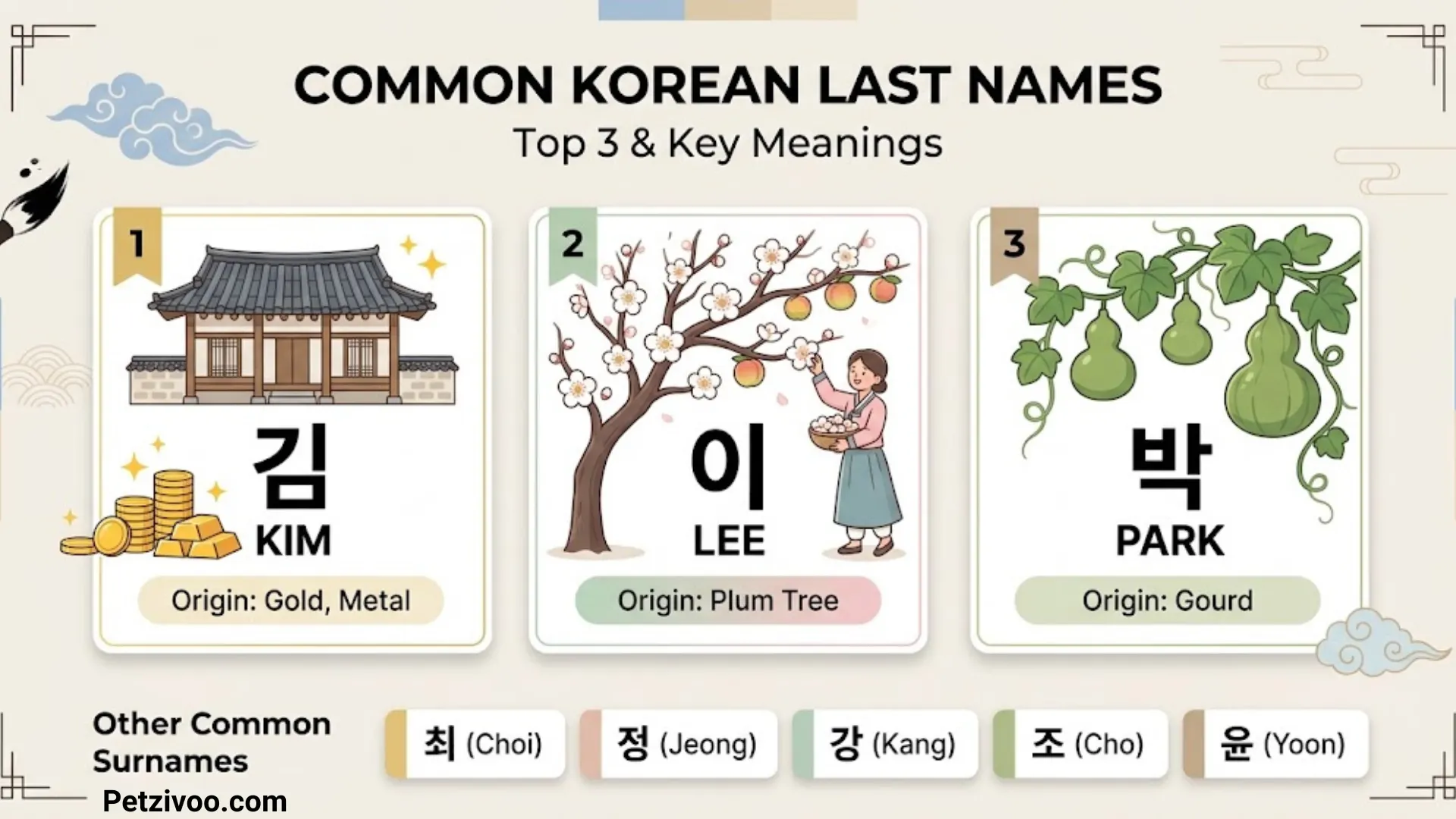
The most common Korean last names include Kim, Lee, Park, Choi, Jung, Kang, Cho, Yoon, Jang, and Lim. Kim is the most widespread surname in South Korea, followed by Lee and Park.
According to widely reported results from South Korea’s 2015 Population and Housing Census, Kim, Lee, and Park together represented approximately 44.6% of the population. These figures demonstrate how concentrated Korean surname distribution is compared with countries that have a wider variety of frequently used family names.
Here is a useful list of common Korean last names and their Hangul spellings.
| Korean Last Name | Hangul | Alternative Spellings |
| Kim | 김 | Gim, Ghim |
| Lee | 이 | Yi, Rhee |
| Park | 박 | Pak, Bak |
| Choi | 최 | Choe, Choy |
| Jung | 정 | Jeong, Chung |
| Kang | 강 | Gang |
| Cho | 조 | Jo |
| Yoon | 윤 | Yun, Youn |
| Jang | 장 | Chang |
| Lim | 임 | Im, Rim |
| Shin | 신 | Sin |
| Yoo | 유 | Yu |
| Han | 한 | — |
| Oh | 오 | O |
| Seo | 서 | Suh |
| Jeon | 전 | Jun, Chun, Cheon |
| Kwon | 권 | Gwon |
| Hwang | 황 | Huang |
| Ahn | 안 | An |
| Song | 송 | — |
| Hong | 홍 | — |
| Yang | 양 | — |
| Ko | 고 | Go, Koh |
| Moon | 문 | Mun |
| Son | 손 | Sohn |
| Bae | 배 | Pae |
| Baek | 백 | Paik, Paek |
| Heo | 허 | Huh |
| Noh | 노 | No, Roh |
| Nam | 남 | — |
These names represent a selection of widely recognized Korean surnames, not an exact ranking of every entry. Rankings may differ depending on how spelling variations and Hanja-based family lineages are counted.
Common Korean Last Names and Meanings
Many Korean surnames are connected to Hanja, Chinese characters historically used in Korean names. These characters may carry meanings associated with nature, places, objects, or traditional concepts.
However, a surname’s meaning depends on the particular character used by a family. Two surnames with the same Korean pronunciation may have different written characters and interpretations.
| Surname | Hangul | Common Hanja | Commonly Cited Meaning |
| Kim | 김 | 金 | Gold or metal |
| Lee | 이 | 李 | Plum tree |
| Park | 박 | 朴 | Traditionally associated with a gourd or simplicity |
| Choi | 최 | 崔 | Lofty or high |
| Jung | 정 | 鄭 | Associated with an ancient Chinese state |
| Kang | 강 | 姜 | A historical surname character |
| Cho | 조 | 趙 | Associated with an ancient Chinese state |
| Yoon | 윤 | 尹 | Commonly glossed as an official or administrator |
| Jang | 장 | 張 | To stretch or expand |
| Lim | 임 | 林 | Forest or woods |
| Han | 한 | 韓 | Korea or the historical state of Han |
| Ahn | 안 | 安 | Peace or safety |
| Hwang | 황 | 黃 | Yellow |
| Baek | 백 | 白 | White |
| Moon | 문 | 文 | Writing, literature, or culture |
| Son | 손 | 孫 | Grandchild or descendant |
| Yang | 양 | 梁 | Beam or bridge in one Hanja form |
| Heo | 허 | 許 | Permit or allow in a common character gloss |
| Song | 송 | 宋 | Associated with the historical state of Song |
| Seok | 석 | 石 | Stone in one Hanja form |
Kim (김)
Kim is the most common Korean surname. It is frequently written with the Hanja character 金, which means gold or metal. Several important Korean lineages carry this surname, including the Gimhae Kim and Gyeongju Kim clans.
Although many people share the surname Kim, they do not necessarily belong to the same family lineage. Additional genealogical details are needed to establish a specific connection.
Lee (이)
Lee is commonly associated with 李, meaning plum tree. It is also written as Yi or Rhee in English-language records.
The spelling Lee is especially familiar in the United States, while Yi appears in historical and academic romanization. When researching a Korean ancestor, checking alternate spellings can help uncover records that would otherwise be overlooked.
Park (박)
Park is commonly associated with 朴, a character traditionally interpreted in ways that include gourd or simplicity. The surname has a long history in Korea and is associated with prominent lineages, including the Miryang Park clan.
Choi (최)
Choi is commonly written with the Hanja character 崔, which is often glossed as lofty or high. The spelling Choe is closer to the standard Revised Romanization form, although Choi remains widely used in everyday English.
Jung (정)
Jung may also be written as Jeong or Chung. Several Hanja characters can correspond to the Korean spelling 정, so the precise meaning depends on the character associated with a particular family.
Kang (강)
Kang is also romanized as Gang. Depending on the family, different Hanja characters may be used, meaning that its exact interpretation should not be determined from the English spelling alone.
Most Common Korean Last Names by Percentage
South Korea’s 2015 census provides a useful reference for understanding the country’s most common surnames. Commonly published summaries report that Kim accounted for approximately 21.5% of the population, Lee for 14.7%, and Park for 8.4%.
| Surname | Approximate Population Share |
| Kim | 21.5% |
| Lee | 14.7% |
| Park | 8.4% |
| Choi | 4.7% |
| Jung / Jeong | About 4.3% |
| Kang | About 2.4% |
| Cho | About 2.1% |
| Yoon | About 2.1% |
| Jang | About 2.0% |
| Lim | About 1.7% |
These percentages are approximate historical figures, not verified estimates for 2026. Individual rankings can vary when datasets group surnames by pronunciation or distinguish families by their Hanja characters.
Why Are Kim, Lee, and Park So Common?
Korean surname distribution developed through centuries of family traditions, social changes, and historical lineages. The use of family names expanded over time, contributing to the concentration of the population under a relatively small number of surnames.
The 2015 census reported that the ten most common Korean family names accounted for approximately 63.9% of the population. This helps explain why names such as Kim and Lee are frequently encountered in Korean communities around the world.
A common surname alone, however, does not prove that two people are related. Ancestral clan origins, family records, and historical documents can provide more useful information when tracing family connections.
Common Korean Last Names for Girls
Korean surnames generally do not change according to gender. A Korean girl usually carries her family surname in the same form as a boy in the same family.
Names such as Kim, Lee, Park, Choi, Jung, and Kang are therefore suitable examples of surnames used by Korean women. The gender distinction usually comes from the given name rather than the family name.
| Korean Surname | Hangul | Illustrative Full Name |
| Kim | 김 | Kim Min-seo |
| Lee | 이 | Lee Seo-yun |
| Park | 박 | Park Ji-woo |
| Choi | 최 | Choi Ha-eun |
| Jung | 정 | Jung Soo-min |
| Kang | 강 | Kang Ye-jin |
| Han | 한 | Han Ji-eun |
| Yoon | 윤 | Yoon Da-eun |
| Song | 송 | Song Hye-jin |
| Shin | 신 | Shin Yu-na |
These combinations are examples of Korean-style names, not a ranking of the most popular girls’ full names. The meanings of given names can depend on the Hanja selected by the family, so their interpretation should be checked separately.
For character creation or name inspiration, these combinations provide a starting point. For family-history research, use the actual spelling and documented identity of the person you are researching.
Royal Korean Surnames
Several Korean surnames have historical associations with royal families. Kim, Park, and Seok are connected to royal lineages of the Silla kingdom, while Lee, particularly the Jeonju Yi lineage, is associated with the Joseon royal house. Wang was the surname of the Goryeo dynasty’s royal family.
Kim (김)
The Kim surname is closely associated with the Silla kingdom, whose royal house included several rulers with the family name Kim. Today, Kim remains the most common Korean surname, but having the name does not establish royal ancestry.
Park (박)
Park is associated with traditional accounts of Silla’s founding and its early rulers. Various Park clans developed distinct genealogical histories over time.
Lee or Yi (이)
The Joseon dynasty was ruled by the Jeonju Yi royal house. The surname is now frequently written as Lee, although Yi is also used in historical and scholarly contexts.
Wang (왕)
Wang was the surname of the Goryeo royal family. Its historical significance makes it an important name in Korean dynastic history, even though it is much less common than Kim, Lee, or Park.
Seok (석)
Seok is associated with another early Silla royal lineage. It illustrates the variety of family names connected with Korea’s early kingdoms.
Royal associations must be understood in their historical context. Many unrelated or distantly related families can share a surname, and a specific ancestral lineage is more informative than the surname alone.
Uncommon and Least Common Korean Last Names
South Korea has thousands of recorded family names, even though a small group dominates the population. The 2015 census counted 5,582 family names, highlighting the diversity that exists beyond the most familiar surnames.
Examples of less common Korean surnames include Gok, Gwok, Mangjeol, and Hwangmok. Their exact population counts should be checked against the original census tables because spelling, transcription, and counting methods can affect published lists.
| Surname | Hangul | Research Consideration |
| Gwak | 곽 | Also appears as Kwak or Kwack |
| Gyeon | 견 | May have different Hanja interpretations |
| Gok | 곡 | An uncommon surname spelling |
| Gwok | 궉 | A particularly rare surname |
| Mangjeol | 망절 | Recorded in rare-surname references |
| Hwangmok | 황목 | A rare surname requiring careful verification |
Rare surnames can be especially interesting to genealogy researchers because they may help narrow a family-history search. Nevertheless, rarity does not automatically indicate an ancient origin, a noble background, or a unique family relationship.
When investigating a less common Korean surname, begin with its Hangul spelling and check any available Hanja characters. Historical documents and ancestral place information can help distinguish a genuine surname from a romanization variant.
Common Korean Last Names in America
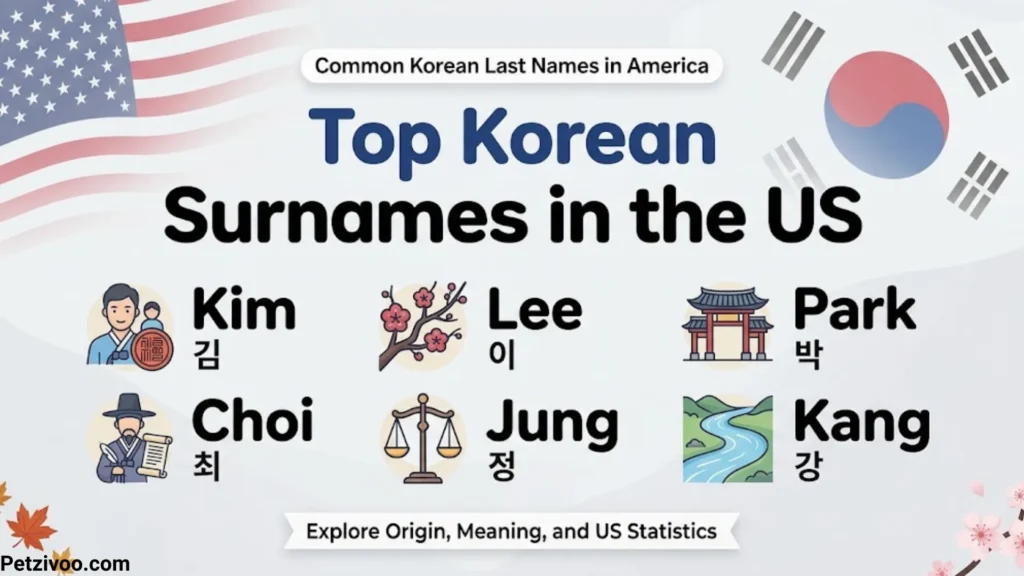
Common Korean last names in America include Kim, Lee, Park, Choi, Jung, Kang, Cho, and Yoon. These names are also widespread in South Korea and are familiar in Korean American communities.
However, South Korean census rankings should not be treated as exact rankings for the United States. American surname patterns are shaped by migration history, family preferences, and the spelling conventions used in official records.
Korean Surname Spelling Variations in the United States
Korean surnames may appear differently in English depending on romanization standards and family preferences.
- Kim and Gim: Both can represent 김.
- Lee and Yi: Both can represent 이.
- Park and Pak: Both can represent 박.
- Choi and Choe: Both can represent 최.
- Jung and Jeong: Both can represent 정.
- Yoo and Yu: Both can represent 유.
These variations can make genealogy searches more complicated. Someone researching an immigrant ancestor may need to search several spellings to locate older records.
The best approach is to begin with the surname shown on official documents and then compare immigration records, naturalization documents, family records, and any available Korean-language sources. Alternate spellings can be useful clues, but they should not be assumed to prove that two records belong to the same person.
How Korean Surnames Work
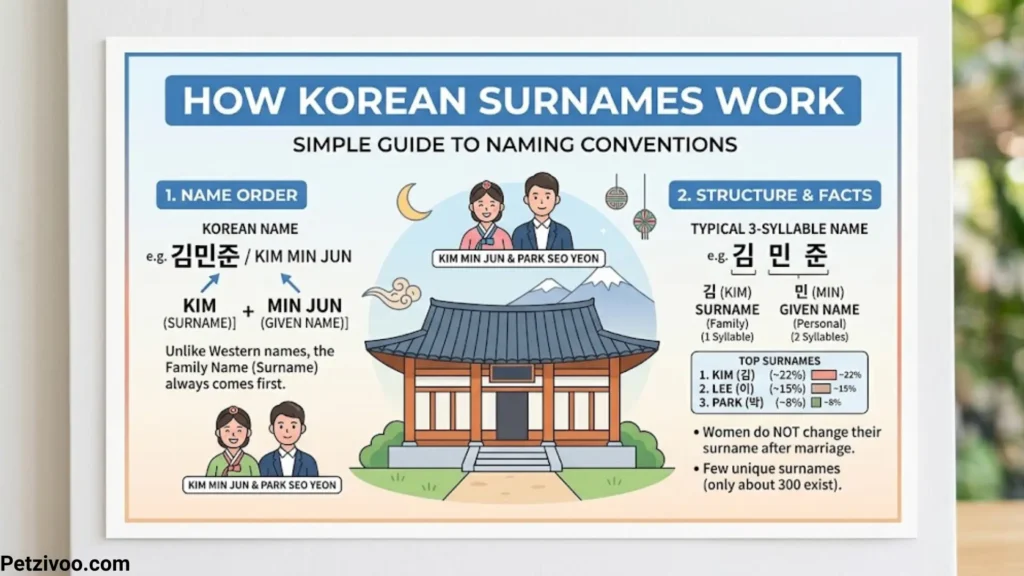
Understanding Korean naming traditions makes surname lists much more useful. Three important concepts are Hangul, Hanja, and bon-gwan.
Hangul and Hanja
Hangul is the standard Korean writing system. Hanja refers to Chinese characters historically used in Korean names.
For example, 김 is the Hangul spelling of Kim, while 金 is one commonly associated Hanja character. Because a Korean surname’s pronunciation can correspond to different characters, its exact meaning may require family-specific information.
Bon-Gwan and Family Lineage
Bon-gwan refers to a family’s ancestral origin or clan seat. Traditionally, it distinguishes lineages that share the same surname.
Two people named Kim may belong to different clans, while people from the same clan may share a recognized ancestral history. Bon-gwan can therefore be an important starting point for genealogy research.
Korean Surname Order
Korean names traditionally place the family name first, followed by the given name. In Kim Min-jun, for example, Kim is the surname and Min-jun is the given name.
Some English-language records reverse the order to match Western conventions. When comparing records, check the person’s actual family name rather than assuming that the final word is always the surname.
Are All Korean Surnames One Syllable?
Most familiar Korean surnames, including Kim, Lee, Park, and Choi, are one syllable in Korean. However, multisyllabic surnames also exist.
Namgung (남궁) and Hwangbo (황보) are examples of less common compound surnames. These names demonstrate that Korean surname traditions extend beyond the short names most frequently encountered.
Frequently Asked Questions
What Is the Most Common Korean Last Name?
Kim (김) is the most common Korean last name in South Korea. Commonly reported figures from the 2015 census place its share at approximately 21.5% of the population.
What Are the Top Three Korean Surnames?
The top three are Kim (김), Lee (이), and Park (박). Together, they accounted for approximately 44.6% of South Korea’s population in the 2015 census.
What Korean Last Names Are Used by Girls?
Girls generally use the same family surnames as boys. Common examples include Kim, Lee, Park, Choi, Jung, Kang, and Han.
What Are Some Rare Korean Last Names?
Gok, Gwok, Mangjeol, and Hwangmok are examples of uncommon surnames found in surname references. Exact population counts should be verified using census data.
Which Korean Surnames Have Royal Origins?
Kim, Park, and Seok are associated with royal lineages of Silla. Lee, especially the Jeonju Yi lineage, is associated with Joseon, while Wang was the surname of Goryeo’s royal house.
Do All People With the Same Korean Surname Belong to One Family?
No. Many unrelated or distantly related lineages can share a Korean surname. Hanja characters and bon-gwan can help distinguish family origins.
Why Is Lee Sometimes Written as Yi?
Lee and Yi are alternative romanized spellings of the Korean surname 이. The difference reflects historical spelling and romanization conventions.
How Can I Find the Origin of My Korean Last Name?
Start with the surname’s Hangul spelling, identify any known Hanja characters, and research the family’s bon-gwan. Historical documents and reliable genealogy sources can help confirm the family connection.
Conclusion
Common Korean last names reveal important details about Korean language, history, and family traditions. Kim, Lee, and Park are the most recognizable surnames, while Choi, Jung, Kang, Yoon, and many others contribute to the country’s diverse naming landscape.
Understanding these names requires more than translating a surname into English. Hanja characters can change a surname’s interpretation, romanization can produce different spellings, and bon-gwan can distinguish family lineages that share the same name. Royal associations also need to be considered in their historical context rather than treated as proof of modern ancestry.
If you are exploring Korean surnames for a family-history project, researching cultural traditions, or choosing a name for a fictional character, combining accurate spelling with historical context will give you a more meaningful understanding of Korean last names.

I am Noah Williams, an animal enthusiast and pet content creator who loves discovering creative ways to celebrate the bond between pets and their owners. I specialize in researching memorable pet names, naming trends, and meaningful ideas for dogs, cats, and other beloved animals.
I enjoy helping families choose names that are not only beautiful but also reflect their pet’s personality and unique qualities. My goal is to provide simple, inspiring, and practical naming advice for every type of pet owner.
My books include:
- The Ultimate Pet Names Encyclopedia
- Finding the Right Name for Your New Best Friend
 Isabella Carter