
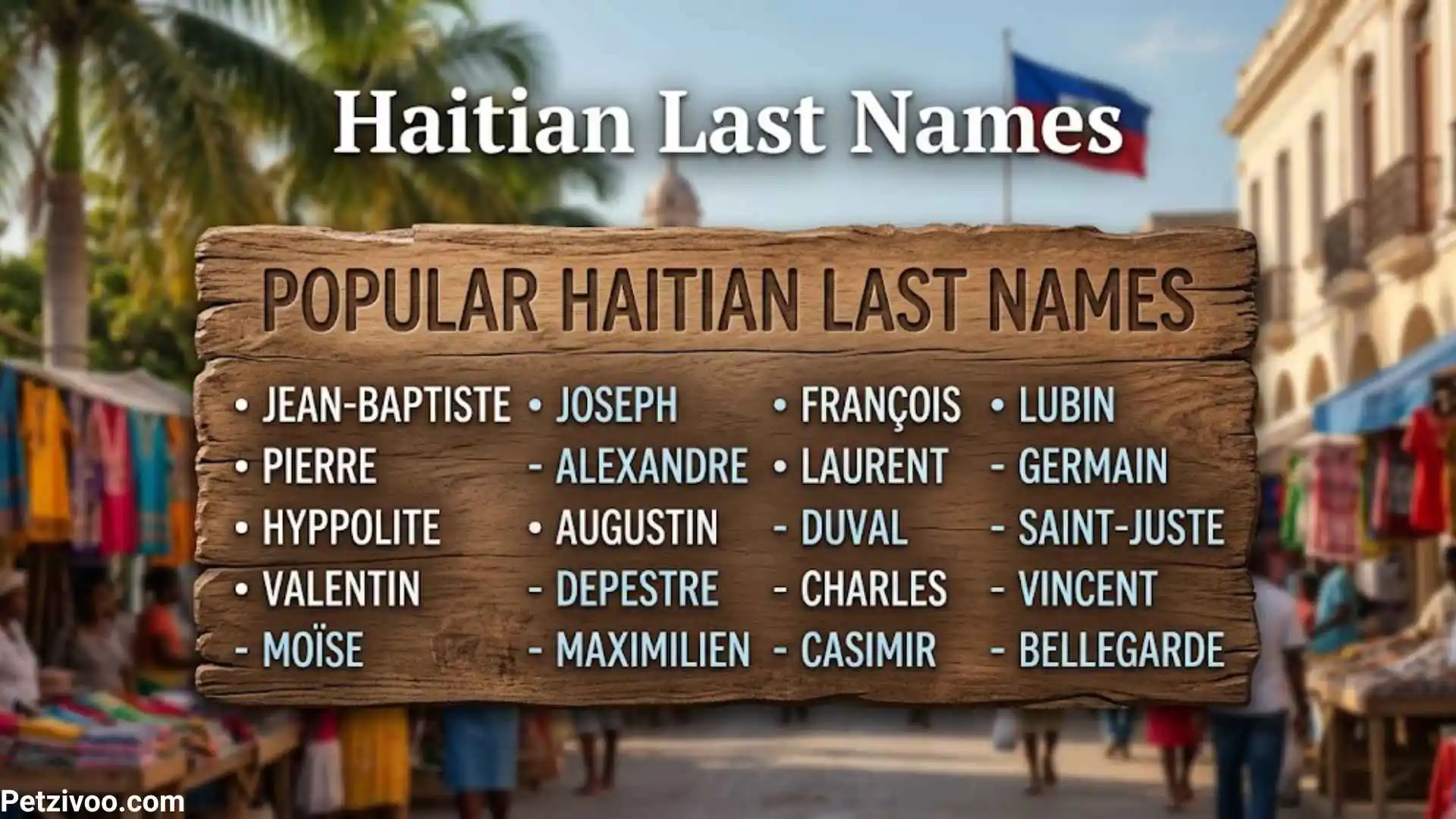
Haitian last names reflect a long history of French colonial rule, African heritage, migration, religion, and changing family traditions. Names such as Jean, Pierre, Joseph, Louis, and Charles are especially familiar in Haiti, while surnames such as Toussaint, Bien-Aimé, Fils-Aimé, and Saint-Fleur have distinctive linguistic or cultural associations.
If you’re researching your family tree, exploring Haitian heritage, writing a character, or searching for a meaningful surname, understanding these names can help you make a more informed choice. This guide covers common Haitian last names, their possible meanings, alphabetical examples, French influences, and practical ways to investigate a family’s history.
What Are Haitian Last Names?
Haitian last names are family names used in Haiti and among Haitian communities around the world. Many have French-language roots, while others reflect different linguistic influences and individual family histories.
Unlike first names, which parents generally select for a child, surnames are often inherited from previous generations. They can preserve family connections even when relatives move between Haiti, the United States, Canada, France, and other countries.
Some Haitian surnames are recognizable French personal names that also became family names. Jean, Pierre, Joseph, and Louis are examples. Others, including Bien-Aimé and Fils-Aimé, contain French words that express affection or family relationships.
However, a surname does not tell the complete story of a person’s identity. Two people with the same Haitian last name may come from entirely unrelated families, and the same surname can have different origins in different places.
The History and Origins of Haitian Surnames
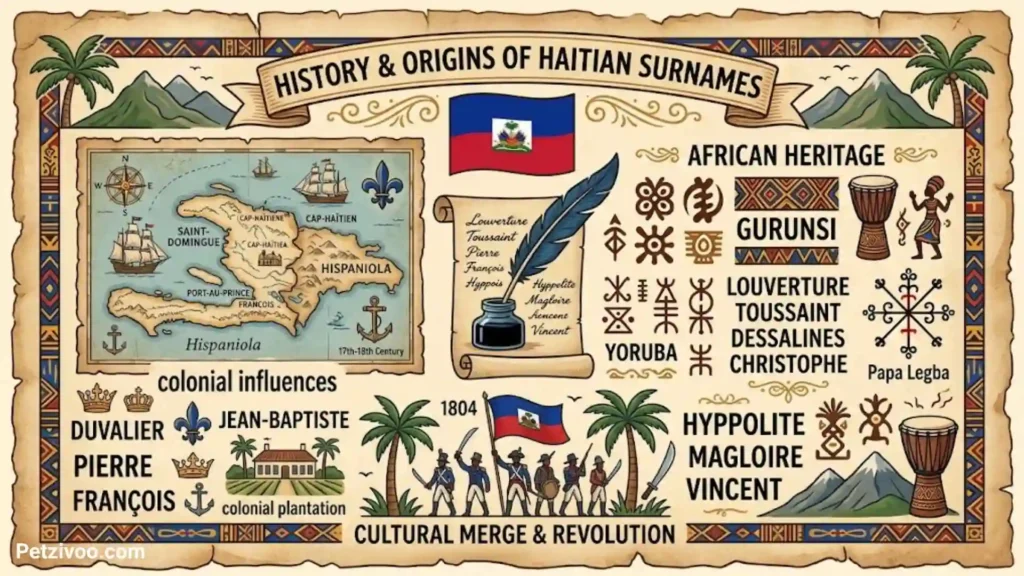
Haitian surnames developed within a complex historical setting. Before Haiti became independent in 1804, the territory was the French colony of Saint-Domingue. Colonialism, slavery, the Haitian Revolution, emancipation, and subsequent migration all influenced how names were recorded and passed down.
French Linguistic Influence
French has had a significant influence on Haitian surnames. Names such as Pierre, Antoine, François, Michel, and Toussaint are examples of French personal names that are also used as surnames.
The widespread use of these names does not mean every Haitian family has the same ancestry. It reflects historical naming practices and the ways names became established within Haitian communities.
African Heritage and Family History
Haitian culture has deep African roots. However, tracing an individual surname directly to a specific African language or ethnic group can be difficult, particularly when historical records are incomplete or names were changed during colonial and postcolonial periods.
Some surnames may preserve family-specific traditions or linguistic influences that are not immediately obvious from their modern spelling. Genealogical documents and family knowledge are often needed to investigate these connections.
Religious and Personal Names
Christian names and names associated with religious traditions also appear among Haitian surnames. For example, Toussaint comes from the French expression for All Saints’ Day, while Jean and Joseph have long-standing biblical and Christian associations.
These linguistic connections help explain a name’s background, but they do not prove that every family bearing it has a particular religious belief or history.
Most Common Haitian Last Names
Some surnames appear especially frequently in Haitian name databases. Forebears lists Jean, Pierre, Joseph, Louis, Charles, François, Paul, Michel, Étienne, and Augustin among Haiti’s leading surnames. Its figures are database estimates rather than a current official census ranking.
Here are familiar Haitian surnames and useful background on each.
| Haitian Last Name | Origin or Association | Meaning or Background |
| Jean | French | French form of John, associated with the meaning “God is gracious.” |
| Pierre | French | French form of Peter; related to the Greek word for rock or stone. |
| Joseph | Biblical and French-language tradition | From Joseph, a biblical personal name traditionally interpreted as “he will add.” |
| Louis | French and Germanic roots | Derived from a Germanic personal name associated with fame and battle. |
| Charles | French and Germanic roots | Derived from a personal name historically associated with a free man. |
| François | French | French form of Francis, traditionally associated with a Frenchman or a person from France. |
| Paul | Latin and Christian tradition | From Latin Paulus, meaning “small” or “humble.” |
| Michel | French | French form of Michael, meaning “Who is like God?” |
| Étienne | French | French form of Stephen, derived from a Greek word meaning “crown” or “wreath.” |
| Augustin | Latin and French tradition | Related to Augustine and the Latin name Augustus. |
| Antoine | French | French form of Anthony; its deeper etymology is debated. |
| Toussaint | French | Literally associated with All Saints’ Day. |
| Alexis | Greek through French | Related to a name meaning “helper” or “defender.” |
| Désir | French | Related to the French word for desire or longing. |
| Cadet | French | Literally associated with a younger son or younger person in a family. |
These explanations describe linguistic roots rather than guaranteed family histories. For example, the surname Pierre may have originated from a personal name or developed independently in another naming context. FamilySearch and other surname references provide more detailed discussions of individual names such as Toussaint.
Haitian Last Names and Meanings
Many Haitian surnames have meanings that can be understood through French, Latin, Greek, or biblical naming traditions. Others require historical evidence before a precise explanation can be established.
Here are additional examples worth exploring.
- Bien-Aimé — French; means “well-loved” or “beloved.” It is a distinctive compound surname with an affectionate meaning.
- Fils-Aimé — French; literally suggests “beloved son.” Its exact family history depends on the records available.
- Saint-Fleur — A French-language compound combining saint and fleur, meaning “flower.” The literal components do not establish the circumstances in which the surname originated.
- Baptiste — French form associated with Baptist, particularly the Christian name John the Baptist.
- Bastien — A French surname and personal-name form associated with Sébastien.
- Chéry — Associated with the French word chéri, meaning “dear” or “beloved.” The history of a particular family may differ.
- Noël — French for Christmas; it may also be associated with a personal name or a birth around the Christmas season.
- Salomon — French-language form of Solomon, a biblical name associated with peace.
- Placide — From a Latin-derived personal name associated with calmness or gentleness.
- Delva — A surname found in Haiti. Its exact etymology should be confirmed through a reliable surname dictionary or family records rather than inferred from spelling alone.
A useful rule is to distinguish a word’s dictionary meaning from a surname’s actual origin. A family may have carried a name for generations without knowing why it was first adopted.
Unique and Rare Haitian Last Names
Unique Haitian last names can be useful when researching a less familiar family line or choosing a surname for a fictional character. However, “rare” is relative: a name that is uncommon in one database or country may be well established in a particular Haitian community.
The following names offer a range of distinctive spellings and compound forms.
| Surname | Why It Stands Out | Research Note |
| Bien-Aimé | Distinctive French compound | The literal meaning is “well-loved.” |
| Fils-Aimé | Unusual compound structure | Its French components suggest “beloved son.” |
| Saint-Fleur | Memorable compound surname | Its components mean “saint” and “flower.” |
| Jean-Pierre | Compound personal-name form | A combination of Jean and Pierre; also established as a Haitian surname. |
| Jean-Baptiste | Compound Christian name | Combines Jean and Baptiste. |
| Saint-Louis | Religious and historical associations | A French compound involving the name Louis. |
| Louissaint | Distinctive joined spelling | May be related to French-language name elements, but family-specific evidence is needed. |
| Toussaint | Historical and religious associations | Connected with All Saints’ Day and found in Haiti and other French-speaking communities. |
These names are not all necessarily rare in Haiti. They are included because their forms are distinctive or their meanings are especially interesting. To establish actual rarity, consult a surname database with a defined geographic area and date.
Haitian Last Names by Letter
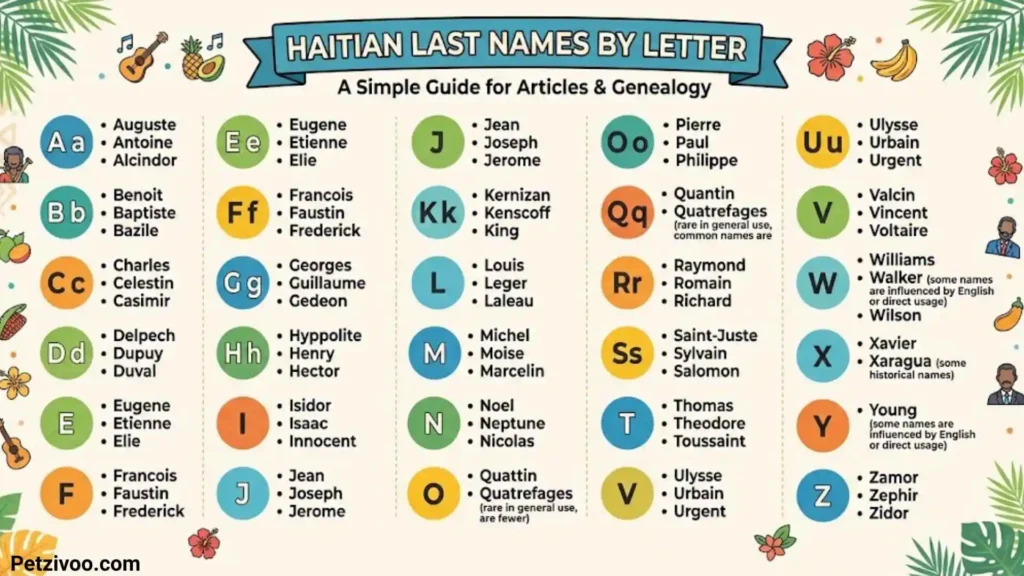
Alphabetical lists help readers find names quickly and support family-history research when the spelling of a surname is known.
Haitian Last Names Starting With B
- Baptiste — French-language surname associated with the Christian name Baptist.
- Bastien — Related to the French personal-name form Sébastien.
- Belizaire — A surname found in Haiti; the precise origin should be verified through a specialized reference.
- Bien-Aimé — French compound meaning “well-loved.”
- Blanc — French for “white”; it can have different historical explanations as a surname.
- Blaise — French personal-name form associated with Blaise and the Latin name Blasius.
Haitian Last Names With C
- Cadet — French surname associated with a younger son or younger person.
- Charles — A surname derived from a widely used personal name.
- Chéry — Related to a French word meaning “dear” or “beloved.”
- Chérubin — French-language form associated with the word “cherub,” a religious term.
- Civil — A surname found in Haiti; its precise origin should not be assumed from the English word alone.
- Colas — A surname that can be related to French forms of Nicolas, depending on the family line.
Haitian Last Names With D
- Désir — Related to the French word for desire or longing.
- Delva — A Haitian surname whose precise etymology needs family-specific or dictionary evidence.
- Ducasse — A surname associated with French-language naming traditions.
- Duclos — French surname generally associated with a place or topographic feature.
- Desir — A common unaccented spelling of Désir in records that omit French diacritics.
- Dumarsais — A distinctive surname associated with Haitian history and public life.
Haitian Last Names With J
- Jean — French form of John.
- Jean-Baptiste — Compound surname combining Jean and Baptiste.
- Jean-François — Compound French personal name used as a surname.
- Jean-Pierre — Compound name associated with the French forms of John and Peter.
- Joseph — A biblical personal name widely used as a surname.
- Jeanty — A surname found in Haiti and other French-influenced naming contexts; consult a specialist reference for its exact etymology.
- Julien — French personal name derived from Julian, also found as a surname.
Haitian Last Names With M
- Manigat — A distinctive Haitian surname associated with Haitian public history.
- Mathieu — French form of Matthew.
- Métayer — French surname historically associated with a sharecropper or tenant farmer.
- Michel — French form of Michael.
- Monestime — A surname found in Haitian communities; its exact origin should be researched rather than guessed.
- Moreau — French surname associated with a historical nickname, often connected with dark coloring, although individual origins can vary.
Haitian Last Names Starting With P
- Paul — Latin-derived Christian name used as a surname.
- Petit — French for “small” or “little”; it can have several surname origins.
- Pierre — French form of Peter, associated with a rock or stone.
- Philippe — French form of Philip, a name of Greek origin traditionally interpreted as “lover of horses.”
- Pierrot — A French diminutive associated with Pierre.
- Préval — A surname associated with Haitian public life; spelling and family history should be checked against records.
Alphabetical lists are a starting point, not a complete directory. If you’re researching an ancestor, consider searching accented and unaccented forms as well as spacing and hyphen variations.
French Haitian Last Names
French-language surnames are common in Haiti because of the country’s colonial history and the ways French personal names became established as family names.
Examples include:
- Lacroix — French for “the cross,” often associated with a place or a religious reference.
- Laguerre — Literally “the war” in French; its historical surname origin may involve a nickname or another naming context.
- Lamothe — A French surname often associated with a place name.
- Laurent — Derived from a Latin personal name associated with laurel.
- Moreau — A French surname with several possible historical explanations.
- Noël — French for Christmas and also a personal name.
- Toussaint — Connected to All Saints’ Day.
- Duclos — A French surname associated with a place or enclosed area.
A French-looking surname does not necessarily mean that a person has recent French ancestry. Names can persist through generations and cross national boundaries, particularly in the Caribbean and its diaspora.
Haitian Last Names for Men and Women
Haitian family names are generally not divided into separate male and female forms in the way that some other naming traditions distinguish surnames by gender.
For example, Jean, Pierre, Joseph, Chéry, and Bien-Aimé can be used as surnames by people of different genders. A woman’s surname does not automatically need a feminine ending simply because she is a woman.
This is an important distinction for anyone searching for “Haitian last names male” or “Haitian last names girl.” If the goal is to find names for a boy or a girl, the search may be about given names rather than family names.
For genealogy, use the surname recorded in the relevant civil, church, immigration, or family documents. Do not assume a person’s surname changed at marriage or that every family followed the same naming practice.
Haitian First Names vs. Last Names
Haitian first names and surnames can overlap. Jean, Joseph, Pierre, Michel, and Louis, for example, are recognizable French personal names that can also function as Haitian surnames.
First names are selected for an individual, while inherited surnames generally connect a person to a family line. The same spelling can therefore serve different roles depending on the person’s full name.
If you’re choosing a first name, consider examples such as:
- Girls’ names: Marie, Rose, Nadège, and Magalie.
- Boys’ names: Jean, Frantz, Jacques, and Emmanuel.
These are examples of given names used in Haitian communities, not a ranking of popularity. Usage varies by family, generation, language, religion, and personal preference.
A separate guide to Haitian first names and their meanings would be more useful for readers who specifically want boy names, girl names, or baby-name ideas.
How to Research a Haitian Family Name
Finding the history of a Haitian surname requires more than looking up a dictionary definition. The strongest conclusions come from connecting the surname to identifiable people and historical documents.
Start With Known Family Information
Write down the full names of parents, grandparents, and great-grandparents when known. Include birth dates, approximate locations, marriage information, and immigration destinations.
Even a broad location, such as a town or department in Haiti, may help distinguish one family from another.
Check Civil and Church Records
Search for birth, marriage, death, baptismal, and burial records where available. Older records may use French spellings, while later documents may omit accents or use different spacing.
Compare multiple documents rather than relying on a single entry.
Search Spelling Variations
Names such as François and Francois may appear differently depending on the record system. Compound names may also be written with spaces, hyphens, or joined forms.
Search for reasonable variations without assuming that every similar spelling represents the same family.
Use Surname Databases Carefully
Genealogy resources such as FamilySearch, Geneanet, and Forebears can help you identify possible origins, geographic distributions, and research leads. Their results may differ because they use different records, time periods, and methods.
A surname database can suggest a direction for research, but a family tree should be supported by evidence connecting each generation.
Frequently Asked Questions
What Is the Most Common Haitian Last Name?
Jean is listed as Haiti’s most common surname in the Forebears database, followed by Pierre and Joseph. Treat this as a database-based ranking rather than a current official census result.
What Are Some Popular Haitian Last Names?
Common examples include Jean, Pierre, Joseph, Louis, Charles, François, Paul, Michel, Étienne, Augustin, Antoine, and Toussaint. Their prevalence reflects long-standing naming traditions and historical influences.
Do Haitian Last Names Have French Origins?
Many Haitian surnames have French-language roots, but not every surname has one clearly established origin. Haiti’s history and population movements have shaped a more complex naming landscape.
Are Haitian Last Names Different for Men and Women?
Haitian surnames are generally shared across genders rather than routinely taking separate masculine and feminine forms. Individual family practices and official records should guide genealogical research.
What Are Some Rare Haitian Last Names?
Bien-Aimé, Fils-Aimé, Saint-Fleur, and Jean-François are distinctive examples. Whether a surname is genuinely rare depends on the location, population, and records being examined.
Can a Haitian Surname Reveal Your Ancestry?
A surname can provide clues about language, historical naming practices, or possible family connections. It cannot independently prove ethnicity, nationality, or descent from a particular ancestor.
Conclusion
Haitian last names offer valuable clues about the country’s language, history, and family traditions. Familiar names such as Jean, Pierre, Joseph, and Louis sit alongside distinctive compounds such as Bien-Aimé, Fils-Aimé, and Saint-Fleur.
Understanding their meanings is a useful first step, but a surname’s dictionary definition is not the same as a family’s documented history. For anyone exploring Haitian ancestry, combining surname references with civil records, family documents, and oral histories offers a more reliable path to understanding where a name came from.

I am Amelia Parker, a dedicated pet lover and creative writer who enjoys helping pet owners find names that perfectly match their furry companions. I have a passion for exploring unique, adorable, and meaningful pet names inspired by personality, appearance, nature, and popular culture.
I believe every pet has a special story, and choosing the right name is one of the first ways owners create a strong connection with their animals. Through my research and writing, I share fresh ideas and helpful guides that make naming pets easier and more enjoyable.
My books include:
- The Perfect Pet Name Collection: Ideas for Every Furry Friend
- Amazing Animal Names: Creative Inspiration for Pet Lovers
 Noah Williams
 Isabella Carter