
Chinese last names offer a fascinating look at family history, language, and cultural traditions. Many Chinese surnames have been passed down for centuries, while others reflect ancient states, royal families, occupations, places, or historical events. Some are familiar worldwide, including Wang, Li, Zhang, and Chen.
The most common Chinese last names are generally short, often written with one Chinese character, and inherited by people regardless of gender. However, their English spellings can vary depending on dialect, romanization system, and family migration history.
This guide explores common Chinese last names and meanings, historical royal surnames, uncommon family names, and naming patterns among Chinese communities in the United States and the Philippines.
What Are Common Chinese Last Names?
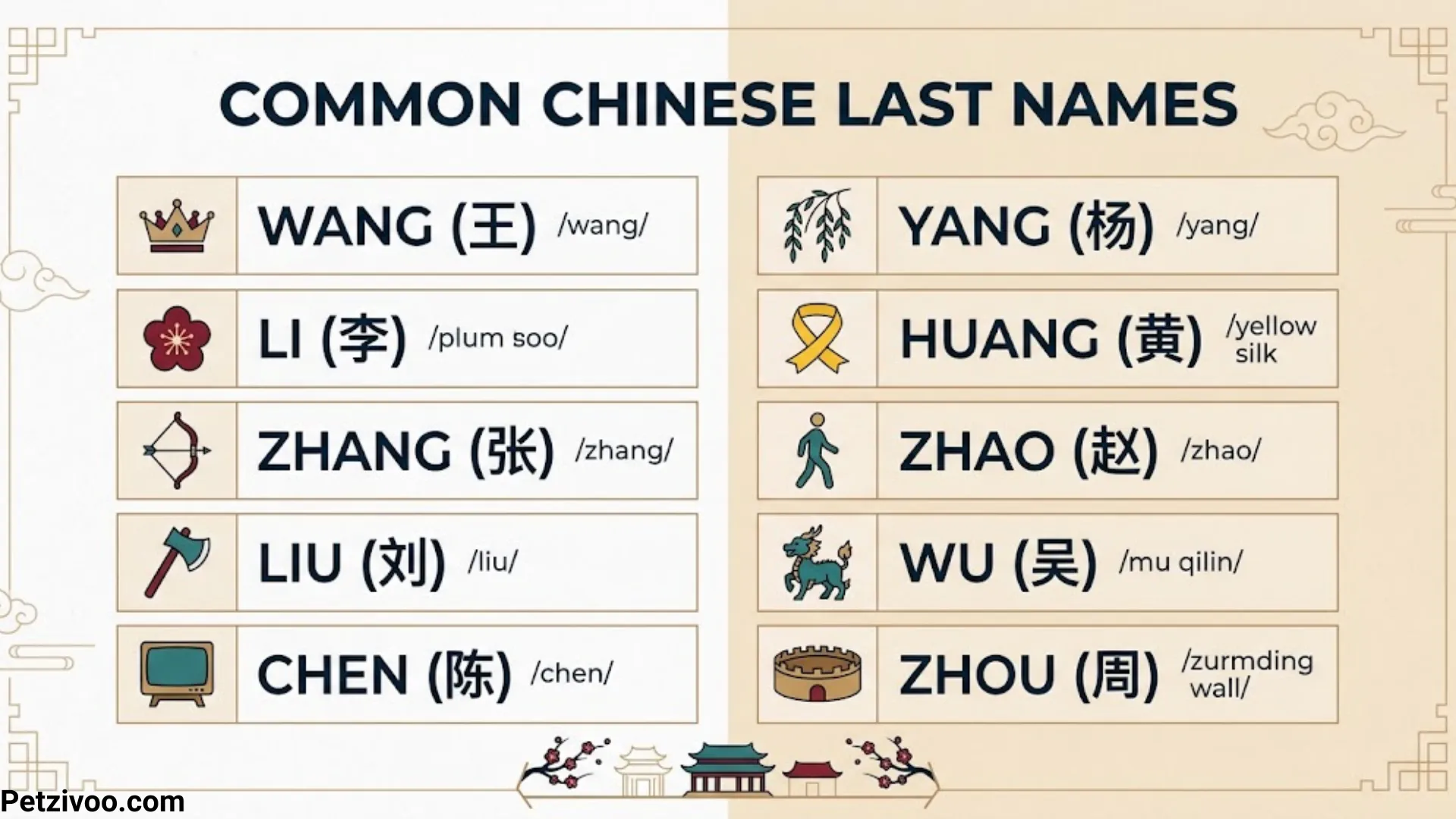
Common Chinese last names are family names shared by large numbers of people in China and Chinese communities around the world. Wang (王), Li (李), Zhang (张), Liu (刘), and Chen (陈) are among the best-known examples.
Chinese surnames generally appear before given names. For example, in the name Wang Xiaoming (王小明), Wang is the family name and Xiaoming is the given name.
China has thousands of documented surnames, but a relatively small group accounts for a substantial proportion of the population. The traditional Hundred Family Surnames, known as Bǎijiāxìng (百家姓), is a famous historical text that lists hundreds of family names. It was compiled during the Song dynasty and was used as a traditional literacy primer. Its sequence reflects historical and cultural circumstances, not a modern population ranking.
Today, surname frequency depends on the population and dataset being considered. Rankings in mainland China may differ from those among Chinese Americans, Chinese Filipinos, and overseas Chinese communities.
Most Common Chinese Last Names and Their Meanings
Many Chinese surnames are associated with ordinary words, ancient kingdoms, family lineages, or historical titles. The meaning of a character can provide a useful clue, but it does not always establish the exact origin of a particular family.
Here are some widely recognized Chinese last names and their commonly associated meanings or historical connections.
| Chinese Last Name | Character | Meaning or Historical Association |
| Wang | 王 | King; also associated with ancient royal lineages |
| Li | 李 | Plum or plum tree |
| Zhang | 张 | To stretch, open, or draw out |
| Liu | 刘 | An ancient surname with historical and character-related interpretations |
| Chen | 陈 | An ancient state; the character can also mean to arrange or display |
| Yang | 杨 | Poplar tree |
| Huang | 黄 | Yellow |
| Zhao | 赵 | Ancient state and prominent historical surname |
| Wu | 吴 | Associated with the ancient state of Wu |
| Zhou | 周 | Associated with the Zhou dynasty; the character also has meanings such as surrounding or complete |
| Xu | 徐 | Associated with an ancient state and lineage |
| Sun | 孙 | Grandchild or descendant |
| Ma | 马 | Horse |
| Zhu | 朱 | Vermilion or reddish color |
| Hu | 胡 | Has several historical and linguistic associations |
| Guo | 郭 | Outer city wall |
| He | 何 | A common surname with several historical explanations |
| Lin | 林 | Forest or grove |
| Gao | 高 | High or tall |
| Luo | 罗 | A character with historical and lexical meanings including a type of net |
These are useful starting points rather than definitive genealogical explanations. For example, Wang literally means “king” as a Chinese word, but a modern Wang family does not necessarily descend from royalty. Similarly, Li is associated with the plum tree, yet individual Li family branches may have different historical origins.
Other common Chinese surnames include Zheng (郑), Liang (梁), Xie (谢), Song (宋), Tang (唐), Xu (许), Han (韩), Feng (冯), Deng (邓), Cao (曹), Peng (彭), and Cai (蔡).
Why Chinese Surname Meanings Can Be Complicated
Chinese surnames developed through different historical processes. Some originated from ancient states or territories, while others came from noble titles, official positions, clan names, or changes in family identity.
Romanization adds another layer of complexity. Chen and Chan, for example, can represent the surname 陈 in different pronunciation systems. The spellings Wang and Wong can also correspond to the character 王 in different linguistic contexts.
Therefore, the Chinese character, ancestral location, family records, and historical spelling are often more useful for genealogy than an English spelling alone.
Royal Chinese Surnames and Their Historical Origins
China’s imperial history includes many ruling families, so there is no single surname that represents every Chinese royal lineage. Different dynasties had different ruling surnames, some of which remain very common today.
Here are notable examples.
| Surname | Chinese Character | Historical Connection |
| Ji | 姬 | The royal house of the Zhou dynasty |
| Ying | 嬴 | The ruling lineage associated with the Qin dynasty |
| Liu | 刘 | The imperial family of the Han dynasty |
| Li | 李 | The imperial family of the Tang dynasty |
| Zhao | 赵 | The ruling family of the Song dynasty |
| Zhu | 朱 | The imperial family of the Ming dynasty |
| Yang | 杨 | The imperial family of the Sui dynasty |
| Sima | 司马 | A compound surname associated with the Jin dynasty’s ruling family |
| Aisin Gioro | 爱新觉罗 | The Manchu imperial clan of the Qing dynasty |
The last example is particularly important: Aisin Gioro is a Manchu clan name, not an ordinary single-character Han Chinese surname.
Are Common Chinese Last Names Associated With Royalty?
Some common Chinese last names have important imperial associations. Liu, Li, Zhao, Zhu, and Yang, for instance, were used by ruling families during particular dynasties.
However, historical association is not proof of direct descent. These surnames spread through generations, migrations, adoption, changes in family identity, and other historical circumstances. Millions of people share these names without necessarily having any connection to an imperial family.
The traditional Hundred Family Surnames also begins with Zhao, Qian, Sun, and Li. Its opening sequence reflects historical circumstances surrounding its compilation rather than a current ranking of the most common surnames.
Common Chinese Last Names for Males and Females
Chinese family names generally do not have separate male and female forms. A person with the surname Wang uses Wang whether that person is a man or a woman.
This differs from naming traditions in some cultures where surnames change according to gender or marital status. In ordinary Chinese naming conventions, the family surname remains the same.
Common Chinese Last Names for Males
Examples of common surnames used by Chinese men include:
- Wang (王)
- Li (李)
- Zhang (张)
- Liu (刘)
- Chen (陈)
- Yang (杨)
- Huang (黄)
- Zhao (赵)
- Wu (吴)
- Zhou (周)
These names are not exclusively male. They are inherited family names used by people of different genders.
Common Chinese Last Names for Females and Girls
The same surnames are used by Chinese women and girls. Examples include Wang, Li, Zhang, Chen, Lin, Xu, Huang, and Yang.
When someone searches for common Chinese last names for girls, it is important to distinguish family names from given names. Names such as Meilin, Xiaoyu, and Yating may be used as given names, depending on the characters selected, but they should not automatically be treated as surnames.
A surname alone does not determine a person’s gender. The given name, Chinese characters, and personal context may provide additional information, but naming conventions vary.
Uncommon and Least Common Chinese Last Names
Not every Chinese surname consists of a single character. Some families have compound surnames written with two or more Chinese characters. These surnames can be less familiar to readers outside Chinese-speaking communities.
Examples include:
| Surname | Chinese Characters | Background |
| Ouyang | 欧阳 | A well-known compound surname with historical clan associations |
| Sima | 司马 | Historically associated with an official title and prominent lineages |
| Zhuge | 诸葛 | A compound surname famous through historical figures such as Zhuge Liang |
| Shangguan | 上官 | A historical compound surname associated with ancient titles and lineages |
| Situ | 司徒 | Historically connected with an official title |
| Murong | 慕容 | Associated with historical northern Chinese and Xianbei lineages |
| Tuoba | 拓跋 | Associated with the ruling clan of the Northern Wei dynasty |
These surnames are distinctive examples, but they should not all be described as equally rare. Some have well-documented historical significance, and their present-day frequency varies.
What Are the Least Common Chinese Last Names?
There is no single reliable answer without defining the population, time period, and data source. A surname that is uncommon nationwide may be more familiar in a particular region or among descendants of a specific clan.
For family-history research, an unusual surname may be especially valuable because it can help narrow a search to a particular ancestral location or historical record. However, rarity alone does not prove that two families with the same surname are closely related.
Researchers should also consider alternate characters, traditional and simplified Chinese forms, and regional romanizations before concluding that a surname is rare.
Most Common Chinese Last Names in America and the US
Chinese American surnames reflect immigration from different regions of China and the wider Chinese-speaking world. As a result, the English spellings used in the United States do not always match Mandarin pinyin.
Recognizable Chinese-derived surnames in the United States include:
| English Surname | Possible Chinese Character | Notes |
| Lee | 李, among other possibilities | May reflect different Chinese or other East Asian surname traditions |
| Chen | 陈 | Common Mandarin pinyin spelling |
| Wang | 王 | Common Mandarin pinyin spelling |
| Wong | 王, among other possibilities | Often associated with Cantonese romanization |
| Lin | 林 | Common Mandarin pinyin spelling |
| Huang | 黄 | Common Mandarin pinyin spelling |
| Liu | 刘 | Common Mandarin pinyin spelling |
| Yang | 杨 | Common Mandarin pinyin spelling |
| Zhang | 张 | Common Mandarin pinyin spelling |
| Wu | 吴 | Common Mandarin pinyin spelling |
These examples illustrate familiar surnames rather than a verified current ranking of Chinese American surnames.
Why Chinese American Surnames Have Different Spellings
Chinese immigrants arrived in the United States from regions with different languages and dialects. Families also retained spellings recorded on historical immigration documents, legal papers, and other official records.
For example, Chen and Chan may represent the same Chinese character in different romanization systems. Wang and Wong can likewise be related to 王, although surname spellings can have more than one origin.
The US Census records surnames and demographic information, but surname spelling alone does not establish a person’s ethnicity. Some spellings are shared across multiple cultural and linguistic traditions.
For accurate research, distinguish between a general list of common surnames in China and a statistical ranking of surnames among Chinese Americans. Census year, ethnicity definitions, and spelling variations can change the results.
Common Chinese Last Names in the Philippines
Chinese surnames are also familiar in the Philippines, where Chinese Filipino communities have long-standing family and cultural connections. Many Chinese Filipino surnames reflect southern Chinese linguistic traditions, particularly Hokkien, rather than Mandarin pinyin alone.
Examples include:
| Surname | Possible Chinese Character | Naming Context |
| Tan | 陈 | Common Hokkien-derived spelling |
| Lim | 林 | Commonly associated with 林 |
| Sy | 施 | A familiar Chinese Filipino surname spelling |
| Uy | 黄 | Commonly associated with 黄 |
| Co | 许 | A spelling found in Chinese Filipino naming traditions |
| Chua | 蔡 | Commonly associated with 蔡 |
| Ong | 王 | A spelling associated with 王 in some southern Chinese traditions |
| Go | 吴 | Commonly associated with 吴 |
| Lao | 刘 | A spelling found in Chinese Filipino communities |
| Lee | 李 | A widespread spelling with more than one possible origin |
These character associations are common examples, not universal rules. The same Latin spelling may represent different Chinese characters, depending on the family and the language used by its ancestors.
How Chinese Filipino Surnames Differ From Mainland Chinese Names
Chinese Filipino families may use a Chinese surname alongside a Spanish-derived, English, or Filipino given name. Their surnames may also reflect historical romanization systems that differ from those used in modern mainland China.
For example, Tan may correspond to 陈, while Mandarin pinyin renders that character as Chen. Neither spelling is automatically more authentic; each reflects a different linguistic and historical context.
When researching a Chinese Filipino family, check older documents, relatives’ records, ancestral hometowns, and the Chinese characters associated with the surname whenever possible.
How Chinese Last Names Work
Understanding the basic structure of Chinese names makes surname research more accurate.
Family Name Usually Comes First
In standard Chinese name order, the surname appears before the given name. For example, in Zhang Wei (张伟), Zhang is the family name and Wei is the given name.
In English-language settings, some people reverse the order or use a Western-style given name first. Always consider how the individual presents their own name.
Most Chinese Surnames Use One Character
Many familiar surnames, including Wang, Li, Chen, and Zhang, use one Chinese character. Compound surnames such as Ouyang and Sima use more than one.
The number of characters does not determine a surname’s importance, age, or authenticity.
Traditional and Simplified Characters May Differ
Some surnames have different traditional and simplified written forms. For example, 陈 is the simplified form of 陳, while 刘 is the simplified form of 劉. The romanized surname may remain Chen or Liu in both cases.
When tracing historical records, checking both forms can help locate documents from different periods or regions.
How to Research a Chinese Family Surname
If you are researching your own family history, start with the surname’s Chinese characters if they are available. Then gather older spellings, ancestral hometown information, immigration records, family documents, and the names of relatives from earlier generations.
Do not assume that every person with the same surname belongs to one extended family. Many unrelated lineages share common Chinese surnames. A reliable family history depends on records and documented relationships, not surname meaning alone.
Frequently Asked Questions
What Are the Most Common Chinese Last Names?
Wang, Li, Zhang, Liu, and Chen are among the most common Chinese surnames. Their exact rankings depend on the population and dataset being used.
What Do Common Chinese Last Names Mean?
Some familiar examples include Wang, meaning king; Li, associated with the plum tree; Yang, associated with the poplar tree; Ma, meaning horse; and Lin, meaning forest. A character’s literal meaning does not necessarily establish a family’s precise historical origin.
Are Chinese Last Names Different for Males and Females?
Generally, no. Chinese family surnames are usually inherited in the same form by men and women. Given names, rather than surnames, are more likely to differ between individuals.
What Are Some Chinese Last Names Associated With Royal Families?
Ji, Ying, Liu, Li, Zhao, Zhu, and Yang are associated with different historical ruling families. A surname’s royal history does not prove that a modern bearer descends from an emperor.
What Are Some Uncommon Chinese Last Names?
Ouyang, Sima, Zhuge, Shangguan, Murong, and Tuoba are examples of distinctive or compound surnames with historical associations. Their current frequency varies, so they should not automatically be described as the rarest Chinese surnames.
Are Chinese American Last Names Different From Chinese Last Names in China?
The surnames themselves may overlap, but English spellings can differ because of dialects, romanization, immigration history, and family preferences. For example, Chen and Chan may represent the same character in different linguistic contexts.
Why Are Tan, Lim, and Sy Common Chinese Filipino Surnames?
These spellings reflect Chinese Filipino naming traditions, often associated with southern Chinese languages such as Hokkien. The precise Chinese character should be confirmed for each family rather than inferred from the spelling alone.
Conclusion
Common Chinese last names connect modern families with a long history of language, migration, and cultural traditions. Wang, Li, Zhang, Chen, and Liu are widely recognized examples, while surnames such as Ouyang, Sima, and Zhuge illustrate the variety of Chinese family names.
Historical royal surnames provide another perspective, but a shared name does not prove noble ancestry. Similarly, Chinese American and Chinese Filipino surname spellings often reflect different regional languages and immigration histories.
Whether you are exploring genealogy, researching Chinese culture, or choosing a surname for a fictional character, the best starting point is to understand the written characters, historical context, and regional variations behind each name.

I am Noah Williams, an animal enthusiast and pet content creator who loves discovering creative ways to celebrate the bond between pets and their owners. I specialize in researching memorable pet names, naming trends, and meaningful ideas for dogs, cats, and other beloved animals.
I enjoy helping families choose names that are not only beautiful but also reflect their pet’s personality and unique qualities. My goal is to provide simple, inspiring, and practical naming advice for every type of pet owner.
My books include:
- The Ultimate Pet Names Encyclopedia
- Finding the Right Name for Your New Best Friend
 Amelia Parker
 Isabella Carter