
Ukrainian last names offer clues about family history, traditional occupations, personal names, and the languages spoken across Ukraine and neighboring regions. Some surnames are widely recognized, such as Shevchenko, Melnyk, and Kovalenko, while others are less common or reflect particular regional traditions.
Many Ukrainian surnames developed from the names of ancestors, occupations, nicknames, or places. Their spellings can also vary when Ukrainian names are written in English. Understanding these patterns makes it easier to explore Ukrainian family names, discover their possible meanings, and research your ancestry.
This guide covers common Ukrainian last names, male and female surname forms, old and rare surnames, alphabetical examples, and Jewish Ukrainian family names.
What Are Ukrainian Last Names?
Ukrainian last names are inherited family names used to identify individuals and connect generations. They developed over time through naming customs, local languages, occupations, personal names, and historical administrative practices.
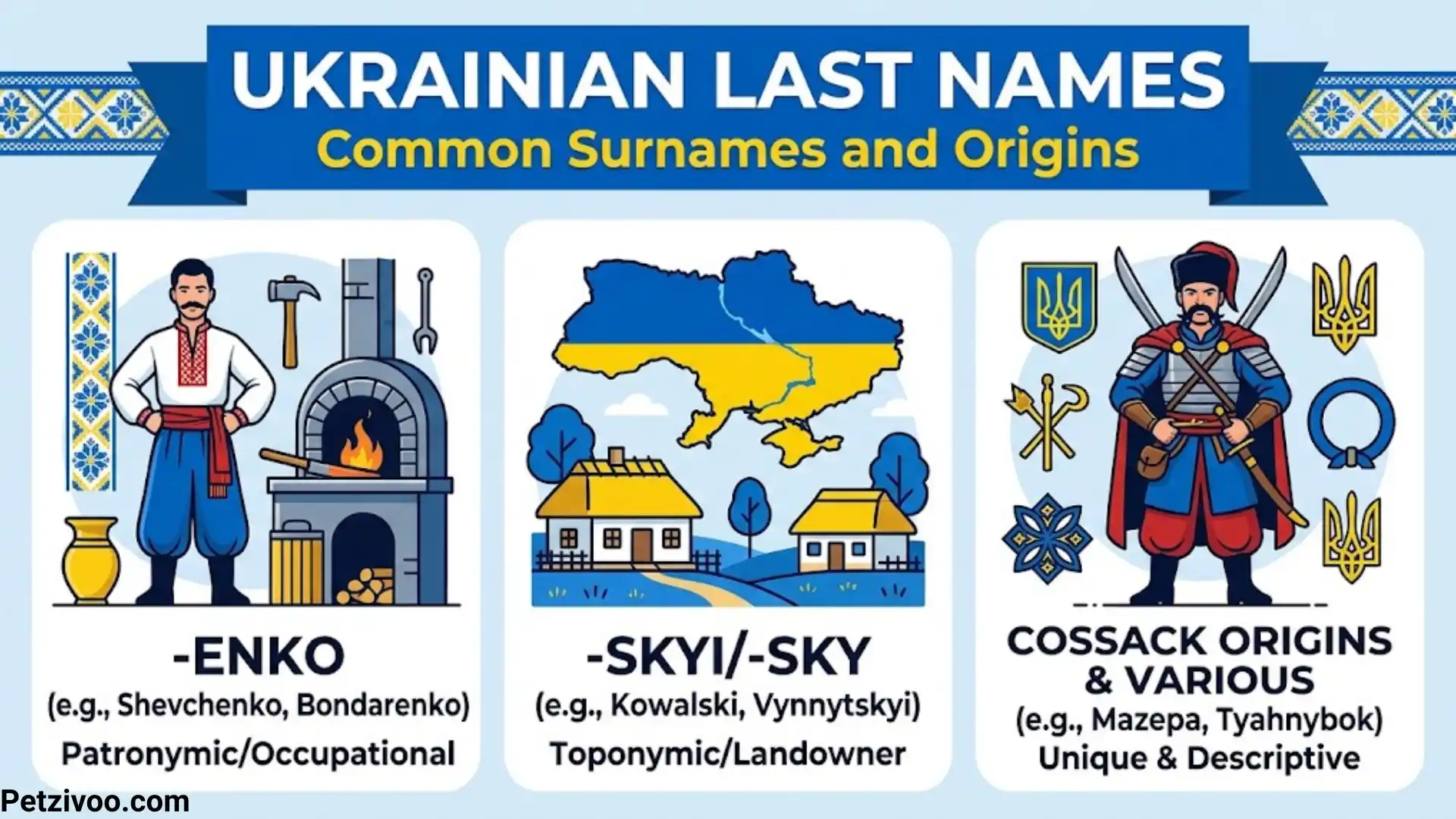
Many recognizable Ukrainian surnames end in -enko, -uk, -chuk, or -skyi. However, Ukrainian naming traditions are diverse, and some surnames have forms that also occur in Russian, Polish, Belarusian, Jewish, or other regional traditions.
How Ukrainian Surnames Developed
Ukrainian surnames can reflect several different sources:
- Occupations: Melnyk is associated with a miller, while Bondar refers to a cooper, a person who makes or repairs wooden barrels.
- Ancestral names: Many surnames developed from a father’s name or another ancestor’s personal name.
- Nicknames: Names could originate from physical characteristics, personality descriptions, animals, or familiar expressions.
- Regional identities: Some surnames reflect connections to a locality, landscape, or community.
- Historical influences: Ukrainian, Polish, Russian, Yiddish, German, and other languages have influenced the surnames found in the region.
These categories can overlap. A surname may have more than one possible origin, and its modern spelling does not always reveal how it first developed.
Common Ukrainian Surname Endings
These are useful linguistic clues, not definitive proof of ancestry.
| Surname Ending | Examples | General Pattern |
| -enko | Shevchenko, Kovalenko | Often associated with family or descendant-name formation |
| -uk / -yuk | Kravchuk, Romanyuk | Common in several Ukrainian regional naming traditions |
| -chuk | Kovalchuk, Shevchuk | Often associated with patronymic or family-name formation |
| -skyi / -sky | Zaliznytskyi, Ostrovsky | May indicate a place, association, or other historical relationship |
| -ovych / -evych | Ivanovych, Petrovych | Common in patronymics and related name formations |
The meanings of these endings depend on the name’s linguistic and historical context. A suffix should not be interpreted as having one fixed meaning in every surname.
Common Ukrainian Last Names and Meanings
Some of the best-known Ukrainian surnames developed from traditional trades, personal names, and familiar descriptive words. OpenHeritage’s surname map, based on population and burial records, lists Shevchenko, Melnyk, Kovalenko, Bondarenko, and Ivanov among the country’s most frequent surnames in its dataset.
Here are common Ukrainian last names and their commonly reported meanings.
| Last Name | Commonly Reported Meaning or Origin |
| Melnyk | Miller; associated with operating a grain mill |
| Shevchenko | Traditionally associated with a shoemaker and a descendant or family connection |
| Kovalenko | Derived from koval, meaning smith or blacksmith |
| Bondarenko | Associated with a bondar, or cooper who makes wooden barrels |
| Tkachenko | Associated with tkach, meaning weaver |
| Kravchenko | Associated with kravets, meaning tailor |
| Kovalchuk | Related to koval, meaning blacksmith |
| Koval | Blacksmith or smith |
| Shevchuk | Related to the traditional shoemaking occupation |
| Boyko | Associated with the Boyko ethnographic group of the Carpathian region |
| Lysenko | Commonly linked to a nickname derived from lys, meaning bald |
| Moroz | Means frost; also associated with a personal name or nickname |
| Bondar | Cooper, a maker of wooden barrels |
| Oliynyk | Traditionally associated with producing or selling oil |
| Tkach | Weaver |
| Kovalchuk | A family name associated with a blacksmith |
| Popovych | Traditionally a descendant or son of a priest |
| Kravets | Tailor |
| Kozak | Cossack; associated with the historical Cossack communities |
| Mazur | A regional or ethnonymic surname associated with Mazovia or a Mazur |
Note: These are general etymological explanations, not guaranteed definitions of every family’s surname. Individual family histories can differ.
More Popular Ukrainian Surnames
Other recognizable names include:
- Pavlenko — traditionally associated with the personal name Pavlo.
- Petrenko — commonly linked to Petro, the Ukrainian form of Peter.
- Marchenko — often associated with the personal name Mark or a related form.
- Lysenko — commonly linked to a descriptive nickname.
- Rudenko — may be associated with a personal or descriptive root.
- Savchenko — commonly linked to a personal name or its familiar form.
- Havryliuk — associated with the personal name Havrylo.
- Kuzmenko — often connected with the personal name Kuzma.
- Romanenko — commonly associated with the name Roman.
- Humenyuk — a surname found in Ukrainian surname records.
These examples illustrate why Ukrainian surnames are useful for family-history research: some preserve traces of occupations, while others point toward the personal names used by earlier generations.
Ukrainian Last Names for Men and Women
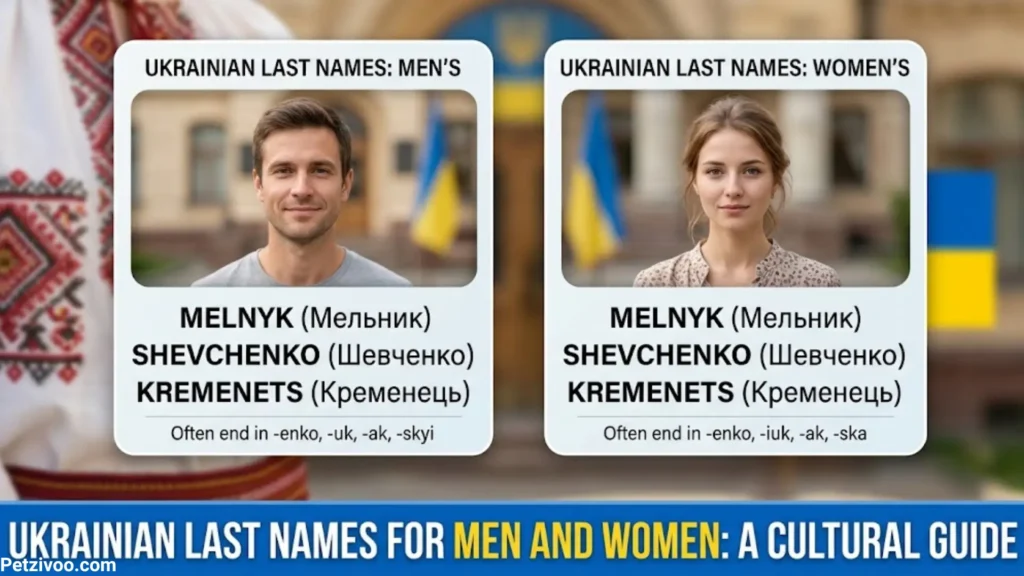
Ukrainian surname forms do not always work the same way as English surnames. Some Ukrainian family names have masculine and feminine forms, while others remain unchanged regardless of gender.
For example, surnames ending in -skyi may have a feminine form ending in -ska. By contrast, many surnames ending in -enko or -chuk are commonly used in the same form by men and women.
Ukrainian Male Last Names
Examples of masculine surname forms include:
- Shevchenko — associated with traditional shoemaking.
- Kovalenko — associated with a blacksmith.
- Bondarenko — associated with a cooper.
- Melnyk — miller.
- Kravchuk — associated with tailoring.
- Petrenko — commonly associated with the personal name Petro.
- Havryliuk — associated with the personal name Havrylo.
- Kravets — tailor.
- Boyko — associated with a regional ethnographic identity.
- Zelenskyi — a surname with a locational or descriptive formation.
These are examples of surnames used by men, not a list of names that only men can possess.
Ukrainian Female Last Names
Some surnames have feminine grammatical forms, particularly names ending in -skyi or related adjective-like endings.
| Masculine Form | Feminine Form |
| Zelenskyi | Zelenska |
| Shevchuk | Shevchuk |
| Kovalenko | Kovalenko |
| Melnyk | Melnyk |
| Shevchenko | Shevchenko |
| Ostrovskyi | Ostrovska |
The examples show two patterns: some names change their endings, while others remain the same.
In English-language records, gendered endings may be simplified, omitted, or inconsistently transliterated. Therefore, a surname’s spelling in an American document may not fully reflect its traditional Ukrainian form.
Ukrainian Last Names for Girls
Readers searching for Ukrainian last names for girls may be looking for a character name, a family-history reference, or a surname that sounds distinctive.
Some examples with feminine forms include:
- Zelenska — feminine form of Zelenskyi.
- Ostrovska — feminine form of Ostrovskyi.
- Shevchenko — a surname used by women and men.
- Kovalenko — used by women and men.
- Melnyk — used by women and men.
- Kravchuk — used by women and men.
For an authentic choice, consider whether you want a traditional Ukrainian spelling, an English transliteration, or a surname that works naturally in an English-language story.
Old, Rare, and Unique Ukrainian Surnames
Old Ukrainian surnames can preserve evidence of earlier occupations, local communities, personal names, and descriptive expressions. However, an old-sounding name is not necessarily ancient, and a rare name is not automatically historically significant.
Old Ukrainian Surnames
The following surnames have traditional linguistic or occupational associations:
| Surname | Historical Association |
| Koval | The traditional occupation of a blacksmith |
| Bondar | The craft of making wooden barrels |
| Tkach | The weaving trade |
| Kravets | The tailoring trade |
| Melnyk | Milling grain |
| Kozak | Cossack communities and their historical identity |
| Popovych | A family connection associated with a priest |
| Moroz | Frost or a personal name derived from the same word |
| Kuts | A surname with regional and potentially multiple linguistic origins |
| Mazur | A regional or ethnonymic association |
These surnames are historically informative, but their presence does not establish a family’s exact age. To determine when a particular family first used a name, researchers need documentary evidence such as church registers, civil records, or archival material.
Rare Ukrainian Surnames
Rare Ukrainian surnames can be especially interesting to genealogists because their distribution may be concentrated in particular areas or among descendants of a smaller family group.
Examples worth investigating include:
- Shmandura — documented in Ukrainian-Jewish linguistic and cultural research.
- Tantsiura — a surname documented in the same regional context.
- Zhvavy — another surname mentioned in research on Ukrainian and Jewish naming traditions.
- Bormashenko — a Jewish surname formed according to Ukrainian surname patterns, with a specific historical linguistic explanation.
- Liberchuk — a surname discussed in research on Ukrainian-Jewish naming, associated with the personal name Liber.
- Shaiuk — a surname discussed in the same research and linked to the personal name Shaia.
These examples are documented in research on Ukrainian and Yiddish language contact, including names shared across communities.
Their inclusion here does not mean each is rare nationwide today. Rarity changes by region and dataset, so anyone seeking a genuinely uncommon surname should check a reliable surname-distribution resource.
Unique Ukrainian Last Names
If you are looking for Ukrainian last names that stand out, consider the following:
- Zaliznytskyi — a surname form associated linguistically with zaliznytsia, the Ukrainian word for railway.
- Tovstonoh — a compound surname whose elements are associated with the Ukrainian words for thick and foot.
- Kryvoruchko — a compound surname formed from elements associated with crooked or bent and hand.
- Chernous — a compound surname whose elements are associated with black and mustache.
- Ostrovskyi — a surname associated with a place or the word for island.
Compound surnames can preserve descriptions that made sense in an earlier linguistic or local setting. Their exact origin in a particular family, however, may require additional evidence.
Ukrainian Last Names Starting With G, P, K, H, and M
The following examples cover the requested alphabetical searches. Spellings use common English transliterations; variants may appear in records depending on the source language and transliteration system.
Ukrainian Last Names Starting With G
| Surname | Commonly Reported Association |
| Havryliuk | Connected with the personal name Havrylo |
| Hnatiuk | Commonly associated with the personal name Hnat |
| Hnatenko | Often linked to Hnat |
| Hrytsenko | Commonly linked to Hryts or Hryhorii |
| Hryshchenko | Associated with a personal-name root |
| Holub | Means pigeon or dove |
| Honcharenko | Associated with a potter |
| Humenyuk | A documented Ukrainian surname |
The English letter G may be used for surnames beginning with Ukrainian Г, while H is the more usual transliteration in modern Ukrainian-to-English spelling. As a result, a surname may appear under G in older or Russian-influenced records and under H in modern Ukrainian transliteration.
Ukrainian Last Names Starting With P
| Surname | Commonly Reported Association |
| Petrenko | Personal name Petro |
| Pavlenko | Personal name Pavlo |
| Panchenko | A personal-name-based formation |
| Ponomarenko | Traditionally associated with a church functionary or cantor |
| Polishchuk | Associated with Polissia, a historical geographic region |
| Popovych | Descendant or son of a priest |
| Pavliuk | Associated with the personal name Pavlo |
| Prokopenko | Associated with the personal name Prokop |
Ukrainian Last Names Starting With K
| Surname | Commonly Reported Association |
| Kovalenko | Blacksmith |
| Kovalchuk | Blacksmith-related family name |
| Koval | Smith or blacksmith |
| Kravchenko | Tailor |
| Kravchuk | Tailor-related family name |
| Kovalchuk | A widely documented Ukrainian surname |
| Kozak | Cossack |
| Kuts | A surname with regional and potentially multiple origins |
| Kuzmenko | Associated with the personal name Kuzma |
| Kostenko | Commonly linked to a personal name or related root |
Ukrainian Last Names Starting With H
| Surname | Commonly Reported Association |
| Hnatiuk | Personal name Hnat |
| Havryliuk | Personal name Havrylo |
| Hrytsenko | Personal name Hryts |
| Hryshchenko | A personal-name-based formation |
| Holub | Pigeon or dove |
| Honcharenko | Potter |
| Humenyuk | A documented Ukrainian surname |
| Hrabovskyi | A surname with a locational or descriptive formation |
Remember that H and G are not interchangeable in modern Ukrainian transliteration. For instance, the surname Гаврилюк is usually rendered Havryliuk, whereas Гончаренко is Honcharenko. A separate letter, Ґ, is normally represented as G.
Ukrainian Last Names Starting With M
| Surname | Commonly Reported Association |
| Melnyk | Miller |
| Moroz | Frost |
| Mazur | Regional or ethnonymic association |
| Marchenko | Associated with a personal name |
| Martyniuk | Associated with the personal name Martyn |
| Melnychuk | Associated with a miller or milling |
| Moskalenko | A surname with a historical regional or social association |
| Mykhailenko | Associated with the personal name Mykhailo |
| Makarenko | Associated with the personal name Makar |
| Martseniuk | Associated with a personal-name root |
These lists provide examples rather than exhaustive rankings. They include recognizable names, but the exact etymology of an individual family name can differ from its most common interpretation.
Jewish Ukrainian Last Names and Their Origins
Jewish Ukrainian last names reflect centuries of Jewish life in the lands that are now Ukraine. Many Jewish communities used surnames influenced by Yiddish, Hebrew, Ukrainian, German, Polish, and Russian. Some Jewish families adopted surnames shaped by Ukrainian naming patterns, while others retained names with roots in different languages.
This shared history means a surname alone cannot reliably establish whether someone is Jewish, Ukrainian, or descended from a particular family.
Examples of surnames associated with Ukrainian-Jewish history include:
| Surname | Historical or Linguistic Context |
| Bormashenko | A Jewish surname formed according to Ukrainian surname patterns |
| Liberchuk | A surname discussed in research on Ukrainian-Jewish naming |
| Shaiuk | A surname linked in that research to the personal name Shaia |
| Gubenko | A surname with a Ukrainian linguistic form, also documented in Jewish surname research |
| Gonta | Documented among surnames shared across Ukrainian and Jewish communities |
| Zabara | A surname documented in Ukrainian-Jewish linguistic research |
| Tantsiura | Found in research discussing surnames shared by Ukrainians and Jews |
| Zhvavy | Documented in the same historical and linguistic context |
These examples illustrate linguistic overlap rather than exclusive ethnic ownership. The Ukrainian-Jewish Encounter’s research describes how surnames developed through language contact and different administrative traditions.
Why Jewish Ukrainian Surnames Can Have Different Origins
Historically, Jewish family names were influenced by the regions in which communities lived and the authorities responsible for recording their names. Some surnames reflected occupations, personal names, nicknames, or words in Yiddish and German. Others were formed from Ukrainian or Russian words and naming patterns.
For genealogy, it is important to examine the family’s religious records, place of residence, historical documents, and original surname spelling. A name’s linguistic origin is only one piece of evidence.
How to Research Your Ukrainian Family Name
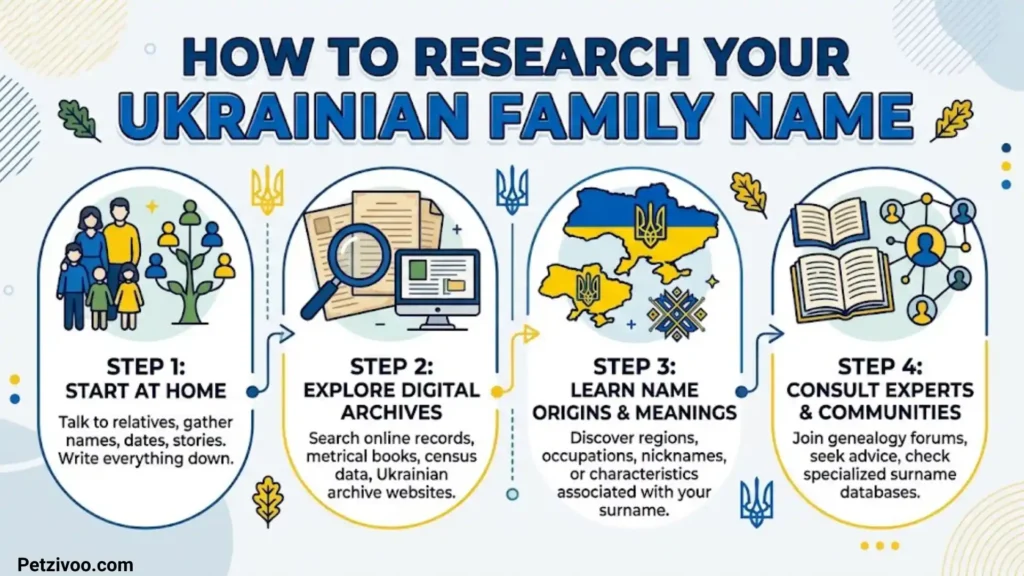
If you are researching a Ukrainian last name for genealogy, start with documented family information rather than relying only on a surname-meaning website.
1. Find the Original Spelling
Ukrainian names are written in Cyrillic. A surname may have several Latin spellings because of transliteration differences, migration, or historical records created in different languages.
For example, Melnyk may also appear as Melnik in Russian-influenced records. Searching both forms can help uncover additional documents.
2. Identify the Family’s Region
Try to determine the town, village, or region where your ancestors lived. Regional information can help distinguish between surnames that look similar but have different origins.
3. Look for Historical Records
Useful records may include:
- Church baptism, marriage, and burial registers.
- Civil birth, marriage, and death records.
- Immigration and naturalization documents.
- Historical census and residence records.
- Cemetery inscriptions and family documents.
For Jewish Ukrainian ancestry, synagogue-related records, Jewish community archives, and relevant historical databases may provide additional evidence.
4. Compare More Than One Source
A surname dictionary may offer a likely meaning, but genealogical documents are needed to establish a particular family’s history. Compare dates, locations, relatives, and alternative spellings before drawing conclusions.
OpenHeritage’s Surname Map of Ukraine is one starting point for exploring surname distributions through historical population and burial data.
5. Separate Family History From General Etymology
Even if a surname generally means “miller” or “blacksmith,” that does not prove the first person in your family with the name worked in that occupation. The meaning may reflect an ancestor’s job, an earlier nickname, or a different historical process.
The strongest family-history conclusions come from combining linguistic evidence with records that connect generations.
Frequently Asked Questions About Ukrainian Last Names
What are the most common Ukrainian last names?
Melnyk, Shevchenko, Kovalenko, Bondarenko, and Tkachenko are among the prominent Ukrainian surnames listed in surname-distribution resources. Exact rankings depend on the dataset, date, and spelling variants counted.
What is a typical Ukrainian last name?
A typical Ukrainian surname may end in -enko, -uk, -chuk, or -skyi. Examples include Shevchenko, Kovalchuk, Kravchuk, and Zelenskyi, although Ukrainian surnames do not all follow these patterns.
Do Ukrainian surnames change for men and women?
Some do. For example, Zelenskyi and Zelenska are masculine and feminine forms of a surname. Many other Ukrainian surnames, including Shevchenko and Kovalenko, commonly retain the same spelling across genders.
What do Ukrainian last names mean?
Ukrainian last names can refer to occupations, ancestors’ personal names, nicknames, places, or historical communities. Melnyk is associated with a miller, Koval with a blacksmith, and Holub with a pigeon or dove.
What are some rare Ukrainian last names?
Names such as Shmandura, Tantsiura, and Zhvavy appear in research on Ukrainian-Jewish linguistic history. However, their present-day rarity should be checked against a current, clearly defined dataset.
Are Jewish Ukrainian last names different from other Ukrainian surnames?
Some have Hebrew, Yiddish, or German origins, while others reflect Ukrainian or Russian language patterns. Because these traditions overlap, a surname alone cannot reliably establish a person’s religion or ancestry.
How can I find my Ukrainian family name’s original meaning?
Find the original spelling in Cyrillic, identify the family’s historical region, compare linguistic references, and search historical records. This approach is more reliable than assuming a surname has one universal meaning.
Conclusion
Ukrainian last names offer valuable clues about family history, traditional occupations, personal names, and cultural heritage. Surnames such as Shevchenko, Melnyk, Kovalenko, and Bondarenko reflect different aspects of Ukrainian naming traditions.
If you are exploring common Ukrainian last names, searching for rare surnames, or researching your ancestry, understanding their meanings and linguistic origins can help you make more informed discoveries. Remember that a surname’s meaning does not always reveal a family’s complete history, so historical records and original spellings are important when tracing your roots.

 Noah Williams
 Amelia Parker