
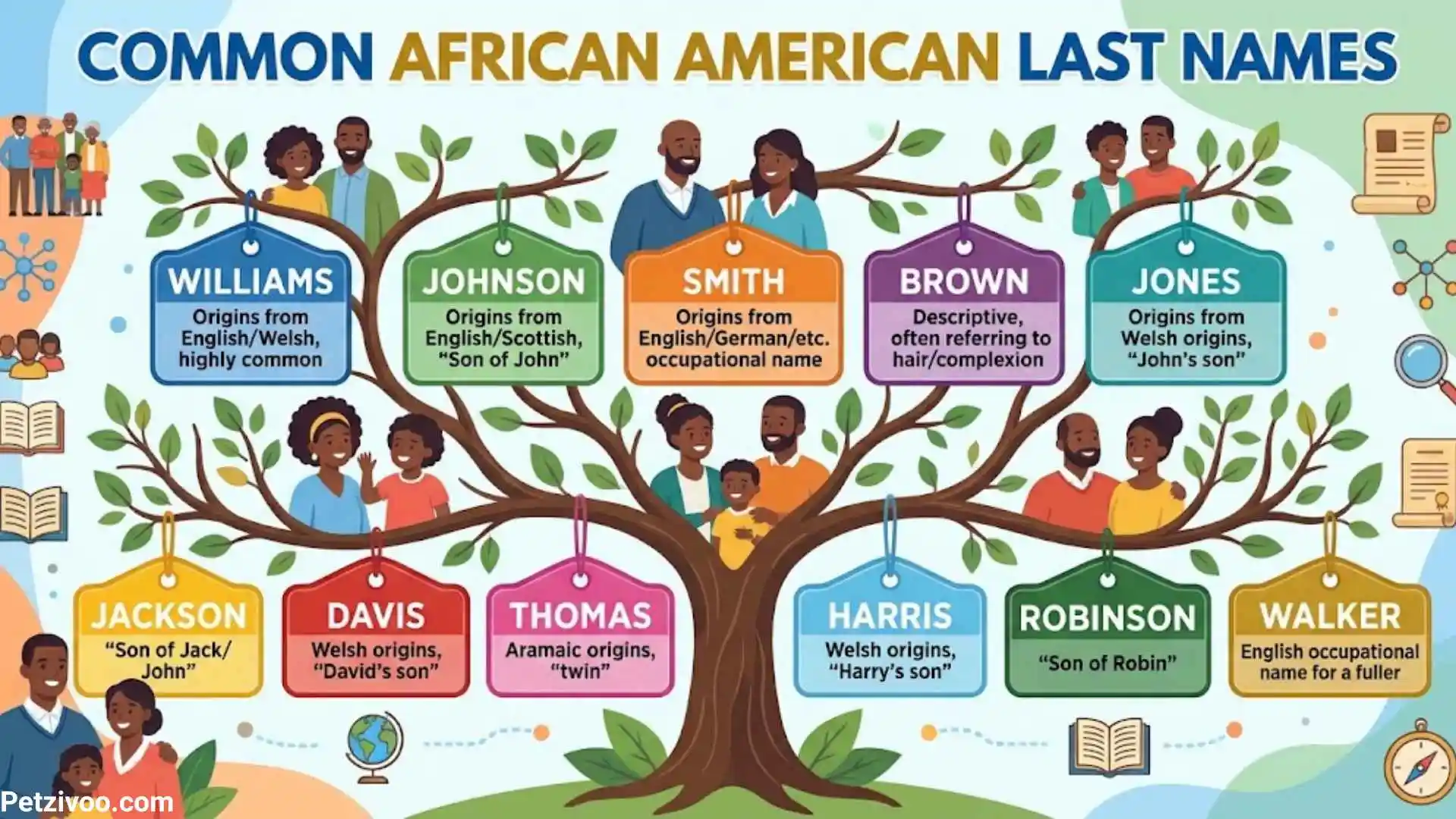
African American last names tell stories of family, culture, migration, resilience, and history. Many familiar surnames have English, Scottish, Irish, French, or other European roots, while others reflect African heritage, Caribbean connections, or more recent immigration. Their histories can be connected to slavery and emancipation, but they can also reach back to free Black communities, personal choices, occupations, and geographic places.
If you’re researching your family tree, looking for a meaningful surname for a character, or simply exploring names, understanding their origins can make the search more rewarding. This guide covers common African American last names, their meanings, distinctive choices, and practical ways to research family history.
What Are African American Last Names?
African American last names are surnames used by African Americans in the United States. They include many of the same family names found throughout the wider American population, as well as surnames associated with African, Caribbean, and other ancestral backgrounds.
Names such as Smith, Johnson, Williams, Jackson, and Brown are familiar examples. However, none of these surnames belongs exclusively to African Americans. A surname can be shared by people with very different family histories.
African American surnames may reflect several influences:
- Family heritage: Names passed down through generations.
- Historical circumstances: Changes in naming practices during slavery and after emancipation.
- Language and geography: Names inherited from different countries, regions, or local communities.
- Personal choices: Surnames adopted, restored, or changed by individuals and families.
- Cultural identity: Names retained or selected as expressions of family and community history.
A surname is a useful starting point for research, but it cannot independently establish a person’s race, ancestry, or relationship to a historical family.
The Origin and History of African American Last Names
African American surnames have multiple historical origins. Understanding the major influences helps explain why many familiar names appear across different communities.
Surnames Before and During Slavery
Before the Civil War, some Black Americans were free and maintained family names through generations. Enslaved people, however, often faced severe restrictions on family life, recordkeeping, and the ability to control their own identities.
Enslaved individuals were not consistently recorded by their own surnames in historical documents. Some records identify people only by first names, ages, relationships, or the names of enslavers. This makes it difficult to establish the origin of a particular family name without additional evidence.
It is also inaccurate to assume that every African American surname came from a former enslaver. Some people later used names associated with former enslavers, while others retained existing family names or selected surnames connected to respected individuals, places, occupations, or personal preferences.
Surnames After Emancipation
Emancipation created new opportunities for formerly enslaved people to establish legal identities, formalize marriages, reunite families, and make independent decisions about their names.
During Reconstruction, records created by the Freedmen’s Bureau and other institutions documented many formerly enslaved people and their families. These records can help researchers connect names across different stages of a family’s history.
Some families retained surnames already in use, while others changed or adopted names. A surname appearing in a postwar record does not automatically reveal when or why a family first began using it.
African and International Influences
African American surnames do not all have European origins. Some families have surnames connected to African languages and naming traditions, including names brought through immigration or preserved through particular family histories.
Caribbean, Latin American, and other international connections have also contributed to the variety of surnames found among African Americans today.
For this reason, researching a surname should involve the family’s location, migration history, language, and historical records rather than relying on a single generalized explanation.
Common African American Last Names
Many African American families have surnames that are also widespread throughout the United States. The following are familiar examples, not a verified ranking of the most common African American surnames.
| Last Name | Commonly Associated Origin | Meaning or Background |
| Smith | English, Scottish | Occupational name for a metalworker or blacksmith. |
| Johnson | English, Scottish | Patronymic surname meaning “son of John.” |
| Williams | English, Welsh | Derived from the given name William. |
| Brown | English, Scottish, and other origins | Often associated with a person’s complexion, hair color, or another distinguishing characteristic. |
| Jones | Welsh, English | Traditionally derived from John, often interpreted as “son of John.” |
| Jackson | English, Scottish | Originally meant “son of Jack.” |
| Davis | Welsh, English | Commonly derived from David, meaning “son of David.” |
| Wilson | English, Scottish | Patronymic surname meaning “son of Will.” |
| Robinson | English | Derived from Robin, a diminutive of Robert. |
| Harris | English, Welsh | Often derived from Harry or Henry. |
| Moore | Multiple origins | May have different roots depending on the family and region. |
| Lewis | Welsh, English, and other origins | Can derive from the given name Lewis or related naming traditions. |
| Walker | English, Scottish | Historically associated with a worker who processed or thickened cloth. |
| Taylor | English, French | Occupational surname associated with tailoring. |
| Clark | English, Scottish | Traditionally associated with a clerk or learned professional. |
| Thomas | Welsh, English, and other origins | Derived from the personal name Thomas. |
These meanings describe common linguistic roots, not the documented histories of every family carrying the name.
For example, a family named Williams may have inherited the surname through several generations in the United States, while another Williams family may have a different migration history. The spelling alone cannot determine whether the two families are related.
For reliable population comparisons, the U.S. Census Bureau’s surname data are a stronger source than informal lists that label names as exclusively Black or African American.
African American Last Names and Their Meanings
Some surnames interest readers because of their literal meanings, occupational associations, or connections to family identity. The examples below include names with relatively straightforward interpretations and names whose histories require more context.
| Surname | Origin or Association | Meaning or Interpretation |
| Freeman | English | Historically associated with a person who was free rather than bound to a particular status or obligation. |
| Carter | English, Irish, and other origins | Occupational surname associated with transporting goods by cart or wagon. |
| Baker | English | Occupational surname for someone who baked bread or other foods. |
| Cooper | English, Scottish | Occupational surname for a maker of barrels and other wooden containers. |
| Turner | English, Scottish | Often associated with a person who shaped wood, metal, or other materials on a turning device. |
| Fisher | English, German, and other origins | Often occupational, referring to a person who fished. |
| King | English, Scottish, and other origins | May have originated as a nickname, title-related name, or designation in a local community. |
| Grant | Scottish, English, and French-related histories | Has multiple possible origins; its meaning depends on the family’s linguistic background. |
| Washington | English place-name surname | Associated with places named Washington in England. |
| Lincoln | English | A place-name surname associated with Lincoln and related locations. |
| Fields | English | Often a topographic surname connected to fields or open land. |
| Rivers | English, French-related, and other histories | May be associated with geographic features or place names. |
| Banks | English, Scottish | Often a topographic surname associated with slopes, hillsides, or riverbanks. |
| Hill | English, Scottish, and other origins | Commonly a topographic surname associated with a hill. |
How to Interpret Surname Meanings
A surname’s traditional meaning is not necessarily the reason a specific family received it. For example, someone with the surname Baker might descend from an ancestor who worked in baking, but that connection should not be assumed without historical evidence.
Some names also developed independently in different languages. Even when two families share a surname, their names may have unrelated origins.
For genealogy, use a surname meaning as a research clue rather than proof of a family’s occupation, social status, or ancestry.
Unique and Uncommon African American Last Names
People searching for unique African American last names often want names that are distinctive, memorable, or less familiar than common surnames. The following examples can inspire character names or help readers recognize names worth investigating in family history.
They are real surnames or established surname forms, but their inclusion here does not mean they are statistically rare among African Americans.
| Surname | Background | Why It Stands Out |
| Booker | English | A distinctive surname with historical associations in the United States. |
| Douglass | Scottish, English-related surname histories | Recognizable through historical figures and literary associations. |
| Langston | English | A surname with a clear, memorable sound and historical cultural associations. |
| Hightower | English | A compound-style surname that sounds strong and visually distinctive. |
| Freeman | English | Carries a historical association with freedom and personal status. |
| Rivers | English and other possible origins | A nature-related surname with a flowing, memorable sound. |
| Fields | English | Simple, recognizable, and connected to landscape vocabulary. |
| Justice | English, French-related histories | A surname associated with the word for fairness or the administration of law. |
| Noble | English, French-related histories | May have originated as a nickname or status-related surname. |
| Love | English, Scottish, and other possible origins | A short surname with a familiar positive association. |
| Hope | English | A concise surname associated with the ordinary English word “hope.” |
| Parks | English, Scottish, and other possible origins | May be associated with parks, enclosures, or place names. |
Some of these names are recognizable because of their historical or cultural associations rather than their rarity. For instance, Douglass and Langston are familiar to readers of African American history and literature.
If you need a genuinely uncommon surname for a genealogy project, check census records and historical documents rather than relying on a list of names described as rare.
Rare and Uncommon Surnames: What Is the Difference?
The terms rare, uncommon, and unique are often used interchangeably online, but they are not identical.
- Rare: A name used by relatively few people in a defined population.
- Uncommon: A name that is less familiar or less frequently encountered.
- Unique: A name that feels distinctive, although it may be shared by many people.
A name can be uncommon in one region and familiar in another. A surname can also appear rare simply because it has several spelling variations.
To determine whether a surname is statistically rare, researchers need reliable population data and a clear definition of the population being studied.
Powerful, Cool, and Meaningful Black Last Names
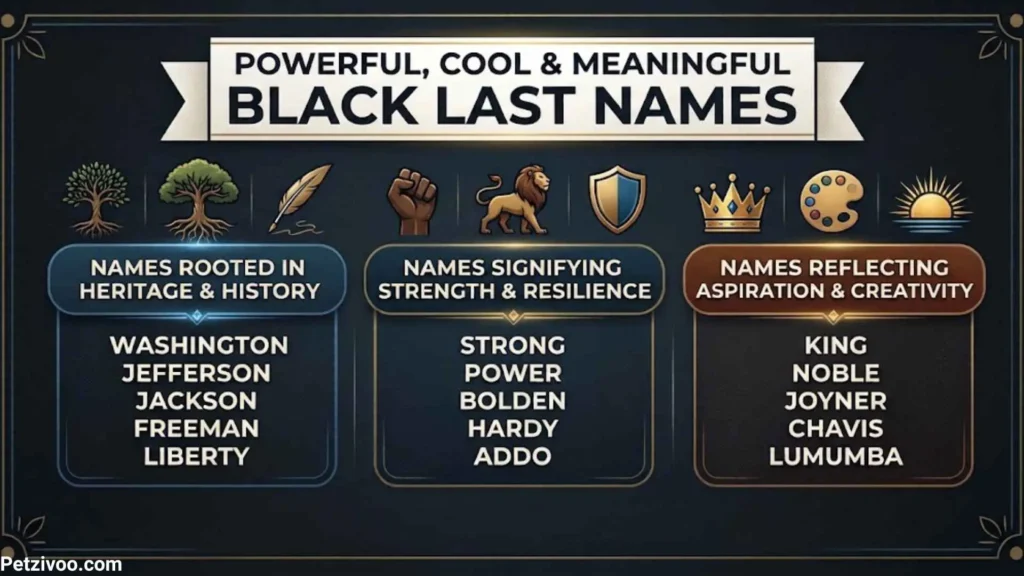
Some readers search for Black last names because they want a particular feeling or association. For creative writing, character development, or personal inspiration, these preferences can be useful, as long as they are not confused with a surname’s proven historical meaning.
Powerful Black Last Names
These surnames may sound authoritative or evoke ideas of leadership, strength, history, or independence.
- Washington: A recognizable American surname associated with political and historical figures.
- King: A concise surname with a title-related association.
- Freeman: A surname historically connected with free status.
- Noble: A name associated with nobility or status-related terminology.
- Grant: Short and strong in sound, with several possible historical origins.
- Hightower: A visually distinctive compound surname.
These are subjective descriptions of how a name may sound or feel. They do not establish that the families carrying them were historically more powerful than others.
Cool Black Last Names
If you’re choosing a memorable surname for a fictional character, these options offer a variety of sounds and styles.
- Langston: Literary and distinctive.
- Rivers: Nature-inspired and easy to pronounce.
- Banks: Short, crisp, and familiar.
- Booker: Traditional with a recognizable rhythm.
- Fields: Simple and connected to the natural landscape.
- Douglass: Formal and historically recognizable.
A cool surname does not have to be rare. Familiarity, rhythm, spelling, and the way a surname pairs with a first name may matter more than statistical frequency.
Meaningful Black Last Names
For readers looking for names with a deeper association, the following examples may be worth considering.
- Freeman: Historical associations with freedom or free status.
- Justice: A connection to fairness and the law through the ordinary English word.
- Hope: A familiar word associated with optimism.
- Love: A familiar word associated with affection and connection.
- Noble: A word associated with dignity or elevated status.
- Washington: A surname with strong historical associations in American public life.
These associations may help when selecting a name for a story or exploring possible family connections. They should not be treated as proof of the original intention behind an ancestor’s surname.
African American Last Names for Male and Female Characters
A surname is generally shared across genders in English-language naming traditions. Therefore, most African American last names can work for male and female characters without changing their spelling.
African American Last Names for Male Characters
If you’re looking for a masculine-sounding combination, consider these surnames based on sound, style, and familiarity:
- Jackson
- Washington
- Freeman
- Booker
- Hightower
- Carter
- King
- Banks
- Robinson
- Langston
For example, a writer might pair a traditional surname such as Jackson with a contemporary first name, or use Langston for a character whose story has literary or historical connections.
These are creative suggestions, not surnames exclusive to men.
Unique Black Last Names for Female Characters
The same principle applies to female characters. A surname’s suitability depends on the character’s background, the setting, and the writer’s goals, not on whether the name is inherently feminine.
Consider:
- Rivers
- Fields
- Douglass
- Freeman
- Parks
- Justice
- Hope
- Noble
- Washington
- Langston
Rivers and Fields may suit a character in a contemporary story, while Douglass or Washington may carry recognizable historical associations for readers. The character’s personal background should determine whether a particular surname makes sense in the story.
For historical fiction, it is especially important to research the time period and family circumstances before selecting a surname.
Famous African American Last Names
Certain surnames are widely recognized because of prominent African American historical figures, artists, writers, athletes, activists, and political leaders. These associations can help readers recognize names with an important place in American cultural history.
| Surname | Notable Association | Historical Context |
| Washington | Booker T. Washington | Educator, author, and public figure. |
| Douglass | Frederick Douglass | Abolitionist, writer, and orator. |
| Tubman | Harriet Tubman | Abolitionist and Underground Railroad conductor. |
| Parks | Rosa Parks | Civil rights activist known for her role in the Montgomery bus boycott. |
| King | Martin Luther King Jr. | Baptist minister and civil rights leader. |
| Robinson | Jackie Robinson | Baseball player who broke Major League Baseball’s modern color barrier. |
| Truth | Sojourner Truth | Abolitionist and women’s rights advocate. |
| Langston | Langston Hughes | Poet, novelist, and major figure of the Harlem Renaissance. |
| Carver | George Washington Carver | Agricultural scientist and educator. |
| Marshall | Thurgood Marshall | Civil rights lawyer and U.S. Supreme Court justice. |
These surnames are famous because of the people who carried them, not because they are exclusively African American or inherently more significant than other family names.
It is also worth remembering that a surname may have existed in a family long before a famous person made it widely recognizable. Sharing a surname with a historical figure does not establish a family relationship.
How to Research Your African American Family Name
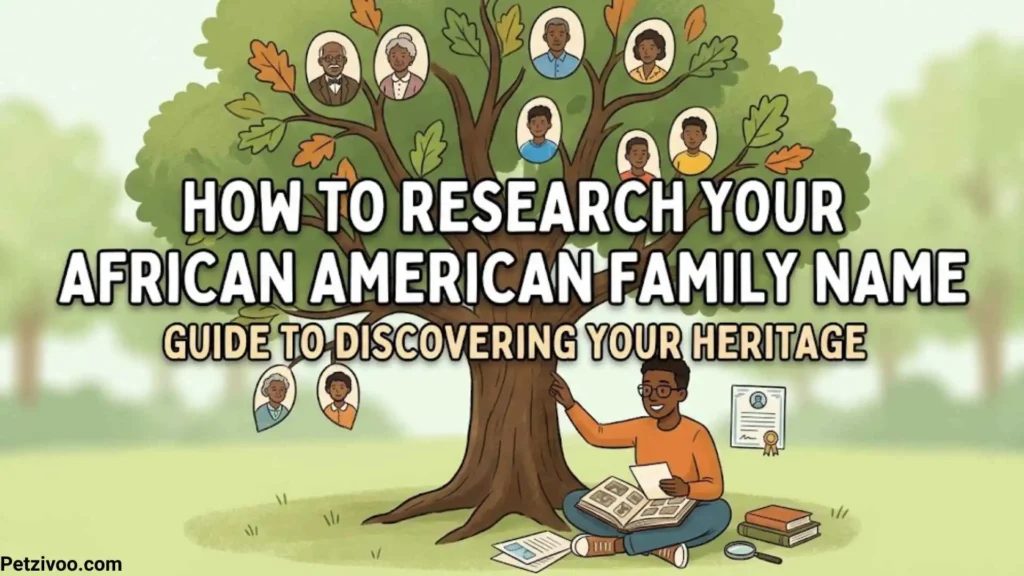
If your goal is to discover where your own surname came from, historical evidence is more valuable than a general list of surname meanings.
The Library of Congress recommends beginning with known family information and using genealogy resources to investigate earlier generations. Research can be particularly challenging before 1870 because enslaved people were not fully represented by name in earlier federal census records.
1. Start With Your Immediate Family
Record the full names of parents, grandparents, great-grandparents, and other known relatives. Ask family members about previous homes, marriages, name changes, and alternate spellings.
Oral histories may offer clues that are not immediately apparent in official documents.
2. Check Census Records
Federal census records can help identify households, relatives, approximate ages, and places of residence. The 1870 census is especially important in African American genealogy because it was the first federal census to enumerate formerly enslaved people as free individuals by name on a broad scale.
Use census information alongside other documents rather than treating a single entry as conclusive proof.
3. Search Freedmen’s Bureau Records
The Freedmen’s Bureau created records during the post-Civil War transition, including documents concerning labor, family relationships, marriages, assistance, and other activities.
These records may help connect an individual to a location, relative, employer, or earlier record. The National Archives provides research guidance for accessing relevant African American historical records.
4. Compare Different Types of Documents
Look for birth and death certificates, marriage records, church registers, military records, land documents, probate files, newspapers, and local archives.
A name appearing consistently across several independent records provides stronger evidence than a single online family tree.
5. Allow for Spelling Variations
Historical documents sometimes contain inconsistent spellings, transcription errors, or differences between handwritten and typed records.
For example, a family surname may appear with a different spelling in an older census or marriage register. Search reasonable variations, but do not assume that similarly spelled surnames belong to the same family.
6. Follow the Evidence, Not Just the Name
Two families may share a surname without sharing a recent ancestor. Conversely, relatives may have different surnames because of marriage, adoption, migration, or personal decisions.
The best family history combines names with dates, locations, relationships, and supporting records.
Frequently Asked Questions
What are common African American last names?
Smith, Johnson, Williams, Brown, Jones, Jackson, Davis, Wilson, Robinson, and Harris are familiar surnames found among African Americans and the wider U.S. population. Their exact prevalence among African Americans should be checked against census data rather than assumed from general surname lists.
Why do many African Americans have English last names?
English-language surnames became common through several historical processes, including slavery, emancipation, family inheritance, and the broader development of American naming practices. However, not every African American surname has English origins, and families adopted or retained names for different reasons.
Did formerly enslaved people take their enslavers’ last names?
Some did, but this was not universal. Other formerly enslaved people retained existing names or adopted surnames connected to family, respected individuals, occupations, places, or personal choices. A specific family’s history requires documentary evidence.
What does the surname Freeman mean?
Freeman is an English surname historically associated with a person who was free rather than subject to certain forms of servitude or obligation. Its use by an African American family may have a particular historical significance, but the surname alone cannot explain when or why that family adopted it.
Are African American last names different for men and women?
Generally, no. In American English naming traditions, surnames such as Jackson, Washington, Freeman, and Carter are normally used regardless of gender. Some cultures have gendered surname forms, but this is not the standard pattern for most English-language surnames.
How can I find the origin of my African American last name?
Start with family interviews and known records, then research census entries, birth and marriage certificates, church records, military documents, local archives, and Freedmen’s Bureau records when relevant. Compare multiple sources and allow for spelling variations before drawing conclusions.
Are rare African American last names necessarily African in origin?
No. A rare surname may have English, Scottish, French, African, Caribbean, or another origin. Rarity describes how frequently a name occurs within a defined population; it does not establish its linguistic origin or the ancestry of the people who carry it.
Conclusion
African American last names reflect many different family histories, cultural influences, and naming traditions. Common surnames such as Johnson, Williams, Jackson, and Robinson coexist with distinctive names such as Langston, Douglass, Freeman, and Hightower. Each can offer a starting point for exploring language, history, or personal identity.
The most important lesson is that a surname’s general meaning is only one part of its story. If you’re researching your ancestry, combine name origins with family memories, historical documents, and reliable genealogy records. If you’re choosing a name for a character, consider its sound, cultural context, and historical associations rather than assuming that any surname belongs exclusively to one group.

I am Noah Williams, an animal enthusiast and pet content creator who loves discovering creative ways to celebrate the bond between pets and their owners. I specialize in researching memorable pet names, naming trends, and meaningful ideas for dogs, cats, and other beloved animals.
I enjoy helping families choose names that are not only beautiful but also reflect their pet’s personality and unique qualities. My goal is to provide simple, inspiring, and practical naming advice for every type of pet owner.
My books include:
- The Ultimate Pet Names Encyclopedia
- Finding the Right Name for Your New Best Friend
 Amelia Parker
 Isabella Carter