
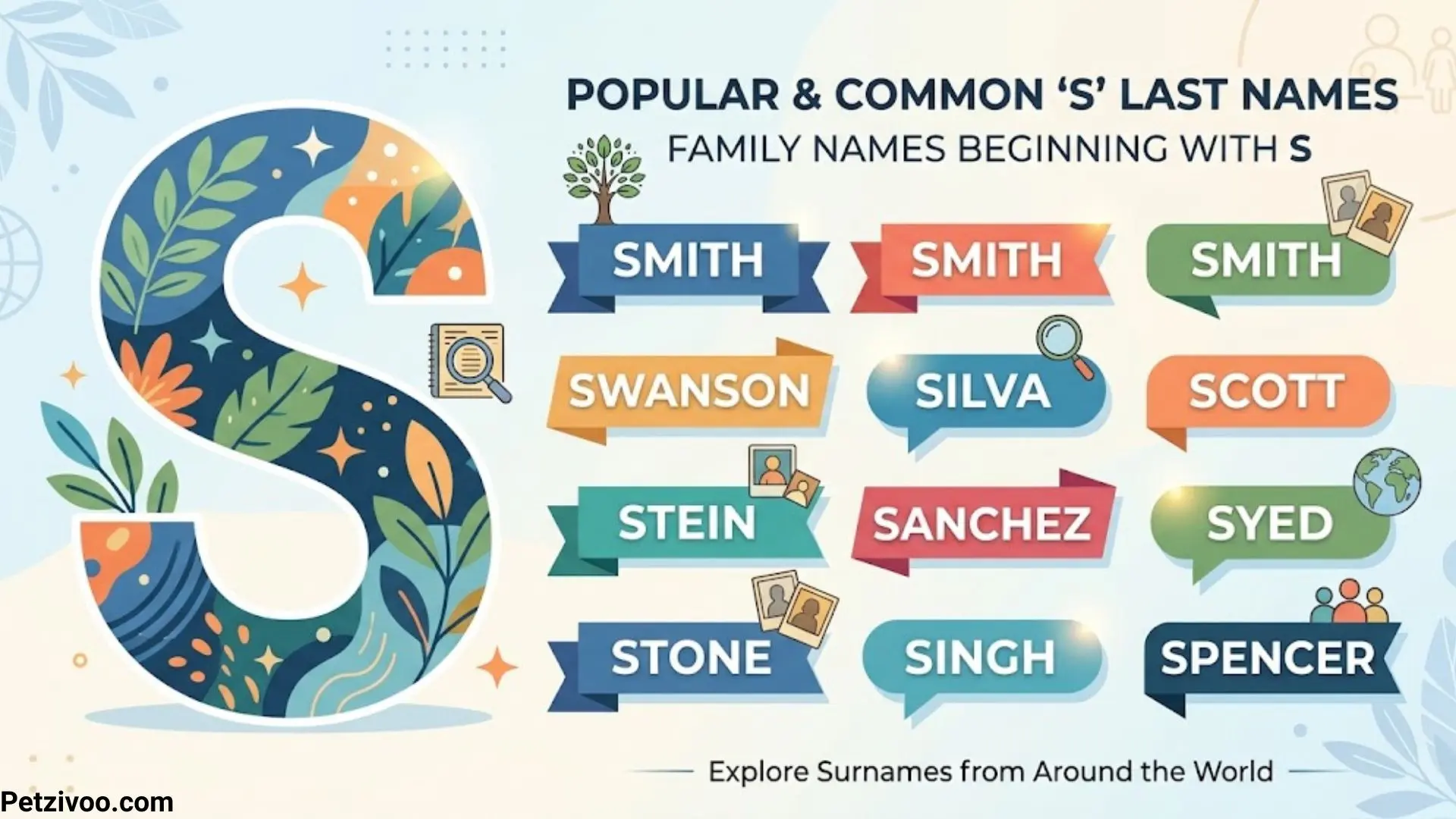
S last names include familiar surnames such as Smith, Scott, Stewart, and Sanders, along with distinctive names such as Sinclair, Sterling, and Sutherland. These surnames come from different languages and traditions, including English, German, Japanese, Spanish, French, and other cultural backgrounds.
If you’re researching your family tree, choosing a surname for a fictional character, or looking for a name that sounds distinctive, this guide brings together common, unique, historical, and culturally diverse last names starting with S.
A surname’s spelling can offer clues about its history, but it doesn’t prove someone’s ancestry. Some names have several independent origins, and their meanings can vary by region and language.
Common S Last Names
Common S last names include names associated with occupations, places, personal names, and family relationships. Many are familiar in the United States because of migration and the country’s diverse population.
Here are some recognizable examples.
| Last Name | Origin or Association | Description |
| Smith | English and Scottish | An occupational surname associated with metalworking. |
| Scott | Scottish and English | Historically associated with a person from Scotland. |
| Stewart | Scottish and English | Related to the occupational title of steward. |
| Sanders | English and other European traditions | Often a form derived from Alexander. |
| Sullivan | Irish | An anglicized form of an Irish Gaelic family name. |
| Simmons | English | A patronymic surname derived from Simon. |
| Spencer | English | Historically associated with a steward or household official. |
| Shaw | English and Scottish | May derive from a word for a small wood or thicket. |
| Stone | English | Often connected with a stony place or landscape feature. |
| Stevens | English | A patronymic surname derived from Steven or Stephen. |
| Simpson | English and Scottish | Traditionally means a son of Simon. |
| Snyder | German and Dutch | An occupational surname associated with tailoring. |
| Schneider | German | An occupational surname meaning tailor. |
| Schmidt | German | An occupational surname meaning smith. |
| Silva | Portuguese and Spanish | Associated with the Latin word for a forest or woodland. |
These examples represent different naming traditions rather than one shared origin. For example, Schmidt and Schneider developed in German-speaking contexts, while Sullivan has Irish Gaelic roots.
Smith, Scott, and Stewart are useful starting points for English-language surname research, but a family’s actual origin requires more than a surname match.
Unique Last Names Starting With S
Unique S last names can be useful when you want something less ordinary than Smith or Scott. Some sound elegant, others have strong historical associations, and some reflect specific places or landscapes.
The word unique here describes the impression a name may create, not a verified statistical ranking of rarity.
| Last Name | Background | Why It Stands Out |
| Sinclair | Scottish and French-Norman associations | Has a polished, traditional sound. |
| Sterling | English and Scottish usage | Suggests strength and refinement in modern English. |
| Sutherland | Scottish | Connected to a historic region in northern Scotland. |
| Somerset | English | Associated with an English county. |
| St. Clair | French and English usage | A distinctive surname with historical spelling variations. |
| Stratton | English | A place-based surname associated with several English locations. |
| Stanhope | English | A traditional place-derived surname. |
| Selwyn | English and Welsh associations | An uncommon-looking surname that also appears as a given name. |
| Somerville | Scottish and French-Norman associations | A long-established surname with a formal sound. |
| Sparrow | English | Associated with the name of the bird. |
| Shepherd | English and Scottish | Traditionally linked to the occupation of caring for sheep. |
| Sorrell | English and French-related forms | Has several possible historical and linguistic associations. |
If you’re selecting a name for a book or game, consider its sound, spelling, and cultural context together. A name such as Sutherland may suit a character with a Scottish setting, while Sterling might fit a contemporary character whose surname needs to be easy to remember.
Don’t assume a name is rare simply because it looks unusual. Genealogy databases and official population records can help establish whether a surname is actually uncommon.
English S Last Names
English surnames often developed from occupations, locations, personal names, nicknames, and relationships. Some became hereditary over centuries, while their spelling and pronunciation continued to change. The Society for Name Studies in Britain and Ireland explains how these different naming patterns shaped the region’s family names.
Examples of English S last names include:
- Smith — An occupational surname associated with a smith or metalworker.
- Shaw — Often connected with a small wood or thicket in northern English and Scottish naming traditions.
- Shepherd — An occupational surname referring to someone who tended sheep.
- Spencer — Historically associated with a steward or household official.
- Sutton — A place-derived surname found in several English locations.
- Sawyer — An occupational surname associated with sawing timber.
- Sykes — A surname with English regional associations, often linked to a stream or small watercourse.
- Simmons — A surname derived from the personal name Simon.
- Simpson — Traditionally a patronymic meaning son of Simon.
- Sykes — An established surname whose exact family origin may differ by location.
- Salisbury — A place-associated surname linked to Salisbury in England.
- Stafford — A place-derived surname associated with Stafford and other locations.
English surnames don’t all have exclusively English roots. Migration, conquest, trade, and language changes brought names from other parts of Europe into English-speaking communities.
For family history research, older parish registers, civil registration records, wills, and census records can help establish where a particular surname appeared in a documented family line.
German S Last Names
German surnames frequently developed from occupations, personal names, places, and physical or geographical descriptions. Occupational surnames are especially easy to recognize in examples such as Schmidt and Schneider.
Here are several German surnames beginning with S.
| Last Name | Meaning or Association |
| Schmidt | Smith; a person who worked with metal. |
| Schneider | Tailor; an occupational surname. |
| Schulz | Historically associated with an official or local administrative role. |
| Schuster | Shoemaker; an occupational surname. |
| Schäfer | Shepherd; a person who tended sheep. |
| Schwarz | Black or dark; potentially descriptive in origin. |
| Schmitt | A variant of Schmidt in some naming traditions. |
| Scholz | A surname historically related to regional forms of Schulz. |
| Sommer | Summer; may have developed from seasonal or descriptive associations. |
| Seidel | A surname with German regional and historical variations. |
| Sauer | Literally associated with sour or tart; surname origins vary. |
| Stein | Stone; may have a geographical or descriptive origin. |
German spelling matters when researching these surnames. For example, Schäfer may appear as Schaefer in records that replace the umlaut with ae. Schmidt and Schmitt may also occur as separate family lines rather than being interchangeable versions of the same name.
A surname’s modern spelling alone cannot establish the exact region or occupation of an ancestor. Local historical records provide stronger evidence.
Japanese S Last Names
Japanese surnames have a distinctive writing system and may be represented by kanji, the Chinese-derived characters used in Japanese. The same romanized spelling can sometimes correspond to different characters, so the original writing is important when interpreting a family’s name.
Common Japanese surnames beginning with S include Satō, Suzuki, Saitō, Sasaki, Shimizu, Sugiyama, and Shibata. Satō and Suzuki are among Japan’s most common family names.
| Surname | Japanese Writing | General Meaning or Context |
| Satō | 佐藤 | Often interpreted through characters associated with assistance and wisteria; historical connections are also discussed. |
| Suzuki | 鈴木 | Commonly interpreted as “bell tree,” although historical origins involve more than a literal translation. |
| Saitō | 斎藤 or 斉藤, among other forms | A widespread surname with multiple written variants and historical associations. |
| Sasaki | 佐々木 | A long-established Japanese family name with historical and regional associations. |
| Shimizu | 清水 | Often interpreted as “clear water” in this spelling. |
| Shimada | 島田 | Commonly interpreted as “island field” from its characters. |
| Shibata | 柴田 | Commonly associated with characters for brushwood and field. |
| Sugiyama | 杉山 | Often interpreted as “cedar mountain.” |
| Seki | 関 | Can refer to a barrier, checkpoint, or pass, depending on context. |
| Serizawa | 芹沢 | One spelling uses characters associated with celery or parsley-like plants and a marsh or wetland. |
These interpretations are tied to specific kanji spellings. They should not be applied automatically to every person whose surname is romanized the same way.
For example, Satō may also be written Satou in romanization, while macrons such as the one in Satō indicate a long vowel. Older records, immigration documents, and family preferences may use different spellings.
If you’re researching a Japanese family, look for the original kanji, regional records, and historical documents instead of relying on an English spelling alone.
Spanish, Hispanic, and Mexican S Last Names
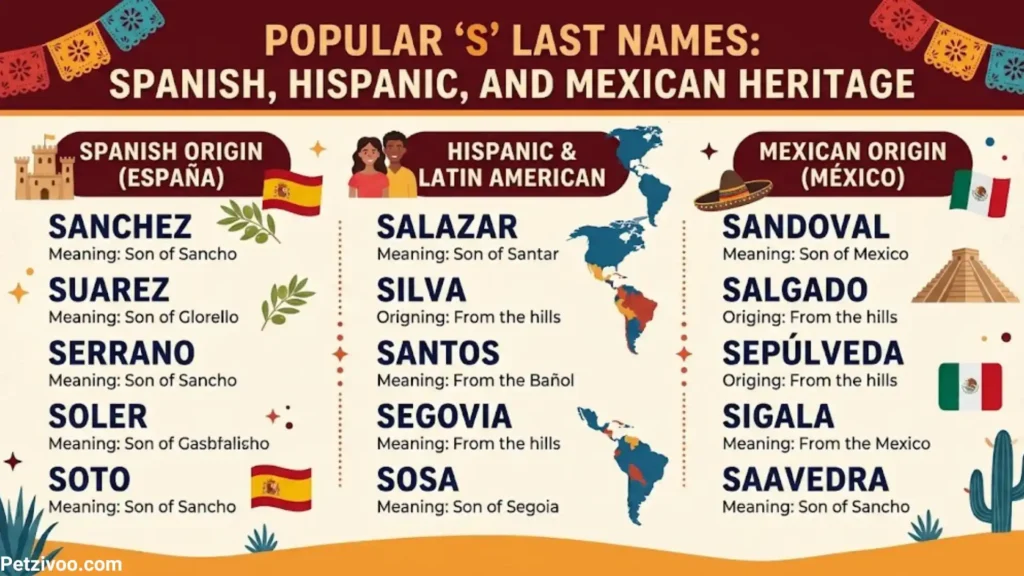
Spanish-language surnames are found in Spain, Mexico, much of Latin America, and communities around the world. However, Spanish, Hispanic, and Mexican are not interchangeable categories: each describes a different linguistic, cultural, or national context.
Many Spanish surnames developed from personal names, occupations, nicknames, and geographical features. Spanish naming traditions also commonly use two family surnames, often reflecting the paternal and maternal family lines, although practices and legal rules vary.
Spanish S Last Names
Examples of Spanish surnames starting with S include:
- Sánchez — A patronymic surname traditionally meaning “son of Sancho.”
- Santos — Means “saints” in Spanish and Portuguese; the history of an individual family name may vary.
- Suárez — A patronymic surname traditionally associated with the given name Suero.
- Salazar — A surname with Basque and Spanish regional associations.
- Serrano — Often associated with mountains or highland regions.
- Soria — A surname associated with the Spanish place name Soria.
- Sola — A surname found in Spanish and other European contexts, with multiple possible origins.
- Solís — A surname associated with Spanish-language naming traditions.
- Segura — Connected with a Spanish word meaning safe or secure, as well as place names.
- Santana — A surname associated with Spanish and Portuguese traditions and religious place names.
Hispanic S Last Names
Hispanic surnames reflect diverse histories across Spanish-speaking communities. Many are also found in Portugal, Brazil, the Philippines, and other regions due to migration, colonial history, and language contact.
Examples include:
- Santos — A surname used in Spanish- and Portuguese-speaking communities.
- Salinas — A geographical surname associated with saltworks or places bearing that name.
- Sandoval — A Spanish surname with geographical and historical associations.
- Santiago — Connected with the Spanish form of Saint James and various place names.
- Sosa — A surname found in Spanish- and Portuguese-speaking regions, with more than one possible origin.
- Sepúlveda — A surname associated with a Spanish place name.
- Saavedra — A surname with historical roots in the Iberian Peninsula.
- Sarmiento — A Spanish surname whose historical interpretations include associations with vine shoots.
These examples should be understood as surnames found across different communities, not as proof that a person belongs to a particular ethnic group.
Mexican S Last Names
Many Mexican surnames have Spanish-language origins, but Mexican family histories can also reflect Indigenous languages, regional naming traditions, migration, and changes introduced through colonial-era records.
Examples of Mexican S surnames include:
- Sánchez — A common Spanish-language patronymic.
- Salazar — A surname with Iberian historical associations.
- Sandoval — A Spanish surname used in Mexico and other countries.
- Santos — A surname used in several Latin American communities.
- Serrano — A geographical or descriptive surname.
- Solís — A surname with Spanish-language historical associations.
- Soto — Often connected with a grove or wooded area in Spanish place-name and surname traditions.
- Salinas — A name associated with saltworks or geographical locations.
- Santiago — A surname connected with the name of Saint James and related place names.
- Sosa — A surname used in Mexico and other Spanish- and Portuguese-speaking regions.
Mexican surname traditions are not limited to one origin. Historical records may also show spelling changes, different surname orders, or names adopted under circumstances that don’t reveal a family’s complete ancestry.
For genealogy, compare birth, marriage, baptismal, census, and immigration records wherever available. A surname may provide a starting clue, but it cannot establish Indigenous, Spanish, or other ancestry by itself.
French S Last Names
French surnames often reflect occupations, locations, personal names, and descriptive terms. Some surnames also have Norman or other regional histories, making it important to distinguish French-language usage from a single, certain place of origin.
Here are several French S last names:
- Simon — Derived from the personal name Simon, which has biblical roots.
- Schmitt — Found in French-speaking areas, particularly regions with German linguistic influence.
- Sauvage — A French word meaning wild; surname origins can depend on local history.
- Sanchez — A surname used in France as well as Spanish-speaking countries, often reflecting migration or family history.
- Seguin — A French surname associated with an older personal name.
- Serre — A surname that may have geographical or regional origins.
- Sabatier — An occupational surname associated with shoemaking in French naming traditions.
- Sorel — A French surname with historical forms and possible nickname-related origins.
- Soulier — Associated with the French word for shoe and potentially with an occupation.
- Sauvé — Related to the French word for saved or rescued, though a family’s etymology needs separate evidence.
French surnames can vary considerably across regions. A name found in southern France may have a different linguistic history from one in Alsace or Normandy. Historical spelling, local dialects, and neighboring languages can all affect interpretation.
American S Last Names
American S last names reflect the country’s many migration histories. English, German, Irish, Scottish, French, Spanish, Japanese, and other surname traditions all appear in American records.
Some examples frequently encountered in the United States include:
| Last Name | Historical or Linguistic Association |
| Smith | English occupational surname |
| Scott | Scottish and English surname |
| Stewart | Scottish and English surname |
| Sanders | Often derived from Alexander |
| Sullivan | Irish Gaelic surname |
| Simmons | English surname derived from Simon |
| Stewart | A traditional surname associated with stewardship |
| Sanchez | Spanish-language patronymic |
| Schmidt | German occupational surname |
| Snyder | German and Dutch occupational surname |
| Sato | Japanese surname |
| Suzuki | Japanese surname |
| Shah | A surname with origins in South Asian and Persianate naming traditions |
| Singh | A surname and name element used in several South Asian communities |
This is an illustrative list, not an official ranking of the most common American surnames. Exact popularity depends on the dataset, census methodology, and year.
American records may show surnames with simplified accents, alternate spellings, or transliterations. A family named Sato, for instance, may use that spelling even when the original Japanese romanization could include a macron.
When researching an American surname, check older census records, immigration documents, naturalization files, local newspapers, and family records. A name’s current distribution may differ from its historical place of origin.
Old Last Names That Start With S
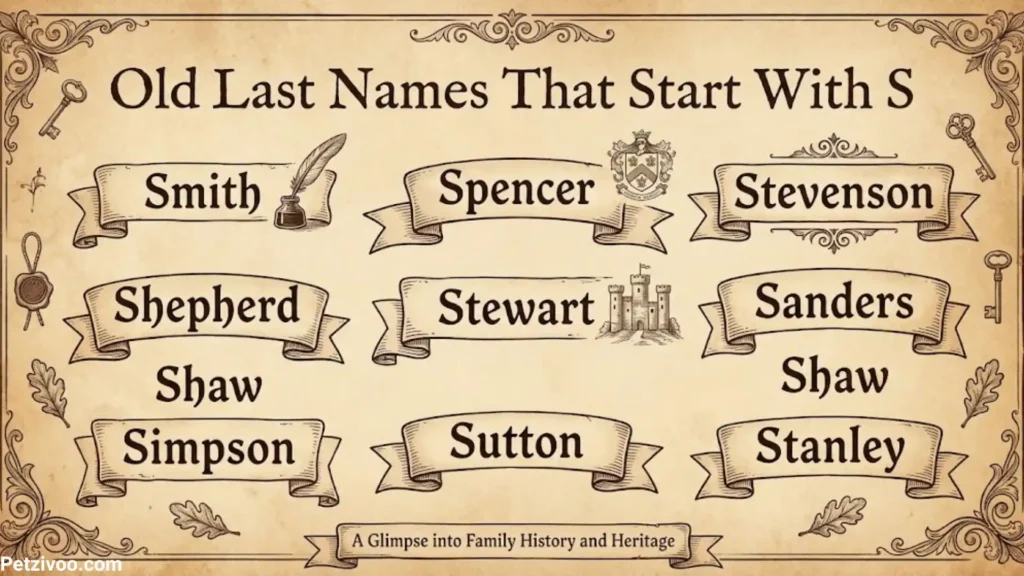
Old S last names include hereditary surnames that developed over many centuries. Some originated as occupations, others as place names or personal-name derivatives. A surname’s age can differ from the age of the family using it today.
Examples with long-established historical associations include:
- Smith — An occupational surname used in English-speaking communities for centuries.
- Stewart — Associated with the historic office of steward and Scottish royal history.
- Sinclair — Connected with Norman-French and Scottish historical traditions.
- Sutton — A place-derived surname associated with multiple English locations.
- Stafford — A place-associated surname linked to English geography.
- Somerville — A surname with French-Norman and Scottish historical associations.
- Salisbury — Associated with a historic English place name.
- Stanhope — An established English place-derived surname.
- Sutherland — Connected with a historic region in Scotland.
- Seymour — A surname with Norman-French and English historical associations.
Hereditary surnames developed at different times across different communities. Some names began as descriptions or personal bynames and became family names over generations.
If you are looking for an old family surname, avoid assuming that every person with that name belongs to one ancient lineage. Historical documents are needed to connect a modern family with earlier bearers of the same surname.
Cool S Last Names
Cool last names are subjective. Some people prefer a short, strong sound, while others like elegant, mysterious, or traditional names. The following surnames are real names with established usage, selected for their sound and associations rather than a popularity ranking.
| Last Name | Style | Description |
| Stone | Strong and simple | A familiar English surname with a compact sound. |
| Sterling | Elegant | Has associations with quality and refinement in modern English. |
| Steele | Bold | A surname associated with the word “steel.” |
| Storm | Dramatic | A surname that evokes a powerful weather event in English. |
| Sawyer | Modern and approachable | An occupational surname with an easy-to-pronounce form. |
| Sinclair | Classic and refined | Has historical associations with Scotland and France. |
| Brilliant | Edgy | An established surname with historical nickname-related origins. |
| Sloan | Short and distinctive | Associated with Irish and Scottish naming traditions. |
| Sterling | Polished | Often chosen for characters who need a memorable surname. |
| Shepherd | Traditional | Suggests a pastoral occupation in its historical sense. |
| Steele | Direct and memorable | Its sound makes it popular for fictional character concepts. |
| Sloane | Contemporary | A variant spelling used as both a surname and a given name. |
For fictional characters, match the surname to the setting and character rather than choosing a name solely because it sounds powerful. A historical Scottish character, for example, may suit a different surname from a contemporary American detective.
S Last Names for Girls
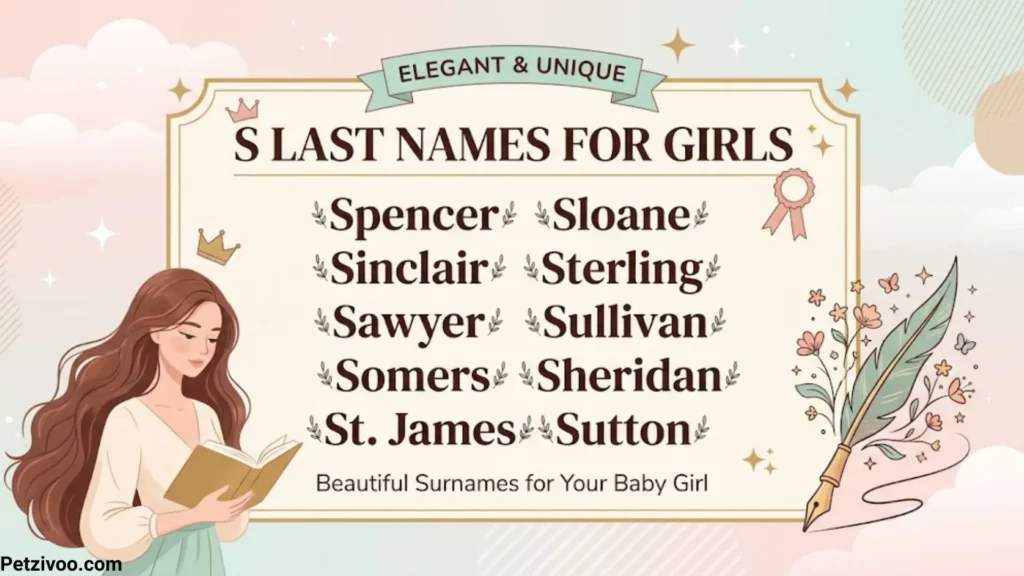
Surnames are generally not gender-specific in English. A last name such as Sullivan, Sinclair, or Sterling can belong to anyone. However, some readers search for surnames for girls because they want a name for a fictional character, a pen name, or a distinctive full-name combination.
Here are some S surnames that may suit feminine character names or elegant naming styles:
- Sullivan — Traditional, recognizable, and versatile.
- Sinclair — Formal and refined in sound.
- Sloane — Short, modern, and distinctive.
- Sterling — Polished and strong.
- Sawyer — Friendly and contemporary.
- Sutton — Compact and modern.
- Seymour — Classic and historically established.
- Sage — A surname also associated with the English word for wisdom or a fragrant herb.
- Shaw — Short and easy to pair with many first names.
- Shepherd — Traditional, with an occupational origin.
- Sparrow — A bird-associated surname with a softer sound.
- Somerset — Formal and place-associated.
- Snow — A familiar English surname connected with the word for frozen precipitation.
- Summerfield — A compound surname with a seasonal, place-like impression.
- Santos — A surname used across multiple cultural traditions.
These names are suggestions based on sound and style, not names that belong exclusively to women. If you’re choosing a name for a character, think about pronunciation, cultural setting, and whether the first and last names work well together.
What Were S Last Names Like in the 1980s?
The phrase “80’s last names” can mean different things. Some people want surnames for characters set in the 1980s, while others are searching for family names associated with people born during that decade.
There is no single surname style exclusive to the 1980s. Many surnames used during that period had been established for generations.
For a fictional story set in 1980s America, familiar names such as Smith, Stevens, Sanders, Sullivan, Scott, and Stewart can sound appropriate because they are longstanding surnames. However, their presence in a story doesn’t establish that they were especially popular in that decade.
To research actual surname popularity during the 1980s, look for historical census data or other reliable records with clearly defined dates and geographic coverage. First-name trends and last-name trends are different kinds of data, so they shouldn’t be confused.
If you are creating an 1980s character, also consider the setting, family background, and community. Those details will generally be more useful than trying to find a surname that supposedly represents the entire decade.
How to Research the Origin of an S Surname
A surname can be a useful starting point for family history research, but reliable conclusions come from comparing names with historical records.
Follow these steps to investigate an S last name.
- Start with the oldest known relative. Record full names, approximate dates, places of birth, and known family relationships.
- Collect family documents. Birth certificates, marriage records, death certificates, old letters, and family Bibles may contain important clues.
- Search historical records. Depending on the country, census schedules, church registers, civil registration records, and immigration documents may help establish a timeline.
- Check spelling variations. Surnames such as Schäfer and Schaefer may appear in different forms. Historical records can also contain transcription errors.
- Investigate the language and region. An English surname and a Japanese surname require different research resources. Look for references that explain the specific language and spelling.
- Compare multiple sources. A surname dictionary may suggest an origin, but records connecting your own relatives are needed to establish a family line.
The Society for Name Studies in Britain and Ireland notes that surnames can change substantially in spelling and pronunciation over time. That makes historical context especially important when researching older names.
Avoid drawing conclusions from a surname alone. Two unrelated families may share the same surname, while members of one family may have different spellings in older records.
Frequently Asked Questions About S Last Names
What are the most common last names that start with S?
Smith, Scott, Stewart, Sanders, Sullivan, Simmons, and Stevens are familiar examples of S surnames in English-speaking communities. Exact popularity varies by country and dataset, so this list should not be treated as a universal ranking.
What are some unique last names starting with S?
Sinclair, Sutherland, Somerset, Stanhope, Somerville, and Stratton are distinctive examples. Whether a surname is truly rare depends on its distribution in a particular country or population.
What are some German last names that start with S?
Schmidt, Schneider, Schulz, Schuster, Schäfer, Schwarz, and Schmitt are examples of German surnames beginning with S. Several are occupational surnames, while others have descriptive or historical origins.
What are some Japanese last names that start with S?
Satō, Suzuki, Saitō, Sasaki, Shimizu, Shimada, Shibata, and Sugiyama are Japanese surnames beginning with S. Their meanings depend on the Japanese characters used to write them.
What are some Mexican last names that start with S?
Sánchez, Salazar, Sandoval, Santos, Serrano, Solís, Soto, and Salinas are examples found in Mexican communities. Many have Spanish-language histories, although Mexican family backgrounds are diverse.
Are last names that start with S gender-specific?
Most S surnames used in English are not gender-specific. Names such as Sullivan, Sinclair, and Scott can be used by people of any gender. Some other languages have naming traditions in which surname forms can vary by gender.
How can I find the meaning of my S last name?
Begin with a reputable surname dictionary, then compare its explanation with historical records for your family. Check the original language, spelling, and region because a surname can have multiple origins.
Can two unrelated families have the same S surname?
Yes. The same surname can arise independently in different places or languages. Sharing a surname does not necessarily mean two people have a recent common ancestor.
Conclusion
S last names include a wide variety of surnames, from common choices like Smith, Scott, and Sullivan to distinctive names such as Sinclair, Sterling, and Sutherland. They also reflect different cultural and linguistic traditions, including English, German, Japanese, Spanish, French, and Mexican naming histories.
Whether you’re searching for a unique surname, choosing a name for a fictional character, or exploring your family history, understanding a name’s background can make your search more meaningful. Remember that surname origins and meanings may vary, so historical records and reliable references are the best ways to learn more about a particular family name.

I am Amelia Parker, a dedicated pet lover and creative writer who enjoys helping pet owners find names that perfectly match their furry companions. I have a passion for exploring unique, adorable, and meaningful pet names inspired by personality, appearance, nature, and popular culture.
I believe every pet has a special story, and choosing the right name is one of the first ways owners create a strong connection with their animals. Through my research and writing, I share fresh ideas and helpful guides that make naming pets easier and more enjoyable.
My books include:
- The Perfect Pet Name Collection: Ideas for Every Furry Friend
- Amazing Animal Names: Creative Inspiration for Pet Lovers
 Noah Williams
 Isabella Carter