
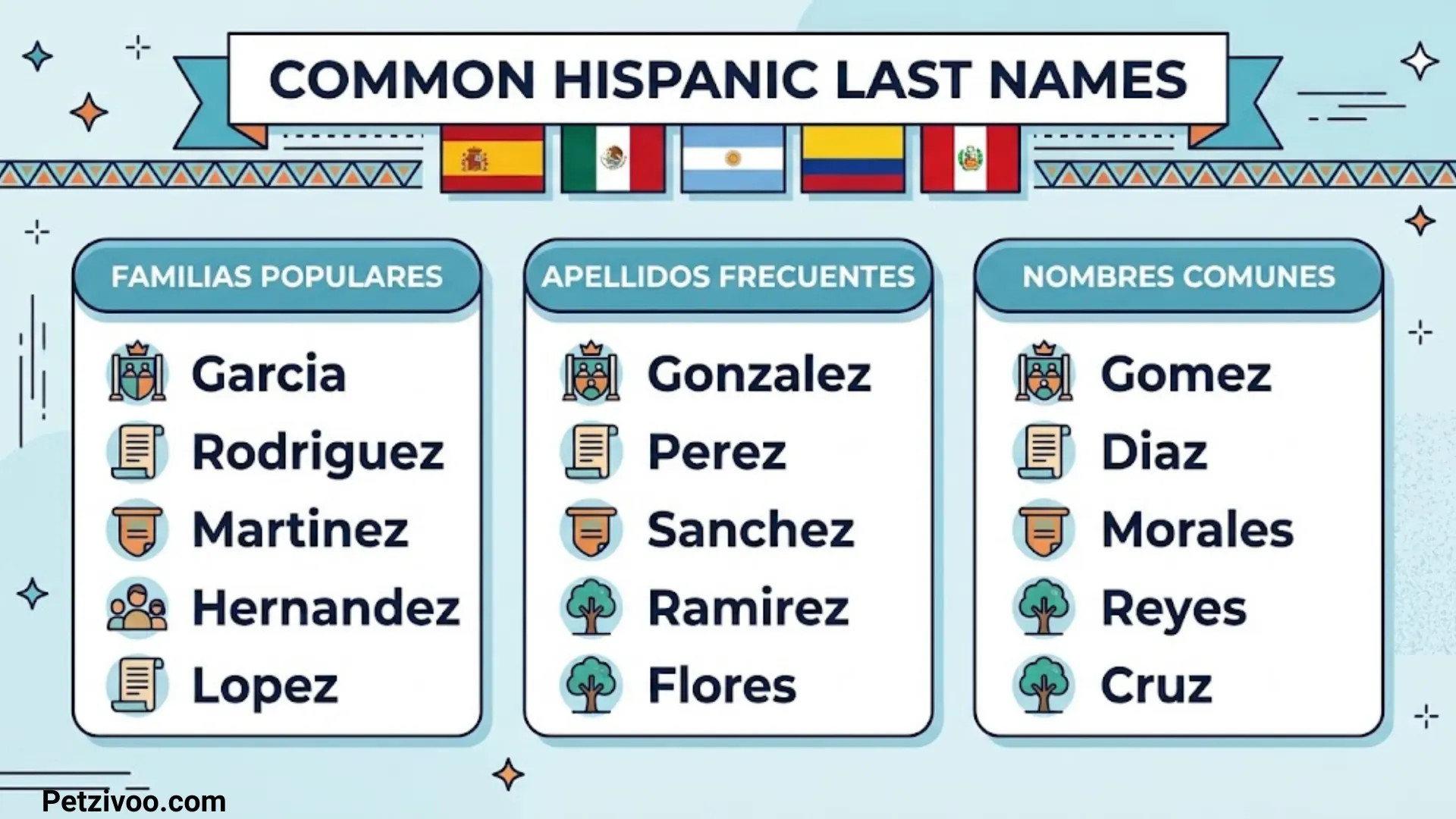
Common Hispanic last names offer a glimpse into family history, Spanish-language traditions, and the many cultures that have shaped Hispanic communities. Names such as Garcia, Rodriguez, Hernandez, Martinez, and Lopez are familiar throughout the United States and across much of Latin America.
Many Hispanic surnames originated from a father’s first name, a family’s occupation, a geographic location, or a physical feature. Others developed through centuries of language change, migration, and regional naming customs. Some are widely shared across several countries, while others are especially associated with particular regions.
This guide explores the most common Hispanic last names, their possible meanings, and additional categories, including old Spanish surnames, uncommon family names, and surnames beginning with specific letters.
What Are the Most Common Hispanic Last Names?
Some of the most recognizable Hispanic last names include Garcia, Rodriguez, Hernandez, Martinez, Lopez, Gonzalez, Perez, Sanchez, Ramirez, and Torres. These surnames are especially familiar in the United States and many Spanish-speaking communities.
The following examples are consistent with surnames appearing prominently in US Census surname data and other established surname references.
| Last Name | Origin and Meaning |
| Garcia | Spanish surname of uncertain ultimate etymology; its precise original meaning is disputed |
| Rodriguez | Patronymic surname derived from Rodrigo |
| Hernandez | Patronymic surname derived from Hernando or related forms of Fernando |
| Martinez | Patronymic surname derived from Martin |
| Lopez | Patronymic surname derived from Lope |
| Gonzalez | Patronymic surname derived from Gonzalo |
| Perez | Patronymic surname derived from Pedro |
| Sanchez | Patronymic surname derived from Sancho |
| Ramirez | Patronymic surname derived from Ramiro |
| Torres | Topographic or locational surname associated with towers |
| Flores | May be connected with flowers or personal names; its precise origin can vary |
| Rivera | Commonly associated with a riverbank or riverside location |
| Gomez | Traditionally derived from an older personal name, Gome |
| Diaz | Patronymic surname derived from Diego |
| Cruz | Spanish word for “cross” |
| Morales | Often associated with mulberry trees or places bearing a related name |
| Gutierrez | Patronymic surname derived from Gutierre |
| Ortiz | Traditionally associated with the personal name Ortun or related forms; the history is not entirely settled |
| Chavez | A surname with Iberian roots and regional spelling variations |
| Mendoza | A Basque-origin surname associated with a place name |
A patronymic surname is a family name derived from an ancestor’s personal name. For example, Rodriguez developed from Rodrigo, while Martinez developed from Martin. These surnames do not prove that every person who bears one descends from the same individual.
The US Census Bureau’s 2010 surname analysis listed Garcia as the sixth most common surname nationally, Rodriguez ninth, and Martinez tenth. These are historical US rankings, not a current ranking of every Hispanic surname worldwide.
Common Hispanic Last Names in the US
Hispanic surnames are widespread throughout the United States, reflecting generations of migration, family growth, and the long history of Spanish-speaking communities in North America.
The Census Bureau’s 2010 surname dataset included surname frequencies and the percentages of people reporting different Hispanic-origin and racial categories. It is useful for studying name patterns, although it should not be treated as a current census of Hispanic identity.
Some familiar examples include:
- Garcia: A highly widespread surname in Spain, Latin America, and the United States.
- Rodriguez: A patronymic surname associated with the name Rodrigo.
- Hernandez: A traditional surname derived from Hernando or a related form.
- Martinez: A family name derived from Martin.
- Lopez: A surname traditionally derived from Lope.
- Gonzalez: A patronymic name associated with Gonzalo.
- Perez: A surname derived from Pedro.
- Sanchez: A surname derived from Sancho.
- Ramirez: A surname associated with the personal name Ramiro.
- Torres: A surname connected with towers or places identified by them.
- Rivera: A surname often associated with riverside geography.
- Flores: A surname with several possible historical explanations, including connections to flowers or personal names.
These names are common examples, not a complete or definitive ranking of surnames among Hispanic Americans.
It is also important to recognize that a surname does not establish someone’s ethnicity. People with Spanish surnames may have different cultural backgrounds, and Hispanic people may carry surnames from Indigenous, African, Asian, European, or other linguistic traditions.
Common Hispanic Last Names by First Letter
Alphabetical surname lists are useful when researching family records, developing fictional characters, or finding names with a particular sound. The examples below include familiar surnames as well as less frequently encountered names.
Common Hispanic Last Names That Start With A
- Alvarez: A patronymic surname derived from Alvaro.
- Aguilar: A surname associated with place names and the Spanish word águila, meaning “eagle.”
- Alonso: A surname derived from the personal name Alonso.
- Andrade: A surname associated with place names in the Iberian Peninsula.
- Acosta: A surname found in Spain and Latin America, with several possible regional origins.
- Arias: A surname with multiple historical explanations and regional variations.
- Ayala: A surname associated with a Basque place name.
- Aguirre: A Basque-origin surname associated with place names.
Common Hispanic Last Names That Start With C
- Castillo: Means “castle” in Spanish and may be locational.
- Cruz: Means “cross” and may have religious or geographic associations.
- Castro: Associated with a fortified settlement or castle.
- Cabrera: A locational surname linked to place names; the name is also associated with the Spanish word for a goat enclosure.
- Campos: Means “fields” and may refer to open land or a place.
- Cortes: A surname with several possible historical origins; spelling and accent variations matter.
- Cervantes: A well-known Spanish surname whose precise etymology is uncertain.
- Carrillo: An established Spanish surname with a debated or context-dependent origin.
Common Hispanic Last Names That Start With D
- Diaz: A traditional patronymic surname derived from Diego.
- Dominguez: Derived from Domingo, the Spanish form of Dominic.
- Delgado: Means “slender” or “thin” in Spanish and may have originated as a descriptive nickname.
- Duran: A surname connected with older personal-name traditions and found across Spanish-speaking regions.
- Duarte: A surname derived from a personal name related to Edward in some Iberian naming traditions.
- De Leon: Means “of Leon” and may identify a geographic association.
- De La Cruz: Means “of the cross,” with possible religious or locational associations.
Common Hispanic Last Names Starting With F
- Fernandez: A patronymic surname derived from Fernando.
- Flores: A widespread surname with multiple possible historical roots.
- Fuentes: Means “springs” or “fountains” and can be locational.
- Franco: A surname with historical associations to the word for a Frank or to older personal-name traditions.
- Figueroa: A surname associated with place names and fig trees.
- Fonseca: A surname linked to Iberian place names.
- Ferrer: A surname found in Spanish and Catalan-speaking areas, traditionally associated with ironworking.
Common Hispanic Last Names That Start With G
- Garcia: A widespread Spanish surname with a disputed original etymology.
- Gonzalez: A patronymic surname derived from Gonzalo.
- Gomez: Derived from an older personal name, Gome.
- Gutierrez: A patronymic surname derived from Gutierre.
- Guerrero: Means “warrior” in Spanish and may have developed from a nickname or descriptive term.
- Gallegos: Means “Galicians” or is associated with Galicia.
- Guzman: An established surname associated with Iberian family and place-name traditions.
- Gil: A surname connected with the personal name Gil.
Common Hispanic Last Names That Start With M
- Martinez: A patronymic surname derived from Martin.
- Morales: Often associated with mulberry trees or related place names.
- Mendoza: A surname of Basque origin associated with a place name.
- Medina: A locational surname found in Spain and elsewhere, ultimately connected with a place-name tradition.
- Molina: Means “mill” and may have originated as a locational or occupational surname.
- Mendez: A patronymic surname derived from Mendo.
- Munoz: A patronymic surname traditionally associated with Munio.
- Montoya: A surname with Basque and Iberian place-name associations.
- Mejia: A surname found across Spanish-speaking communities, with regional variations in its historical interpretation.
Common Hispanic Last Names That Start With R
- Rodriguez: A patronymic surname derived from Rodrigo.
- Ramirez: A patronymic surname derived from Ramiro.
- Rivera: Often associated with riverside geography.
- Reyes: Means “kings” in Spanish and may have religious, symbolic, or nickname-related origins.
- Romero: Historically associated with a pilgrim traveling to Rome or with rosemary in some interpretations.
- Ramos: Means “branches” in Spanish and may have descriptive or religious associations.
- Ruiz: Traditionally derived from the personal name Ruy.
- Rojas: Means “red” or “reddish” in Spanish and may have developed from a descriptive term.
- Rosales: Associated with rose bushes or places where roses grow.
Common Hispanic Last Names That Start With S
- Sanchez: A patronymic surname derived from Sancho.
- Santos: Means “saints” in Spanish and may have religious or calendar-related associations.
- Silva: A surname associated with the Latin word for forest or woodland, especially through Iberian naming traditions.
- Salazar: A surname associated with a Basque place name.
- Soto: Often associated with a grove or wooded area.
- Suarez: A patronymic surname linked to Suero.
- Serrano: Can refer to someone associated with mountains or upland areas.
- Solis: A surname associated with Iberian place-name and personal-name traditions.
- Santana: Often connected with Santa Ana, meaning Saint Anne.
The origins provided here are general linguistic explanations, not proof of an individual family’s ancestry. Regional records may reveal a different origin for a particular family with the same surname.
Old Spanish Last Names
Old Spanish last names reflect centuries of naming practices across the Iberian Peninsula. Some developed from medieval personal names, while others came from occupations, landscape features, settlements, or religious traditions.
The term “old” does not necessarily mean that a surname belongs to a noble family. Many surnames have been used for centuries by families from different social backgrounds.
Examples include:
- Alvarez: A traditional patronymic surname derived from Alvaro.
- Fernandez: A historical surname derived from Fernando.
- Rodriguez: A surname derived from Rodrigo.
- Velazquez: A traditional surname associated with the personal name Velasco.
- Benitez: A surname derived from Benito.
- Iglesias: Means “churches” and may be associated with a place or landmark.
- Herrera: Associated with ironworking and the Spanish word for an ironworks.
- Maldonado: A longstanding Spanish surname whose historical explanation is not completely settled.
- Navarro: Traditionally associated with Navarre, a region in northern Spain.
- Pacheco: An established Iberian surname with a debated etymology.
- Vazquez: A patronymic surname historically associated with Vasco.
- Mendez: Derived from an older personal name, Mendo.
Historical surname research requires more than recognizing an old-looking spelling. Parish registers, civil records, land documents, and regional archives can help establish when a particular family began using a name.
Uncommon Spanish Last Names
Uncommon Spanish last names can appeal to readers interested in family history or distinctive names for creative writing. However, a surname that is unusual in one country may be familiar in another.
These examples are less prominent in everyday US surname lists than names such as Garcia or Rodriguez, but their exact frequency depends on the country and dataset.
- Aguado: An established surname associated with the Spanish word for water-related conditions or descriptions; family-specific origins may vary.
- Arriaga: A surname associated with Basque place names.
- Bengoechea: A Basque-origin surname built from elements associated with a lower house or dwelling.
- Castañeda: A surname associated with chestnut trees or a place containing them.
- Echeverria: A Basque surname associated with a new house or dwelling.
- Elizondo: A Basque-origin surname associated with a place near a church.
- Lujan: A surname associated with place names and regional family histories.
- Orellana: A locational surname associated with Spanish place names.
- Zambrano: A surname with Iberian and regional historical associations whose exact origin can vary.
- Zaragoza: A locational surname associated with the Spanish city of Zaragoza.
Some of these names are more common in specific communities or regions than their appearance in a general US list might suggest. They should not automatically be described as rare worldwide.
Less Common Hispanic Last Names
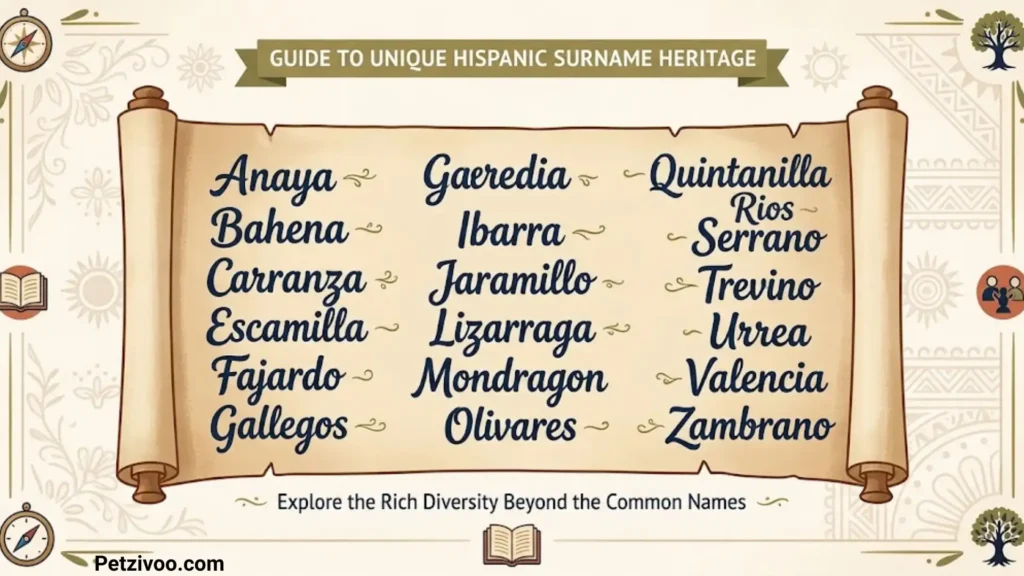
Hispanic surnames are not limited to names of Spanish origin. Across Latin America and Hispanic communities in the United States, family names may reflect Indigenous languages, African ancestry, migration, or other cultural histories.
Examples of surnames that may be less familiar to some US readers include:
- Abarca: An established Iberian surname with historical and regional variations.
- Amezcua: A surname found in Mexico and Mexican-origin communities.
- Barajas: A Spanish surname especially familiar in Mexico and the United States.
- Bautista: Means “baptist” and is associated with Christian naming traditions.
- Cisneros: A Spanish surname associated with place-name and historical family traditions.
- Esparza: A surname linked to a place name in Spain.
- Ibarra: A Basque-origin surname associated with a valley or riverside landscape.
- Ledesma: A locational surname associated with places in Spain.
- Ochoa: A surname with Basque linguistic roots.
- Pineda: Associated with pine trees or places where pine trees grow.
- Trevino: A surname associated with Spanish place names; accents and spelling may vary.
- Zavala: A surname with Basque-origin place-name associations.
Some surnames used in Hispanic communities also come from Indigenous languages and cannot be accurately explained through Spanish etymology alone. Family research may require records from a particular country, region, or language community.
Pretty Spanish Last Names
What makes a Spanish last name pretty is subjective. Some readers prefer names with soft sounds, others like short and elegant spellings, and some prefer surnames with connections to nature, history, or literature.
Here are examples often appreciated for their sound or associations:
- Del Valle: Means “of the valley.”
- Flores: Means “flowers” in Spanish.
- Luna: Means “moon.”
- Rosales: Associated with rose bushes.
- Estrella: Means “star.”
- Marin: A surname associated with the sea or maritime traditions in some interpretations.
- Cielo: Means “sky” or “heaven,” although its use as a surname is less widespread than its use as a word or given name.
- Solano: An established surname with geographic and historical interpretations.
- Montes: Means “mountains” or “wooded heights,” depending on context.
- Vega: Associated with a fertile plain or meadow.
- Paloma: Means “dove” and is also used as a given name.
- Valencia: A surname associated with Spanish place names.
These names are suggestions based on sound and recognizable associations, not an objective ranking of beauty. A surname’s history may differ from its modern Spanish word meaning.
Cool Spanish Last Names
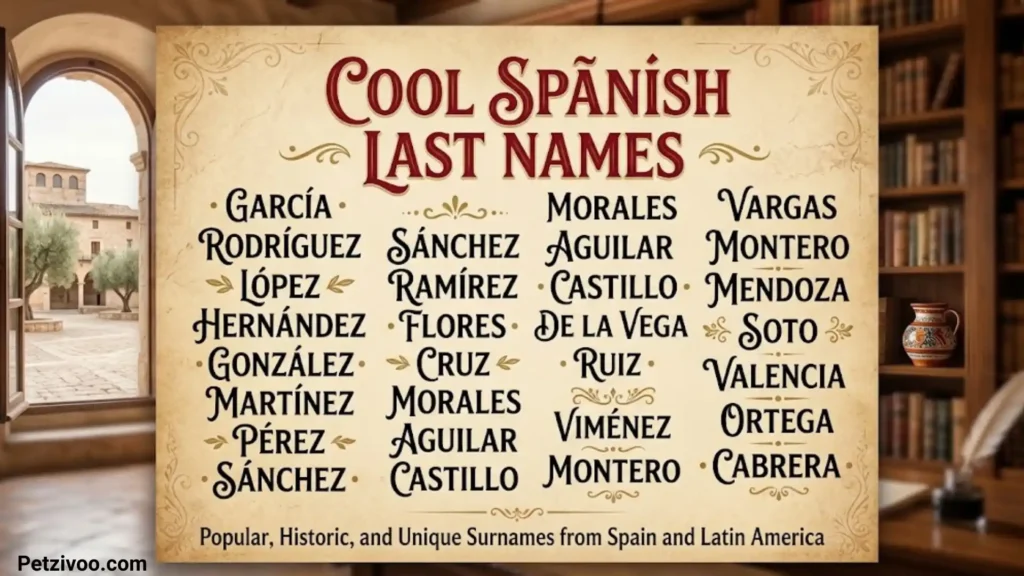
For character naming, pen names, or creative projects, some readers prefer Spanish surnames with a strong sound, memorable spelling, or historical association.
Consider these examples:
- Cruz: Short and memorable; means “cross.”
- Vega: Compact and associated with fertile land.
- Reyes: Means “kings.”
- Bravo: Means “brave” or “bold” in Spanish, depending on context.
- Mendoza: A distinctive surname with Basque-origin place-name associations.
- Del Toro: Means “of the bull.”
- Castillo: Means “castle.”
- Guerrero: Means “warrior.”
- Navarro: Associated with Navarre.
- Valdez: A surname with Iberian historical roots and spelling variations.
- Montoya: An established surname associated with Basque and Iberian naming traditions.
- Salazar: A traditional surname linked to a Basque place name.
A name that sounds bold or modern today may have developed from an ordinary geographic or family reference. Its contemporary style should not be confused with its original historical meaning.
How Hispanic Surnames Get Their Meanings
Understanding surname meanings requires looking at the language, historical period, and place where a family name developed. Spanish surnames often fall into several broad categories.
Patronymic Surnames
Patronymic surnames come from personal names. Many familiar Spanish surnames belong to this group.
Examples include:
- Rodriguez — derived from Rodrigo.
- Fernandez — derived from Fernando.
- Martinez — derived from Martin.
- Gonzalez — derived from Gonzalo.
- Hernandez — derived from Hernando or related forms.
- Sanchez — derived from Sancho.
- Lopez — derived from Lope.
The ending -ez is strongly associated with many traditional Spanish patronymics. Its historical development is complex, however, and not every surname ending in similar letters necessarily has the same origin.
Occupational Surnames
Some surnames developed from a person’s occupation or trade.
- Herrero: Associated with an ironworker or blacksmith.
- Molina: Associated with a mill or mill-related place.
- Ferrer: Traditionally associated with ironworking in Catalan-speaking and related Iberian traditions.
Occupational surnames could become hereditary even when later generations no longer practiced the original trade.
Geographic Surnames
Geographic surnames can identify a town, region, landscape feature, or place associated with an ancestor.
- Navarro: Associated with Navarre.
- Ibarra: A Basque-origin surname associated with a valley or related landscape.
- Montes: Associated with mountains or wooded heights.
- Rivera: Often associated with a riverbank or riverside place.
- De Leon: Associated with Leon in Spain or a place bearing the same name.
A geographic surname may indicate an ancestral connection to a place, but it cannot establish exactly where a particular family originated without supporting records.
Descriptive and Religious Surnames
Some surnames developed from descriptive words, religious associations, or nicknames.
- Delgado: “Slender” or “thin.”
- Moreno: A descriptive surname that can refer to dark coloring, although its precise historical use varies.
- Cruz: “Cross.”
- Santos: “Saints.”
- Bautista: Associated with baptism and the Baptist tradition.
These interpretations explain possible linguistic origins, not necessarily the circumstances under which a particular ancestor received the name.
Why Some People Have Two Spanish Surnames
In many Spanish-speaking naming traditions, a person has two surnames, often one from each parent. Traditionally, the paternal surname comes first and the maternal surname second, although customs and legal rules differ across countries and generations.
For example, someone might be named Ana Garcia Lopez, with Garcia and Lopez representing different sides of the family.
In the United States, these surnames may appear together, separately, hyphenated, or in a different order depending on personal choice and official records. This can create variations in genealogical documents and databases.
Hispanic First Names That Pair With Spanish Surnames
First names and last names serve different purposes, but considering them together can help readers explore family traditions or create believable character names.
Here are examples of Spanish-language first names paired with familiar surnames:
| First Name | Example Full Name |
| Sofia | Sofia Garcia |
| Mateo | Mateo Rodriguez |
| Isabella | Isabella Martinez |
| Diego | Diego Hernandez |
| Camila | Camila Torres |
| Lucia | Lucia Mendoza |
| Gabriel | Gabriel Flores |
| Elena | Elena Castillo |
| Javier | Javier Morales |
| Valentina | Valentina Rivera |
| Alejandro | Alejandro Sanchez |
| Carmen | Carmen Navarro |
These combinations are illustrative, not a claim that particular first and last names are statistically more likely to occur together.
Spanish-language given names are also used in many countries and communities, and their popularity changes over time. For more detailed research, a separate guide to Hispanic first names could cover meanings, pronunciations, traditional choices, and regional differences.
Frequently Asked Questions
What are the most common Hispanic last names?
Garcia, Rodriguez, Hernandez, Martinez, Lopez, Gonzalez, Perez, Sanchez, Ramirez, and Torres are among the most recognizable Hispanic surnames in the United States. Exact rankings depend on the dataset, year, and whether the list measures all surnames or only surnames reported by people of Hispanic or Latino origin.
What is the most common Hispanic last name in the United States?
Garcia was the sixth most common surname overall in the 2010 US Census surname data and ranked prominently among Hispanic surnames. This is a historical ranking rather than a verified current ranking for 2026.
Why do many Hispanic last names end in -ez?
Many Spanish patronymic surnames use the ending -ez and developed from personal names. Examples include Rodriguez from Rodrigo, Martinez from Martin, and Gonzalez from Gonzalo. The historical origins of the suffix are complex, so it should not be treated as a literal translation in every surname.
What are some old Spanish last names?
Examples include Alvarez, Fernandez, Rodriguez, Velazquez, Benitez, Navarro, and Mendez. These names reflect long-standing Iberian naming traditions, but the age of a particular family’s use of a surname must be established through historical records.
Are Spanish last names and Hispanic last names the same?
No. Spanish surnames originated in Spain or developed through Spanish-language naming traditions, while Hispanic surnames may reflect a broader range of cultural and linguistic backgrounds. Many Spanish surnames are common throughout Latin America, but Hispanic family names are not all Spanish in origin.
Can a last name prove that someone is Hispanic?
No. A surname alone cannot establish a person’s ethnicity, nationality, or ancestry. People may inherit surnames through many family lines, and the same surname can be shared by families with different cultural backgrounds.
How can I find the origin of my Hispanic last name?
Start with the spelling of the surname and any known family locations. Search birth, marriage, death, immigration, church, and census records, then compare the findings with reliable surname dictionaries and regional historical resources. Remember that spelling and accents may change across generations or countries.
Conclusion
Common Hispanic last names connect millions of people through shared languages, regional traditions, and family histories. Garcia, Rodriguez, Hernandez, Martinez, and Lopez are familiar examples, while surnames such as Ibarra, Aguirre, Zambrano, and Echeverria show the wider range of Iberian and regional naming traditions.
If you’re researching your family tree, exploring Spanish surname meanings, or choosing a name for a creative project, the most useful approach is to consider both linguistic origins and historical context. A surname can provide an important clue, but family records are the best way to establish a particular family’s story.

 Noah Williams
 Amelia Parker