
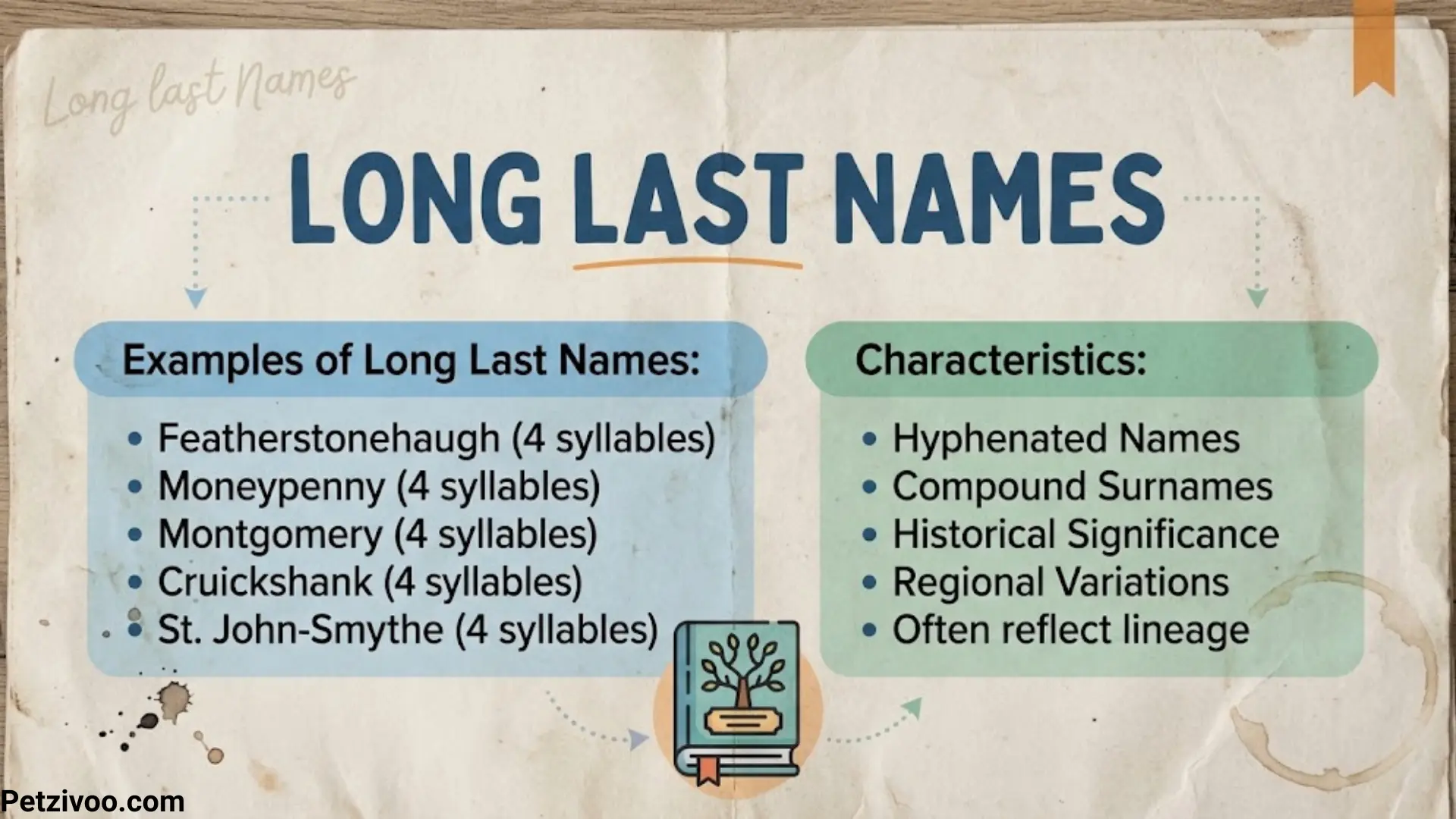
Long last names stand out because of their length, distinctive spelling, cultural background, or interesting history. Some come from occupations and geographical locations, while others developed from parents’ names, nicknames, or combinations of family names. Whether you’re researching your family tree, creating a fictional character, or simply exploring unusual names, there are many long surnames worth discovering.
This guide explores long last names from German, French, Russian, Japanese, and Spanish naming traditions. It also covers unique surnames, meaningful family names, alphabetical examples, and surnames associated with professional athletes. Because surname origins can vary by family and region, the meanings below are presented cautiously where a single interpretation cannot be established.
What Counts as a Long Last Name?
A long last name is generally a surname with many letters compared with familiar family names such as Smith, Lee, or Brown. There is no universal rule defining the exact number of letters a surname must contain to qualify as long.
For this article, surnames with approximately 9–12 letters are treated as long examples, while names with 13 or more letters are particularly lengthy. These are practical editorial categories, not official linguistic classifications.
When comparing names, count the letters in the surname itself. Spaces and hyphens can be counted separately when discussing a complete compound surname. Accented letters, such as ü or č, each represent one letter in ordinary character counting.
Long Last Names With Meanings
Many long surnames developed from occupations, places, personal names, or descriptive words. Their historical meanings may differ from how people understand them today.
| Last Name | Origin | Meaning or Background |
| Richardson | English | Patronymic surname meaning son of Richard. |
| Montgomery | Norman French and English | A place-derived surname associated with historical places named Montgomery. |
| Washington | English | A place-derived surname associated with Washington place-names. |
| Henderson | Scottish and English | Generally a patronymic name meaning son of Henry or Hendry. |
| Schwarzenegger | German-speaking regions | Associated with the Austrian place-name Schwarzenegg; the exact family history depends on the lineage. |
| Eisenhauer | German | Traditionally associated with ironworking; surname histories can differ. |
| Charbonneau | French | Related to French charbon, meaning coal or charcoal. |
| Villanueva | Spanish | Literally associated with a new town or settlement. |
| Chernyshevsky | Russian or East Slavic naming tradition | A surname built from a descriptive root and a surname-forming suffix; the precise family origin requires historical evidence. |
| Watanabe | Japanese | A surname whose interpretation depends on its written kanji and family tradition. |
These examples demonstrate why surname research requires more than translating a modern word. A surname may have developed from a location, an ancestor’s name, or a regional spelling that changed over time. Family records are often necessary to establish which explanation applies to a particular lineage.
Common Long Last Names
Some relatively long surnames are familiar in English-speaking countries. They may appear in historical documents, public records, literature, or everyday life.
- Richardson — A patronymic surname connected with the given name Richard.
- Henderson — A surname associated with Scottish and English naming traditions.
- Montgomery — A historical place-derived surname found in English-speaking countries.
- Robinson — Traditionally a patronymic surname associated with Robert.
- Anderson — A patronymic surname meaning son of Andrew.
- Thompson — A surname traditionally meaning son of Thomas.
- Williamson — A surname meaning son of William.
- Washington — A geographical surname with English origins.
- Fitzgerald — A surname of Anglo-Norman and Irish historical significance.
- Livingston — A surname associated with Scottish place-names and family history.
Popularity depends on the country and the dataset being consulted. This is a collection of recognizable examples, not a statistical ranking of the most common long surnames.
Long German Last Names
German surnames often developed from occupations, places, personal characteristics, and given names. Regional dialects and historical spelling variations also influenced their forms. German family names commonly reflect these different sources of identification.
Here are several longer examples:
- Schwarzenegger — 14 letters. A surname associated with Schwarzenegg in Austria.
- Eisenhauer — 10 letters. Associated historically with ironworking and iron-related vocabulary.
- Schopenhauer — 11 letters. A German surname best known through the philosopher Arthur Schopenhauer.
- Mecklenburg — 12 letters. A geographical surname associated with the German region of Mecklenburg.
- Hohenstein — 10 letters. A place-related name found in German-speaking regions.
- Zimmermann — 10 letters. An occupational surname meaning carpenter.
- Friedrichsen — 12 letters. A patronymic surname connected with the given name Friedrich.
- Sauerbrey — 9 letters. A German surname whose exact origin may depend on the family and region.
German surnames are not all long, and a longer spelling does not automatically indicate noble ancestry. For example, the prefix von can mean “from” or “of” in geographical surnames, but it does not establish noble status in every case.
Long French Last Names
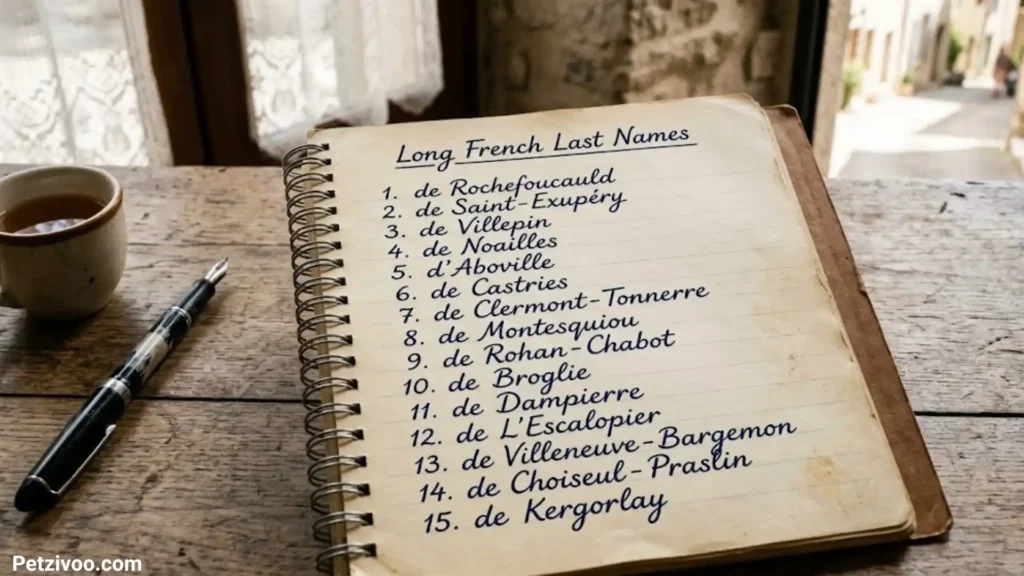
French surnames include occupational names, patronymics, geographical names, and compound family names. Some longer forms preserve references to settlements, landscapes, or historical family lines.
- Charbonneau — 11 letters. Associated with French charbon, or coal and charcoal.
- Montmorency — 11 letters. A place-derived surname associated with the historic Montmorency family and locality.
- Desjardins — 10 letters. Literally related to “the gardens” in French.
- Beauchamp — 9 letters. A geographical name formed from elements associated with “beautiful” and “field.”
- Fontainebleau — 13 letters. A surname or place-name associated with the French locality of Fontainebleau.
- Delacroix — 9 letters. Literally associated with “of the cross.”
- Lafontaine — 10 letters. A name connected with la fontaine, meaning “the fountain” or “the spring.”
- D’Aubigny — 8 letters excluding punctuation. A French-style geographical surname.
French compound surnames may contain particles such as de, du, des, or la. These elements can increase the length of a complete family name, but they should not be added or removed casually when researching a historical person.
Long Russian Last Names
Russian surnames can be formed from given names, occupations, places, nicknames, and descriptive roots. Common surname endings include -ov, -ev, -in, and -sky, although their meanings and uses differ.
- Chernyshevsky — 13 letters. A historically documented surname associated with Russian literary and intellectual history.
- Dostoyevsky — 11 letters. The surname of Russian novelist Fyodor Dostoyevsky.
- Shostakovich — 12 letters. The surname of composer Dmitri Shostakovich.
- Alexandrov — 10 letters. A surname connected to the given name Alexander.
- Kravchenko — 10 letters. A surname found in Ukrainian and other East Slavic naming traditions.
- Mendeleev — 9 letters. The surname of chemist Dmitri Mendeleev.
- Solovyova — 9 letters. A feminine form associated with the masculine surname Solovyov.
- Vladimirov — 10 letters. A surname derived from the given name Vladimir.
In Russian naming traditions, some surnames have masculine and feminine forms. For example, Solovyov and Solovyova can represent gendered forms of the same surname family. However, this pattern should not be applied indiscriminately to every Slavic language or every surname.
A romanized spelling may also differ according to the transliteration system. For family history, compare the original Cyrillic spelling whenever possible.
Japanese Long Last Names
Japanese surnames are often written using kanji, and their pronunciation and meaning can depend on the specific characters used. The Latin-letter spelling alone may not reveal the family’s exact name origin.
Examples of comparatively long Japanese surnames include:
- Minamikawa — 10 letters.
- Nishimura — 9 letters.
- Kobayashi — 9 letters.
- Takahashi — 9 letters.
- Nakamura — 8 letters.
- Watanabe — 8 letters.
- Matsumoto — 9 letters.
- Yamashita — 9 letters.
These spellings are useful when looking for longer Japanese surnames in English text. However, they should not be assigned a single definitive meaning without checking the actual kanji. The same romanized surname can correspond to different written forms, and the length of the romanized spelling does not necessarily reflect the length of the original name.
Spanish Long Last Names
Spanish surnames may come from places, occupations, personal names, and descriptive expressions. Compound surnames are also important in many Spanish-speaking naming traditions.
- Villanueva — 10 letters. Literally associated with a new town or settlement.
- Valenzuela — 10 letters. A geographical surname associated with place-names.
- Encarnación — 11 letters when the accented vowel is counted as one letter. A surname and personal name connected with the Spanish word for incarnation.
- Rodríguez — 9 letters. A patronymic surname traditionally meaning son of Rodrigo.
- Fernández — 9 letters. A patronymic surname traditionally meaning son of Fernando.
- Hernández — 9 letters. A patronymic surname associated with the given name Hernando or Fernando-related historical forms.
- Gutiérrez — 9 letters. A patronymic surname associated with the given name Gutierre.
- De la Cruz — 8 letters excluding spaces. A compound surname meaning “of the cross.”
- Fernández de Córdoba — A compound surname associated with the Spanish place-name Córdoba and family naming traditions.
In many Spanish-speaking settings, a person may have two surnames, often inherited from both parents. That full surname combination can be longer than either surname considered separately. Customs and legal naming rules vary by country and individual circumstances.
Unique and Cool Long Last Names
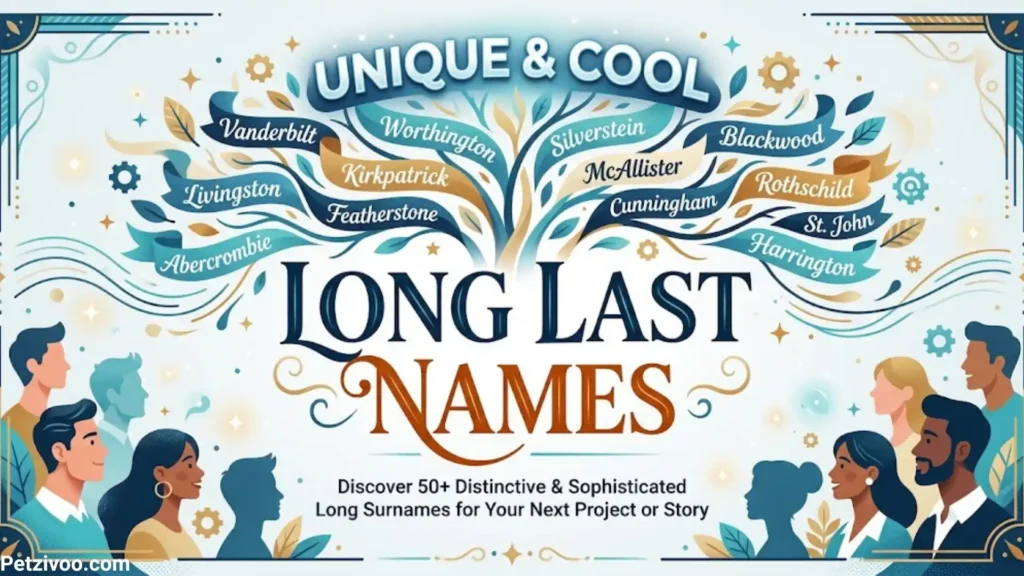
A long surname can sound distinctive because of its rhythm, spelling, or cultural associations. The following names offer different styles without requiring a claim that they are exceptionally rare.
- Featherstonehaugh — 16 letters. A historically established English surname known for an unusual traditional pronunciation, commonly rendered as “Fanshaw.”
- Cholmondeley — 12 letters. An English surname traditionally pronounced approximately “Chumley.”
- Andriuškevičius — 15 letters, counting š and č as single letters. A Lithuanian surname associated with the basketball player Martynas Andriuškevičius.
- Gilgeous-Alexander — 18 letters excluding the hyphen. A compound surname associated with NBA player Shai Gilgeous-Alexander.
- Fitzgerald — 10 letters. A surname with Anglo-Norman and Irish historical associations.
- Montgomery — 10 letters. A geographical surname with an established historical background.
- Schwarzenegger — 14 letters. A distinctive surname associated with Austrian and German-speaking naming traditions.
- Lafontaine — 10 letters. A French surname with a recognizable geographical or descriptive form.
For character naming, a surname may be memorable because it contrasts with a short first name. For example, “Mia Featherstonehaugh” creates a different impression from “Alexander Smith,” even though both names can suit realistic characters.
Weird, Funny, and Unusual Long Last Names
What counts as a weird or funny surname depends on language, pronunciation, and personal experience. A name that seems surprising in English may have a straightforward historical meaning in its original language.
Consider these examples:
- Featherstonehaugh — Its spelling and traditional pronunciation differ dramatically, making it memorable to English speakers.
- Cholmondeley — Another English surname in which the traditional pronunciation is much shorter than the written form.
- Shufflebottom — A documented English surname whose sound may seem humorous to some modern readers.
- Gotobed — A documented English surname that resembles a familiar English phrase.
- Winterbottom — An English surname with a compound form that may sound playful today.
- Sidebottom — A documented English surname with a distinctive modern sound.
These names illustrate how spelling, pronunciation, and changes in language can shape modern reactions to family names. Their unusual appearance is not evidence that the families themselves are unusual, and an unfamiliar surname should not be treated as a reason to ridicule its bearer.
Long Last Names for Boys and Girls
Surnames are generally inherited family names rather than names that inherently belong to boys or girls. Still, writers and people creating fictional identities sometimes search for long surnames that complement a particular first name.
Long Last Names for Boys
- Richardson — A familiar patronymic surname.
- Montgomery — A strong, traditional-sounding geographical surname.
- Schwarzenegger — A distinctive surname with a prominent public association.
- Gilgeous-Alexander — A modern compound surname.
- Fitzgerald — A surname with historical depth.
- Anderson — A widely recognized patronymic surname.
Long Last Names for Girls
- Featherstonehaugh — A memorable choice for a literary or historical character.
- Charbonneau — A French surname with a distinctive sound.
- Villanueva — A Spanish surname with a clear, flowing rhythm.
- Montgomery — A versatile surname for contemporary fiction.
- Lafontaine — A French surname with a lyrical quality.
- Chernyshevsky — A longer surname suitable for a character in a Russian-inspired setting, provided the cultural context is appropriate.
Any of these surnames can be used for characters of different genders. The best choice depends on the character’s background, the setting, and how the complete name sounds.
Long Last Names That Start With B, C, and S
Alphabetical lists help readers find names quickly. The following examples are grouped by their written spelling, with letter counts excluding spaces and punctuation.
Long Last Names That Start With B
- Bellingham — 10 letters.
- Blackburn — 9 letters.
- Buckingham — 10 letters.
- Beauchamp — 9 letters.
- Bradshaw — 8 letters.
Long Last Names That Start With C
- Cunningham — 10 letters.
- Chamberlain — 11 letters.
- Christensen — 11 letters.
- Chernyshevsky — 13 letters.
- Charbonneau — 11 letters.
- Cholmondeley — 12 letters.
Long Last Names That Start With S
- Schwarzenegger — 14 letters.
- Shostakovich — 12 letters.
- Schopenhauer — 11 letters.
- Sutherland — 10 letters.
- Stevenson — 9 letters.
- Solovyova — 9 letters.
These lists include surnames from different linguistic backgrounds. A surname’s first letter in an English transliteration may differ from how a name is alphabetized in its original writing system.
NFL and NBA Players With Long Last Names
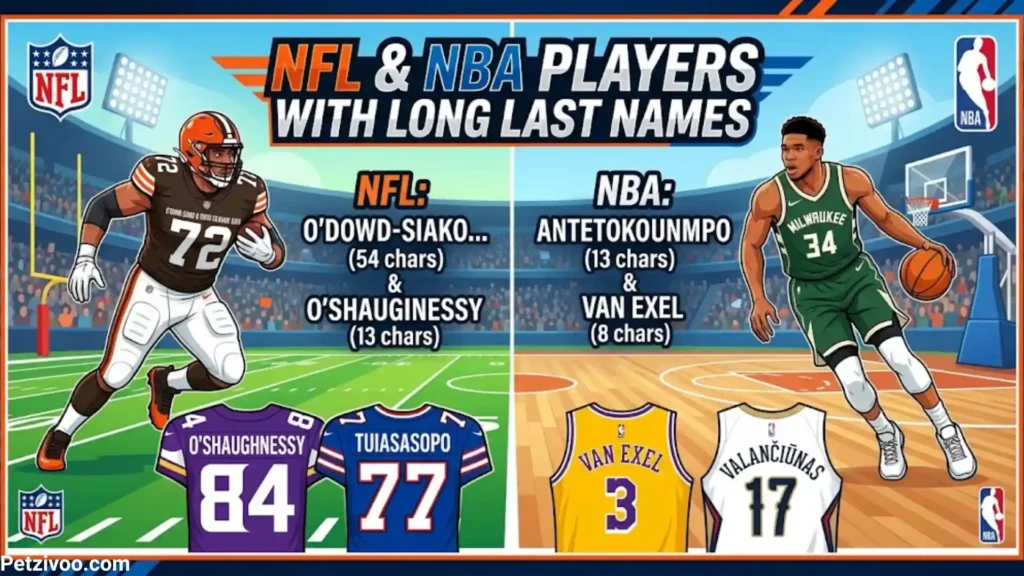
Professional sports provide recognizable examples of lengthy surnames, especially compound names.
NFL Examples
- Amon-Ra St. Brown — The hyphenated given name and multi-part surname make the full name distinctive.
- Christian McCaffrey — The surname McCaffrey contains 10 letters.
- Trevor Lawrence — Lawrence contains 8 letters.
- Patrick Mahomes — Mahomes contains 7 letters.
These are recognizable football-player names, but they are not all exceptionally long surnames. A dedicated NFL list should distinguish surname length from full-name length and verify current roster status.
NBA Examples
- Shai Gilgeous-Alexander — The hyphenated surname contains 18 letters when the hyphen is excluded.
- Nickeil Alexander-Walker — A compound surname containing 15 letters when the hyphen is excluded.
- Martynas Andriuškevičius — The surname contains 15 letters when each Lithuanian letter is counted once.
- Kentavious Caldwell-Pope — The compound surname contains 13 letters when the hyphen is excluded.
Sports references use different counting conventions. For example, some count hyphens while others exclude punctuation. Basketball reporting has specifically highlighted Gilgeous-Alexander and Andriuškevičius among notable long-name examples. See CBS Sports’ discussion of hyphenated NBA names and Basketball-Reference’s player index.
How to Choose or Research a Long Last Name
The best surname depends on why you need it. If you are choosing a name for a fictional character, consider pronunciation, cultural background, and how the surname sounds beside the first name. If you are researching your own family, historical records are more useful than a modern list of surname meanings.
For genealogy, start with the oldest available family documents, such as birth, marriage, immigration, and census records. Compare spellings across generations because clerks may have recorded a name phonetically or adapted it to another language.
For cultural names, check the original spelling when possible. Cyrillic records can clarify Russian surname forms, while Japanese family records may distinguish between kanji that share the same romanized spelling.
Finally, remember that surnames can have several independent origins. Sharing a surname with a historical figure does not prove a family relationship, and a surname alone cannot reliably establish someone’s ethnicity or ancestry.
Frequently Asked Questions About Long Last Names
What is considered a long last name?
A surname with around 9–12 letters can reasonably be described as long for a general-purpose name list, while names with 13 or more letters are especially lengthy. There is no universal official threshold.
What are some of the longest-looking last names?
Featherstonehaugh, Cholmondeley, Schwarzenegger, Chernyshevsky, and Andriuškevičius are examples of distinctive long surnames. Their actual letter counts depend on the spelling and counting convention used.
What are some long last names with meanings?
Richardson traditionally means son of Richard, Zimmermann means carpenter in German, Rodríguez means son of Rodrigo, and Delacroix is associated with “of the cross” in French. Historical family origins may require additional evidence.
Are long last names rare?
Not necessarily. Some long surnames are well established, while others are uncommon or concentrated in particular regions. Length alone does not determine how frequently a surname occurs.
Can a long last name be used for a fictional character?
Yes. A long surname can help distinguish a character, establish a plausible cultural background, or create a memorable full name. Choose a real surname that fits the setting instead of assigning a name a cultural origin it does not have.
Do long surnames always have multiple words?
No. A surname such as Schwarzenegger is one word, while a name such as Fernández de Córdoba contains multiple words. Hyphenated surnames are another category, and counting rules should be stated when comparing their lengths.
How can I find the origin of my own long last name?
Begin with family documents and trace the earliest known spelling. Then consult reputable surname dictionaries, historical records, and genealogy resources. If the surname comes from another language, investigate its original spelling and regional variants before accepting a proposed meaning.
Final Thoughts
Long last names offer a useful way to explore language, family history, and naming traditions. From German occupational surnames to Spanish compound family names and unusually spelled English surnames, each example has its own context.
If you are selecting a surname for a character, prioritize sound, readability, and cultural fit. If you are investigating your ancestry, prioritize documented evidence over assumptions based on spelling alone. That approach makes a list of long last names useful not only for inspiration but also for more accurate surname research.

 Amelia Parker
 Noah Williams